
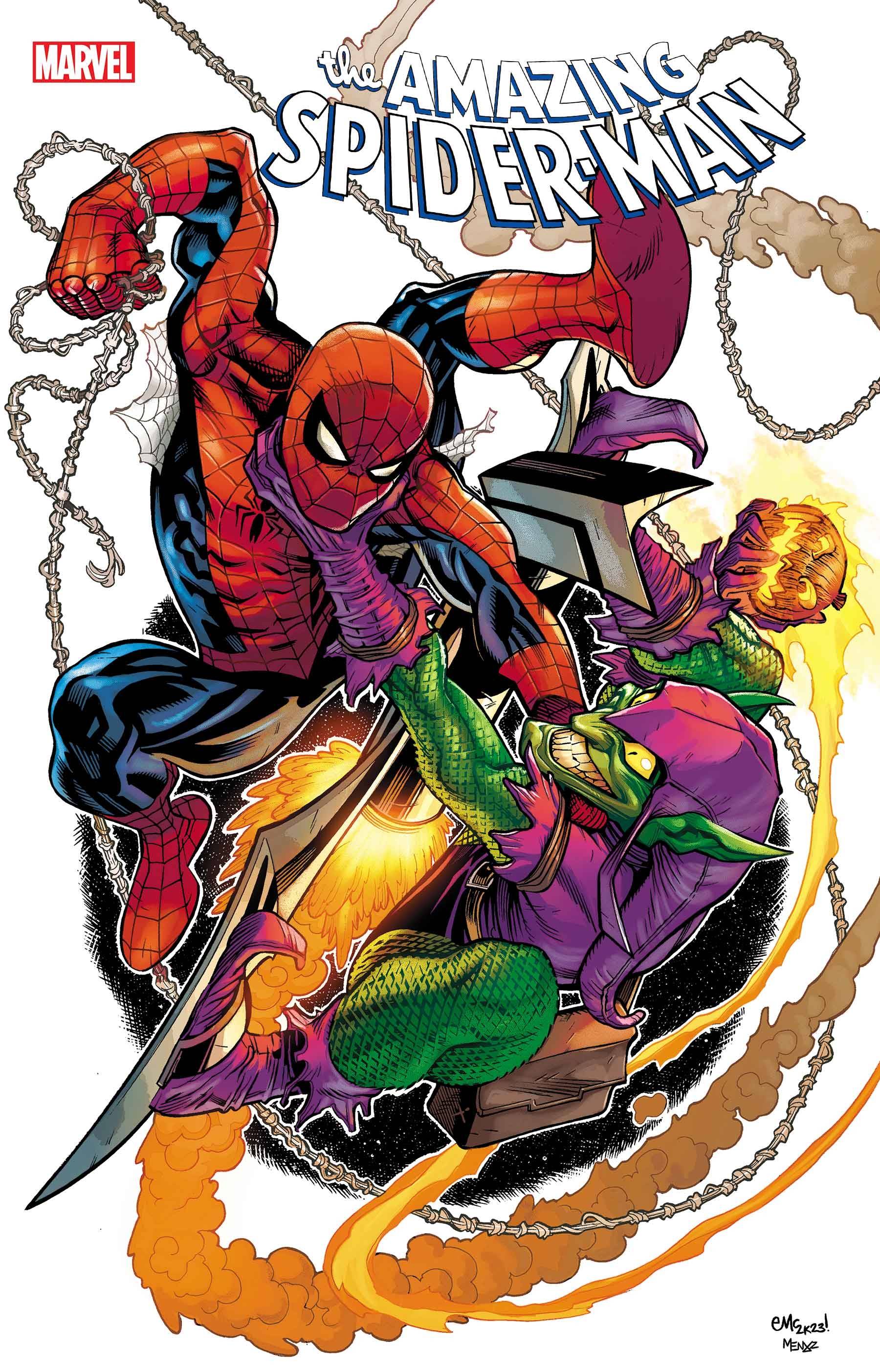
Writers: Zeb Wells, Marv Wolfman, Nikesh Shukla
Pencilers: Ed McGuinness, Terry Dodson
Inker: Mark Farmer
Artists: Crisscross, Juan Ferreyra, and Todd Nauck
Colorists: Marcio Menyz & Erick Arciniega; Terry Dodson; Andrew Dalhouse; Juan Ferreyra; Rachelle Rosenberg
Letterer: Joe Caramagna
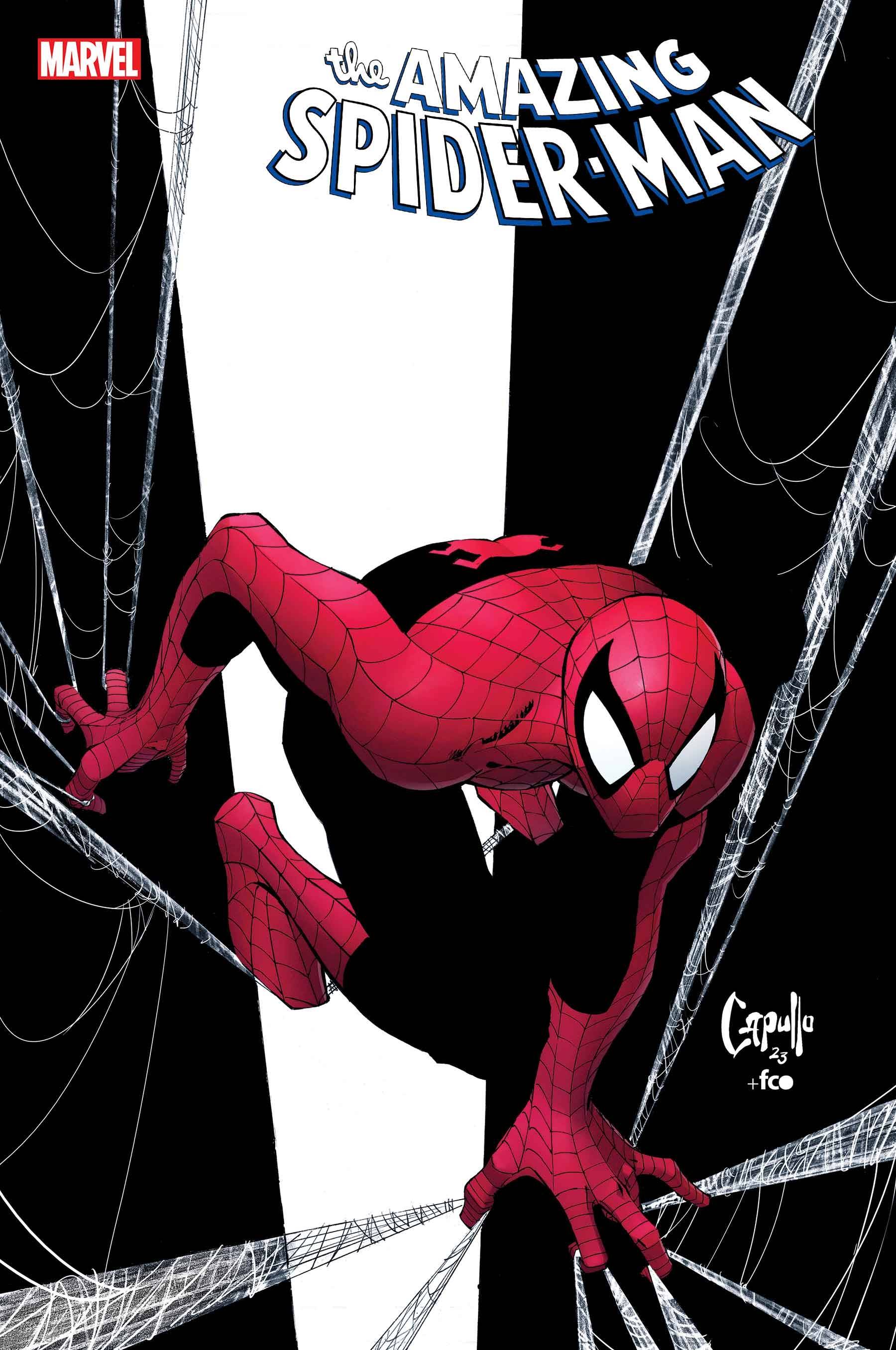
Cover Artists: Ed McGuinness & Marcio Menyz; Nick Bradshaw & Rachelle Rosenberg; Greg Capullo & FCO Plascencia; Iban Coello & Jesus Aburtov; John Romita Sr & Edgar Delgado; John Romita Jr, Scott Hanna & Dean White; John Tyler Christopher
Publisher: Marvel
Price: $9.99
Release Date: May 22, 2024
Spider-Man battled gangs to protect people like Peter Parker's friend, Randy Robertson. Spider-Man also helped Peter's friend, Betty Brant, recapture the Winkler Device from Hobgoblin and Queen Goblin. Spidey even saved the Living Brain from the Sinister Six and stored it in Peter Parker's workplace. But is Peter Parker Spider-Man? Let’s grab some brain food to confront this brainteaser, thwip into Amazing Spider-Man #50, and find out!
Main Story
Peter Parker’s life has not gone smoothly. He confessed to Shay that he doesn’t do well in personal relationships. Yet he’s tried to make more time for friends like Miles Morales, Randy Robertson, and Betty Brant. But then, there was that evening that Michele claimed he stood her up for a date.
In Amazing Spider-Man #50, another strange incident occurs. Instead of saving people from dangerous situations or capturing criminals, Spider-Man is hassling a Real Estate agent named Keyan when Norman Osborn calls. It seems like a strange use of Peter Parker’s precious time. But Peter has bigger fish to fry. The Living Brain is in a chatty mood.
Recently, the giant cerebrum penetrated the digital clean room to travel the worldwide web. Now, it endangers its existence to communicate. The message it sends Peter, which he relays to Norman, could change both men’s lives forever.
After conferring with Dr Curt Connors, Peter heads to Norman's office. Peter is Norman's employee and friend. In Kamala Khan's absence, Peter is Norman's moral compass. Like any multimillionaire, power and influence insulate Norman from the consequences of his actions. Norman can injure or destroy people's lives more effectively than Tombstone's flunkies Kareem or White Rabbit, let alone Tombstone's lawyer Michele or an underhand Real Estate agent named Keyan. The question is, does Norman want to?
Amazing Spider-Man #50 spins a web of story strands over more than half the oversized issue. Zeb Wells unearths Easter Eggs hidden beneath more eye-catching events. Yet Wells also asks if we can be happy when denying our most powerful urges. Can someone who derives pleasure from hurting others ever reform and be satisfied with helping people? Or, like the Living Brain, are we damaging ourselves by ignoring our primary drives and trying to reshape our identities?
Art
A light show surrounds the giant brain. Sparks erupt from monitors in the control room. As lab-coated technicians scramble to understand what's happening, a ticker tape issues from a workstation.
Keyan tries to pull webbing off his dark suit while Spider-Man squats atop a mailbox. More webbing stretches from a window washer's platform to nearby objects. A trio of circular panels nestles beside successive rectangular panels of Spider-Man and Keyan. Norman resides in these circular panels, clad in his dark suit. As he converses with Spidey, he clutches a chess piece. Is it a bishop or a pawn?
Marcio Menyz & Erick Arciniega lavish a loaded palette on Ed McGuinness and Mark Farmer’s stylish art. Old School panels give way to more modern layouts, interposed with splash pages and double-page spreads. Brown, gray, and orange control room scenes give way to vivid colors as a door opens, and a frown becomes a wicked smile. Brightly colored opening scenes transition to electrifying green, purple, and orange. The sunlight illuminating Spider-Man and Kayan shout that this issue takes place after events in Amazing Spider-Man Blood Hunt. But by the end of this story, another darkness has overcome our world.
Welcome to the jungle, baby.

Cat-Nipped!
Story
Spider-Man pursues Black Cat after her latest robbery, but she eludes him. Later, he stops by her Litter Box. Black Cat left him a message in her apartment. Like Freddie Mercury, she says, Don't stop me now. But Spider-Man wants to halt her fun and games. So, he seeks a pattern behind her intriguing crime spree.
In Amazing Spider-Man #50, Marv Wolfman touches on the intriguing link between competition, forgery, and homage. Like Randy Robertson's former relationship with Tombstone's daughter, the story also reveals how closeness to those who don’t share our moral standards can blind us to the harm they cause.
Art
Black Cat swings above the street and somersaults onto a semi-truck trailer. As she races toward the cab, Spider-Man swings past and snatches the poster tube from her shoulder. Sorry, Black Cat! You won’t be bringing that art to your next convention!
Terry and Rachel Dodson populate pages with one or two panels and build around those with thin strips or tiny boxes. Terry Dodson employs a limited palette dominated by blues, making skin tones and the red on Spidey’s costume stand out. The final pages bloom with more colors as Spider-Man thwips into the sunrise.

Time To Make The Donuts
Story
Spider-Man loves Lionel King's donuts. Missing out on them makes Spidey unhappy. Spider-Man has dedicated his life to thwipping and fighting crime. Yet he's amazed by Lionel's dedication to such a mundane task.
Nikesh Shukla’s story in Amazing Spider-Man #50 reminds us to respect how food influences us and unites us with others. It also highlights how a stray comment can transform a person's life.
Art
Introductory scenes focus on the cooking donuts, then pull back to show Spider-Man standing beside Lionel’s food truck. Crisscross devotes a page to Spidey thwipping above the city before he meets with Mrs. King. Andrew Dalhouse employs subdued colors while sparing bright green and pink to highlight Lionel and his mother. A memory bathes in yellow, orange, and copper. After the engaging dialogue and intense kitchen action, the final panel darkens. Will the brightness return when Spidey reunites with Lionel and his mother?

Don’t Thing Thrice, It’s All Right
Story
Lee Gatlin brings a dose of cartoony fun to Amazing Spider-Man #50. Spidey spots the Rhino’s silhouette in a darkened apartment. So he swoops in, only to realize that he’s crashing a surprise birthday party. While packing his story about Spider-Man and the Thing with hijinks and humor, Lee muses on how bringing someone to mind may provoke a seemingly random meetup.
Art
Gangly Spider-Man thwips around a brownstone before swinging through a window and webbing everyone inside. Like the other guests, the ever-loving Thing is wearing a party hat. The next day, a practical joke makes the Thing resemble Rhino. Lee Gatlin complements his fun cartoony art with textured color that imbues this short tale about friends and enemies with depth and atmosphere.

Secrets
Story
While Zeb Wells scattered the seeds for his story in Amazing Spider-Man #50 in preceding issues, Joe Kelly shares another previously unrevealed event. Peter can’t shake some pesky Niffleheim Imps, so he heads to the Sanctum Sanctorum. As Doctor Strange struggles with his health and focus, Peter seems oblivious to the sorcerer’s pain and his need to concentrate. Steven's final words and the stick he clamps in his jaws hint at upcoming developments that may rock Spider-Man's world. That is, assuming he survives the current storyline involving the Living Brain, Norman Osborn, and the Green Goblin.
Kelly’s story reminds us how pestering others to resolve our urgent business can derail others from fulfilling necessary tasks.
Art
In contrast to Lee Gatlin’s black and red Spider-Man, Juan Ferreyra shows tiny green goblins chomping on Spidey’s bright red and blue suit. Spidey trails a cloud of lavender as he tumbles inside the Sanctum Sanctorum. Light shines from the bat's mouths as Spider-Man sits on a hammock. Spindly, articulated limbs pluck the Cornish Pixies away. Yet Spider-Man ignores a nightmarish apparition and regards Doctor Strange on his upholstered, armored throne. Ferreyra’s atmospheric art suggests the power an upcoming Spine-Tingling Doctor Strange series could wield.

Epilogue And Lettering
Like a post-credit scene in an MCU movie, Zeb Wells, Todd Nauck, and Rachelle Rosenberg provide an epilogue in the jungle where Dr Connors plays to close out the main story in Amazing Spider-Man #50.
Aside from Lee Gatlin's hand lettering, Joe Caramagna thwips uppercase black lettering into dialogue balloons and narrative boxes in Amazing Spider-Man #50. The font grows bold for inflection, swells for increased volume, and rarely shrinks. Immense letters help us hear a semi-truck crash, a giant brain scream, and overwhelmingly evil laughter.
Thanks to Marvel for providing a copy for review.

Final Thoughts
When the Living Brain starts talking, its words upend Peter Parker and Norman Osborn’s lives in Amazing Spider-Man #50. Perhaps it's just as well that Peter's heightened strength, agility, and spider-sense prevent him from ever relaxing. He'll need all his wits to confront the enemies that surround him and the demons that lurk within.
Rating 9.4/10
To preview interior art for the main story see my review at Comic Book Dispatch.


