Showing posts with label Terry Pratchett. Show all posts

Monday, September 14, 2015

Roald Dahl's Wondrous Delights

Hungry for something sweet and substantial? Something that will delight you, and transport you on wondrous delights? Then consider James and the Giant Peach, a story that could be considered both an appetizer or an entree. 

In his book, author Roald Dahl relates the story of James, a young boy who lived happily in England until his parents went shopping in London.


A busy street in London
November 2013

Now everyone knows that shopping is incredibly dangerous. On this occasion an even more terrible thing happened to his parents than racking up large credit card bills and getting their credit privileges revoked. A rhinoceros escaped the zoo, and on a busy street in London, in full view of other shoppers, the animal ate James's parents. So James was sent off to live with his aunts in their house in the south of England. 


Aunt Spiker & Aunt Sponge,
Illustration by Quentin Blake

His aunts lived in a little house on top of a hill in the south of England. They made him work all day, beat him for his efforts, and never let him go anywhere. He had no friends. Despite the terrific view, all he could do was stand by the fence and peer out at the surrounding landscape. 


A cottage at Seven Sisters, England.

James was terribly lonely.

One day, a kindly old man appeared in his garden and offered James a bag filled with strange and magical items. He told James how to use them, and promised that if James obeyed his instructions to the letter, he would have a wonderful adventure.


Author Terry Pratchett at the World Fantasy Convention in
Brighton, England, in 2013.
A kindly old man whose strange and magical stories
transported me on many wondrous adventures.

Before James could fulfill the old man's instructions, he tripped over an exposed tree root, and dropped the bag. The contents seeped into the soil before he could gather them back together. Suddenly, a peach appeared on the old tree. 

This peach grew as large as his aunts' house. That night, James discovered a hole in its skin. He climbed inside, and and walked down a tunnel. There, deep inside the peach, the young boy who never got to see anyone else saw some interesting people.


Author Mary Robinette Kowal at the 2013 World Fantasy Convention.
From the lighting, you can tell she did her reading
inside a giant peach.

He met a musical grasshopper, a kindly spider, a polite ladybug, a mischievous centipede, and a frightened earthworm, among others.


James meets interesting people.
Illustration by Quentin Blake


These friendly bugs were as big as him, spoke perfect England, and welcomed him to the heart of the peach. Suddenly, the boy who was always lonely had some new and interesting friends. In the morning, his new friends freed the peach from the old tree. It rolled down the hill, tumbled off the cliff, and plunged into the ocean.


Seven Sisters, England, 2013

From there, James and his friends sailed off across the sea. Later, due to James' ingenuity, they even flew into the sky. Suddenly, the boy who never went anywhere was traveling, and seeing sights he could never have imagined.

To mark the 99th anniversary of Roald Dahl's birth, I read James and the Giant Peach for the first time. His delightful prose, Quentin Blake's magical illustrations, and my own journeys through England combined to satisfy my cravings for a sweet and satisfying read. Even if you haven't traveled to England, and even if your edition doesn't include Quentin Blake's masterful illustrations, I feel confident that Roald Dahl's prose alone will conjure up sufficient imagery to help you visualize James, feel for him and his friends, and help you accompany them on their journey aboard the giant peach. 

Oh, and just in case you're wondering, my brief summary cannot possibly have spoiled your appetite. I haven't told you half of his story, or touched on more than a tidbit of Roald Dahl's strange, magical, and wondrous delights. 

Bon Appetit!

Dragon Dave

Friday, July 3, 2015

Mrs. Allie French, Steam Trains & Faithless Israelites

Mrs. Allie French steps off the train in Appaloosa.

Actress Renee Zellweger has played a number of important roles, but for me, three of her performances tower above all others. These include 1) her role of author Beatrix Potter in the biopic "Miss Potter;" 2) Her role of Novalyne Price, the woman author Robert E. Howard loved, in "The Whole Wide World," and 3) her role of Mrs. Allie French in Ed Harris' excellent Western "Appaloosa." In Allie French, she takes on a real complicated woman, and makes us feel for her. It's a wonder that someone so dedicated to the law and justice like Virgil Cole would take up with someone like Allie. But then, Allie is the first woman with whom he's tried to have a real relationship.


While reading Raising Steam by Terry Pratchett, I was initially puzzled by the need for the trains to stop for water. Steam locomotives burned coal, wood, or oil for their power, right? Wrong. Steam is produced from boiling water, and the combustible materials heat the boiler that makes the water boil that produces the steam. Right? After reading Terry Pratchett's Fantasy novel, it was interesting to watch "Appaloosa," and see a real nineteenth-century steam train chugging up a grade in New Mexico. When it stops beside a water tower, a metal spout swings down that will supply water to the engine. Cole puts away his volume of Ralph Waldo Emerson's essays and poems, and asks Hitch to help him survey their surroundings. The lawmen are transporting Randall Bragg, a rancher convicted of murder, to the place where he will be executed. As the lawmen step outside the carriage, two hired gunmen ride into sight. 


Between them rides Allie, whom they will shoot unless Cole releases his prisoner. So Cole ignores proper procedure, and lets Bragg go, even though he knows the gunmen won't release Allie. Yet Allie seems to view Cole's response as a sort of betrayal.


Cole and Hitch pursue the party, and track them down moments before the group are attacked by Indians. Cole sees enough in that brief glimpse to realize that Allie has gotten intimate with the head gunman. What is she thinking? Is she suffering from Stockholm Syndrome, or is something else going on here?


The two men help the others fight off the Indians, but as they are all in danger, Cole agrees to put off their differences until they reach their destination. Then he sidles up to Allie, and lets her lean into his back, but he can't look at her, not yet. 


Later that evening, she tells Cole that Hitch tried to kiss her, back on that day when Cole sent Hitch down to the building site of their new house. Cole's worked with Everett Hitch for too long to believe that. Still, he loves Allie, and when all the business with the Indians, Bragg, and the gunmen is over, he takes her back. He freely admits he's never had much business with women. Yet something in him loves Allie, and will forgive her anything. He continues to court her, and treat her tenderly. As for Allie, she seems to love Cole, and want to be with him all the time. Yet when he's not around, she feels an instinctive need to be with the man she deems to be in charge of the situation in that moment.

A familiar Old Testament theme is that the Israelites continually loose faith in God and worship the gods of other nations. After watching "Appaloosa" again recently, it struck me that Allie is like the Biblical Israelites: constantly afraid of what will happen next, and who will protect her when the next bad thing occurs. Fear drives her to actions she's not proud of. In comparison, Virgil Cole is like God. He loves Allie, and will always love her. His love for her is unconditional. It's called agape love. It's an ideal that all of us aspire to, but few, if any of us, truly live up to.

Dragon Dave

Friday, March 13, 2015

Uplifted by Terry Pratchett's Magic

This week, I've been struggling to write. Anything. Somehow, I've just felt blocked. Writing seemed purposeless. My willpower lagged, sagged, and waved the white flag. So I took the time to reorganize my comic book collection, no easy feat as it seems to be growing by leaps and bounds. As I did so, it struck me that comics are like chapters in a novel. Sometimes they stand alone. Others rely on your knowledge of what came before, and end on a cliffhanger, demanding you seek out the next installment. But all look to the past, belong to an overarching story and tradition, and pave the way for new comics, of any type, to be written.

Yesterday morning, as I sat down to organize, a bag of comics caught my eye. It was an adaptation of Terry Pratchett's novel The Color of Magic. 


This was the novel with which he introduced us to Discworld, that amazing world that sits on four giant elephants, who ride through space on the back of an immense star-spanning turtle. I had not yet read these four comics, and so instead of moving comics from box to box, I picked up the first issue and met a young tourist who disembarks from a ship in the harbor of Ankh Morpork.


He doesn't speak the local language, but with the use of his guidebook, and by showing off his gold coins, he soon makes his intentions clear.


After being escorted to a tavern, he meets Rincewind, an apprentice wizard who was thrown out of Unseen University not because he learned a spell, but because a spell somehow learned him. It seeped inside him, and when he gets agitated or anxious, it tends to work its magic through him, beyond his conscious control.

You know, kind of like the Hulk.

Rincewind sets himself up as guide, and Twoflower naively gives him four days' pay in advance. When Rincewind uses the money to escape the city, the Patrician of Ankh Morpork has him escorted to the palace. He explains to Rincewind that Twoflower hails from the counterweight continent, the home of the Agatean Empire. It's a government so rich in mineral wealth that it wields tremendous power. Although its citizens rarely travel, Twoflower has taken it into his head to see the world.

The Patrician wants Rincewind to understand how grateful he will be to Rincewind for keeping a protective eye upon their foreign visitor. 


He also explains the unfortunate consequences Rincewind would face, should any harm befall Twoflower.

Soon Rincewind and Twoflower are hitting the streets. Twoflower wants to see everything. He has a little box that makes little pictures of what he sees in extraordinary detail. Rincewind is amazed how friendly and accommodating even the most unfriendly and unaccomodating people can be, when the little box is pointed their way, and a little gold is pressed into their hands. He wonders what kind of magic the box channels to make these fantastic little pictures.


Then, at one point, the top of the box opens, a little imp crawls out, and announces that he's running low on pink paint. Ah, that's how.

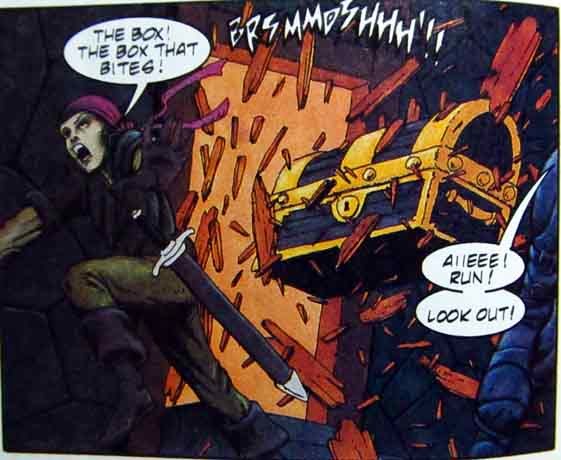
Just as the Patrician feared, some people in Ankh Morpork aren't satisfied with the few gold coins that Twoflower would willingly give them. They also wonder how much they could gain by capturing his luggage, a chest made entirely from sapient pear wood. Pear wood is incredibly expensive in Ankh Morpork, and even the richest wizards can only afford the smallest pieces. So obviously, it must be worth an unimaginable sum.

These villains kidnap Twoflower, but Rincewind and the luggage escape. When Rincewind flees, the luggage stops him and insists that Rincewind rescue its master. So it's up to the anxious (failed) apprentice wizard to concoct a plan to free Twoflower, and in the luggage he finds a powerful ally.


When I put down the first issue, I felt more inclined to write than I had felt previously this week. So I headed off to my desk, and after reading the chapter of another novel, set my own pen to my own pad of paper. When my wife called me at lunch time, I had written several pages, and felt inspired to write more.

Then my wife told me of a news story she had just read online. Terry Pratchett, aged 66, had passed away in his home in England.


As some of you may remember, I had the honor of seeing Terry Pratchett at the World Fantasy Convention in Brighton England back in 2013. Despite the disease he suffered from, he was able to talk a little. Sitting across a cold crowded room from him, I was warmed by the presence of this master storyteller. He wrote over seventy books in his life, and I read a lot of them. More significantly, I derived a great deal of pleasure from nearly every one I read. No doubt others felt the same, as the room was more crowded for him than for anyone else who spoke at the convention. 

All authors create characters and worlds. But some authors' creations dwarf their creator, and dwarf most other authors creations. Terry Pratchett's Discworld is one such creation. It builds on the great fantasy literature of the past, and moves forward, presenting a world with such richness and depth that readers hunger for the next installment. I imagine that Discworld will go on, that other authors will take up their pens and, as with other literary icons like Jane Austen and Arthur Conan Doyle, write future stories set in Terry Pratchett's Discworld. But even if they don't, even if Pratchett's heirs don't allow that, his books are like the comic books in my collection, building upon the rich tradition of comics, and inspiring others to write even better, richer, more diverse stories than they read while growing up. 

I'm one of those authors who were caught up in Terry Pratchett's magic, who was inspired to take up my own pen as a result of Terry Pratchett writing. His stories will live on through others, and hopefully, through me as well. His magic inspired me to write yesterday morning, and all afternoon as well. And if I ever achieve my goal of publication, if ever I contribute a few chapters or issues to the great, overarching story that is Fantasy literature, some of the credit must go to Terry Pratchett. His magic infuses me, uplifts me, and lives inside me. And because of that, I write.

Dragon Dave

Wednesday, August 6, 2014

Terry Pratchett on the Benefits & the Limitations of Magic

Falmer Station welcomes visitors to the local village,
sports fans to Falmer Stadium,
and students to the University of Brighton
or the University of Sussex.


In Terry Pratchett's new Discworld novel Raising Steam, we meet an ambitious young man named Dick Simnel. When he's twenty years old, he takes his reluctant mother out to the barn, and shows her an engine that whizzes around on a circle of metal rails. He explains his principles, which he learned from a book written by an architect. These involve building small, simple models before going on to building larger, more elaborate versions. He proceeds slowly with each prototype, testing components every way he can, and sometimes purposely exploding his creations to discover their limits. He shows her his blueprints, which detail how all the various parts work together. He shares with her his paradigm for how the steam engine works, which is that of a tea kettle boiling, and how the temperature and pressure of the hot air pushes off the lid. Still, his mother cannot grasp the ideas behind his invention, or its potential. "Eee, lad, but what does it do?" she asks him.

"Everything, Mother," he responds. "Everything."

Dick's invention will take him to the large city of Ankh-Morpork, where he will meet Harry King. Like Commander Samuel Vimes, Harry has used hard work and ingenuity to rise from his humble beginnings. In Dick Simnel, Harry sees another promising individual, and agrees to fund further experiments in steam. Then there's Lord Vetinari, the Patrician (or ruler) of Ankh-Morpork, who guesses at the ultimate potential of steam. He challenges the enterprising Moist von Lipwig--who in previous books has founded the Post Office, the Mint, and the Royal Bank--to develop steam power beyond a mere crowd-pleasing curiosity. 

Just as the Clacks have transported information and communication all over Discworld, Lord Vetinari argues that, in time, steam engines could transport peoples and goods between distant cities and countries. This is the gift science offers, which magic never could. The benefits of magic are limited to the practitioner, and those with whom he shares his spells, potions, and devices. Science brings with it not just technological change, but transforms our cultures, and hence the way we live. It frees us from isolation, and links us with those in distant lands. It changes how we see the world, and elevates our dreams beyond anything our parents could have aspired to achieve or become.

Still, there's room for magic, both in Discworld, and for the people of our own. Magic manifests itself in seemingly innocent ways, such as the connections we forge with some people over others, even those whom, on the surface, we seem to share little in common. Magic leads us to prefer some things over others, even if they seem little different in composition and appearance from their neighbor. (Or less adequate or worthy than their neighbor). Magic lifts or suppresses our spirits, so that some days we're happy or sad, but cannot explain why, no matter how hard we try. Magic exists in all these things and more, and adds the spark of mystery that makes life worth living.

Yet when it comes to one aspect of life, there's no mystery whatsoever. We all know why Terry Pratchett has written so many Discworld novels, and we still hunger for more. The answer is both profound and simple: no one else writes like him. Other authors may try, but no one else can consistently amaze us, can make us laugh or cry, and all the while entertain us as thoroughly as Terry Pratchett. Whether this has to do with how he writes, or the types of characters and ideas he tackles, no one can be sure. This is the profound explanation of this mystery. 

The simple explanation for our enduring love of his novels is this: Terry Pratchett is magic. Thus, we benefit from all the happiness he creates, every time he casts another spell on us, by writing another Discworld novel.

Dragon Dave

Monday, August 4, 2014

Terry Pratchett on the Rise of Science

The train station in Falmer, England,
built in 1846 to service trains propelled by steam.

In the beginning, there was magic. Or at least magic seemed to dominate in Terry Pratchett's early Discworld novels. Those adventures often featured wizards like Ponder Stibbons, the Head of Inadvisably Applied Magic at Unseen University. Or we met witches like Granny Weatherwax, with her temperamental magic broom, who fashions spells or potions in her little cottage in the woods. Whenever such character traveled anywhere, they might pack their belongings in an enchanted chest. Fashioned from sapient wood, these pieces of luggage walked or raced along on little wooden legs, and fiercely defended their owners.

But as time went on, and book followed book, science crept into Discworld. This evolution of technology was not an easy process, as magic proved reluctant to cede its territory to a new master. This battle for control of Discworld revealed itself in small ways, such as when a character opened a device to find tiny imps working switches and gears. But at least there were switches and gears, not simply a device performing fantastical functions via a magical spell.

Perhaps the invention of a steam engine on Discworld initially fell into "The Pit" Terry Pratchett described last year at the World Fantasy Convention in Brighton. The Pit was not the hotel where the convention took place, but a folder stored in his office. The Pit holds any ideas he toyed with while writing, but then extracted before completing those stories. As an avid lover of trains, he wanted to see trains chugging across Discworld earlier in his career. Ultimately, he realized that Discworld needed to discover other inventions first, so that the various peoples, cities, and societies would be ready to capitalize on steam power when it arrived.

In his latest novel, Raising Steam, Terry Pratchett introduces us to a determined young man named Dick Simnel, who was ten years old when "his father simply disappeared in a cloud of furnace parts and flying metal, all enveloped in a pink steam. On that very day young Dick Simnel vowed to whatever was left of his father in that boiling steam that he would make steam his servant." His mother has other ideas: she doesn't want to see him follow in his father's footsteps and become the village blacksmith. Nor does she want him to conduct dangerous experiments in the family barn. So she moved back to where she had grown up, and gave her son a good education.

Ironically, her desire to give her son a better life via education backfires, so to speak, when Dick discovers the riches of the library. There he reads the "weird stuff dreamed up by the philosophers" and grounds himself so well in arithmetic that at the age of twenty, he decides he's ready to pursue his father's dream. He assures his frightened mother that one device in particular will prevent him from suffering his father's fate. He pulls it out of his jacket; for all she knows it could be a magic wand. "This will keep me safe, Mother! I've the knowing of the Sliding Rule! I can tell the sine what to do, and the cosine likewise, and work out the tangent of t'quaderatics! Come on, Mother, stop fretting and come with me now to t'barn."

If his mother was a witch like Granny Weatherwax, she could have cast a spell to make her son forget all about steam power. But science is on the rise, and so she finds herself powerless to protect her son, or anyone else on Discworld, from all that Dick's discovery will unleash. 

To be continued...

Dragon Dave

Wednesday, July 30, 2014

Terry Pratchett On Defending The Defenseless

St. Stephen's Church in Brighton, England,
currently used as a homeless shelter.

Terry Pratchett loves to write. As he told fans at last year's World Fantasy Convention in Brighton, England, while other authors may take a break after completing a story, he sees his reward for finishing one book in that he gets to do another one. Then, like his beloved character, copper Sam Vimes, he "starts simple, and proceeds slowly." He may not bother himself to plan too far ahead, instead trusting his storytelling instincts. Should he get into his story, and realize he's followed a false trail, he may end up chucking that story, a portion of it, or the idea underlying it into "The Pit," as he calls it. But he doesn't mind. He can always pull something out of The Pit later, right? In the meantime, he starts off on the writing again, which for him, "goes a lot with impetus and ease."

In his recent novel Snuff, Sam Vimes tries to get out of his holiday in the country. He clearly doesn't want to leave his beloved city of Ankh-Morpork, the place where he feels he belongs. So once he's reached his grand estate, and endured stifled conversations over meals and tea parties with other members of the landed gentry, he seeks respite in the nearby village. For some reason, the locals seem suspicious of him. Why should a member of the aristocracy be visiting a poor man's public house? Why is Commander Vimes of the Ankh-Morpork City Watch sniffing around their village? Their suspicion makes Sam Vimes wonder what, if anything, the locals may have to hide.

Given his reluctance to leave Ankh-Morpork, the time needed to familiarize himself with the running of his estate, and the opportunities he takes to spend time with his son, it takes Vimes awhile to discover his first clue as to the locals' suspicion. Readers may wonder exactly where Pratchett is going with the novel, aside from enjoying the commander's discomfort over having to endure his holiday. But then, a hundred pages in, a note from the blacksmith's son leads Vimes to a hill in the dead of night, where he discovers a blood-soaked rag, and a Goblin's severed hand. Given the amount of blood, he realizes that this Goblin must have been killed.

Murdered.

The thing is, no one cares about Goblins. They exist outside the law, not partaking of life in towns or cities, but eking out their existence in caves. Even Feeney Upshot, the village policeman, who has taken an oath to obey the local magistrate's interpretation of the law, finds Vimes' interest in one Goblin's death a little extreme. As Vimes discovers when he visits the chief constable's office, located in a room inside his mother's house, the young man currently has a Goblin chained up outside for stealing pigswill. Feeney has been brought up to believe certain things about Goblins, such as that they are born thieves, they carry horrible diseases, they eat their own babies, and perhaps worst of all, they stink. Or, as Vimes muses: "It wasn't so much a stink as a sensation. the sensation in fact that your dental enamel was being evaporated and any armor you might have was rusting at some speed."

Vimes takes the young Chief Constable to task on a number of issues, chief among them that the purpose of the law is to protect everyone, including the most defenseless of its citizens. The problem is that, in the eyes of the law, Goblins don't officially exist, and therefore have no legal rights. Vimes refuses to accept this. He doesn't know much about Goblins, so he visits those holed up in nearby caves, who have learned to fear and distrust Humans. He takes on the local aristocracy, and defies the village magistrate, as he investigates how Goblins have been torn from their families, and shipped off down the river. He pursues a trail of greed and corruption, all the while arguing with young Feeney, who exhibits a thorough understanding of the letter of the law, but knows little of its soul. To save the Goblins from the injustice perpetrated upon them--from the way Humans have treated them so inhumanely--Vimes risks his social status, his career, and ultimately his life. But for Vimes, that's his duty, his calling in life: to defend the defenseless. He can no more shirk his duty, and turn a blind eye to injustice and cruelty, even if the law currently protects the perpetrators and sanctions their actions.

At four hundred pages in length, Snuff is a long novel by Terry Pratchett's standards. It takes Vimes a long time to uncover a crime, which can make it difficult for the reader to immerse himself in the story. It delves into more serious themes and issues than Pratchett's fans may have expected, such as slavery and the destructive aspects of illegal drugs. Yet it offers moments of action and excitement, including a climactic rescue-effort and river-battle in which Sam Vimes takes on not just the evildoers, but the very forces of nature. Along the way, he discovers some glorious aspects of Goblin-life to counter the rumors and folklore surrounding them. Once those are made public, they will forever change the way Goblins are viewed. As in our world, such sweeping social change on Discworld starts with one person's refusal to accept a perceived injustice. It's a character with whom Terry Pratchett identifies, who seems to hold his ear* at the moment, who talks to him and tantalizes him with ideas for humorous, exciting, and insightful stories. 

His name is Vimes: Commander Samuel Vimes.

Dragon Dave

*See the previous entry. (It's a doozy).

Monday, July 28, 2014

Terry Pratchett On A Copper's Instincts

A Police Station in Brighton, England

Author Terry Pratchett has been writing Science Fiction and Fantasy stories since the early 1970s. The bulk of them (forty novels and counting) take place on Discworld, a disk-shaped world that floats through space atop four giant elephants. (These elephants, in turn, ride on the back of an even larger turtle). His books have been translated into thirty-seven languages, and are beloved by readers all over the world. Yet he seems somewhat amused by his fame. As he told fans in Brighton at last year's World Fantasy Convention, "I just make things up." 

When he starts a new novel, he grasps those ideas foremost in his mind. He describes these as "low-hanging fruit," the ones easiest to pick. Once he's selected an idea, he just has to figure out what the story will be about. Anyone who has ever attempted to write a novel knows how challenging it can be to explore an idea in fiction. Terry Pratchett makes his job easier by following up on his inquisitiveness about our rapidly evolving world. He studies subjects that interest him, such as real-world technologies and systems. With time and study, his knowledge grows, and these subjects mature into the low-hanging fruit he mentioned. Then, with the hard work of research already done, he begins his story. 

Readers reap the benefits of Terry Pratchett's natural inquisitiveness. Over the years, we have seen Discworld's largely medieval society evolve with the introduction of the printing press and newspapers, a post office system, banking, and the rapid expansion of clacks towers, which transmit the equivalent of telegrams using a shutter-semaphore system. While these concepts are sketched out more simply in his stories, we nonetheless finish his novels with an enhanced appreciation for the inventions and processes that run contemporary society.

One of Terry Pratchett's most popular Discworld characters is Samuel Vimes, who has risen through police ranks to become the Commander of the Ankh-Morpork City Watch. A copper's instincts flow through his veins, and he can sense when something in his city is going (or about to go) amiss. He's been such a successful police officer that he's impressed the rich and powerful, eventually even marrying into the aristocracy. He's become part of the landed gentry, and has more money than he could ever figure out how to spend. Still, he's happiest when he's solving problems in his fair city. So what does Sam Vimes do in Terry Pratchett's recent novel Snuff, when his wife insists they take a vacation at one of their country houses? Or perhaps I should ask: What does he do after the city's ruler, Lord Vetinari, assures Vimes that no urgent crisis in Ankh-Morport require his attention? Well, he can't help but poke his nose into what's going on in community life surrounding his country estate, can he?

If Samuel Vimes has won over readers, he seems even closer to his creator's heart. Perhaps it's the character's natural inquisitiveness, the way he knows every street in Ankh-Morpork, and every aspect of city life, that allows him to sense when something is amiss. Perhaps, when he was a boy, the author considered a career as a policeman. Whatever the reason, if he's ever in trouble with a story set on Discworld, Terry Pratchett knows who he can turn to for assistance. "If a story involves Sam Vimes, I know he'll provide me with a lot of dialogue," he told his readers last year in Brighton. 

As all characters relate in some way to their creator, Pratchett must identify with some aspect of Vimes' psyche. As Vimes is forever interested in the forces underlying life in Ankh-Morpork, perhaps the link is Pratchett's constant fascination with the systems and technologies that drive our modern societies. It's also nice to see an author of Terry Pratchett's stature giving himself the freedom to explore his own interests, and to pursue his own hobbies without worrying immediately when they'll pay off in his fiction. Or even if they will. Of course, it's also nice when he finds a way to share his interests with us. I imagine that's one of the reasons we find his Discworld novels such a joy to read, because the ideas behind them spring from his own joy of discovery. 

Given how Sam Vimes seems to hold Terry Pratchett's ear at the moment*, I imagine he'll continue to play a vital role in future Discworld novels. But then, I could be wrong. After all, I don't have a Copper's instincts. 

Dragon Dave

* Yes, I agree with you. Police officers should not grab people by the ear. Especially not nice people like Terry Pratchett.