Showing posts with label Frank Thorne. Show all posts

Tuesday, December 5, 2023

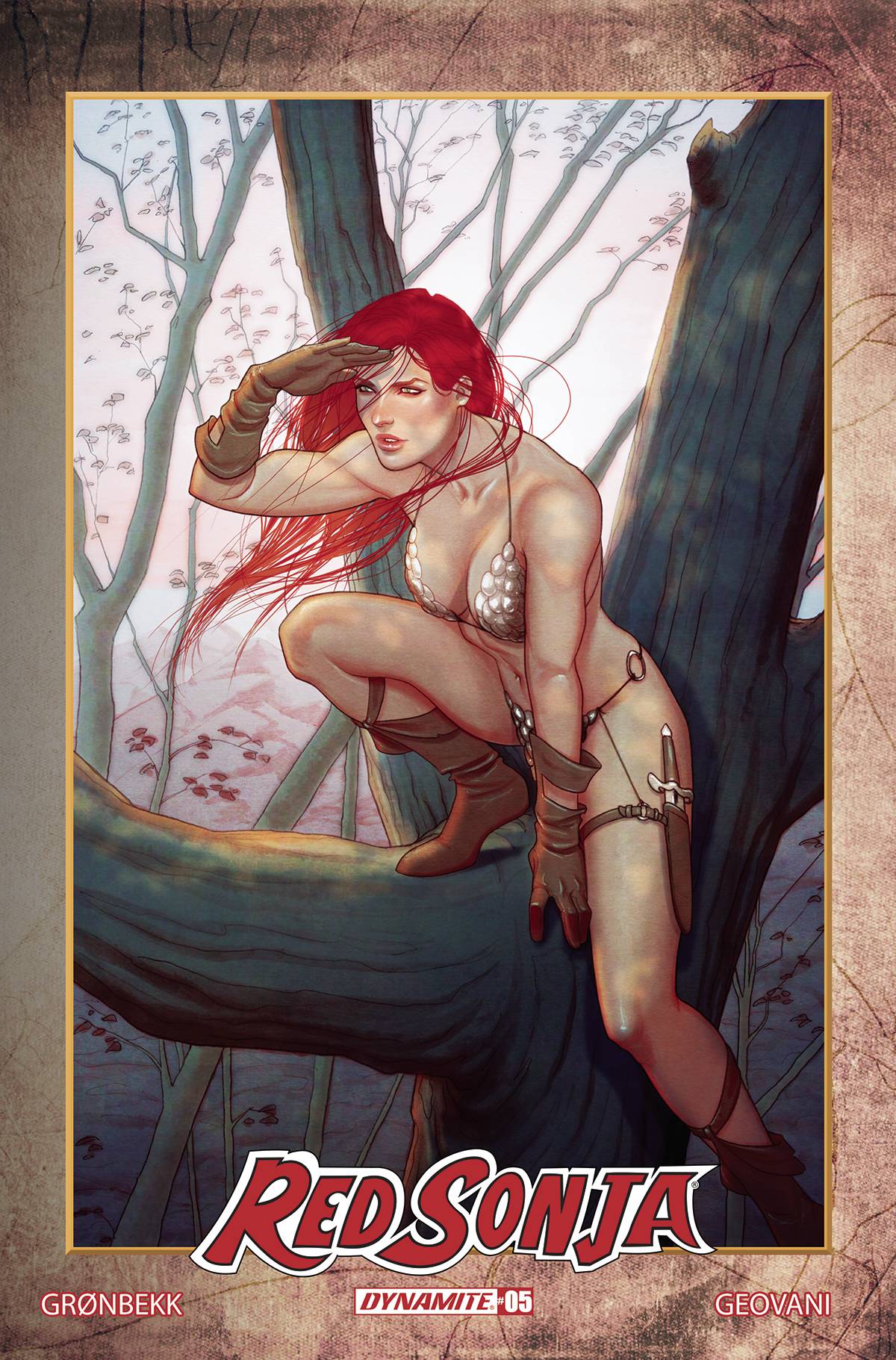
Red Sonja #5 Review


Writer: Torunn Gronbekk

Artist: Walter Geovani

Colorist: Omi Remalante Jr.

Letterer: Simon Bowland

Cover Artists: Lucio Parrillo, Bjorn Barends, Joseph Michael Linsner, Bryan Hitch, Jenny Frison, Frank Thorne & Cosplay

Publisher: Dynamite

Price: $3.99

Release Date: November 15, 2023


Kulan Gath remembers his mortal life. As he gazes down from the astral plane, he watches Red Sonja ride through a snowstorm. What does the dead wizard plan for this warrior maiden who carries the late Lady Alaberta's black diamond? Let’s leap into Red Sonja #5 and find out!


Story

Kulan Gath shares his disdain for civilization with Conan and Red Sonja’s creator. Yet Robert E. Howard never sanctioned poisoning someone, let alone a trusted friend and mentor. Kulan Gath once pursued his quest for power without regard for loyalty or mercy. Now, as his spirit watches people fight and die on the mortal plane, he remembers what it felt like to be alive and kill those around him.


In Red Sonja #5, Thord Varg conquered Velanger to capture her black diamond. By bringing it to the High Priest's city of Vestfold, perhaps Red Sonja can stop his reign of terror. Yet she halts her flight to free refugees. Like an uncaring disease, slavers capture the frightened and homeless. But in Red Sonja, they find more than they bargained for.


Torunn Gronbekk meditates on loyalty versus reason, power versus compassion, and achievement versus satisfaction in Red Sonja #5. As priests use sex, violence, and human sacrifice to worship their gods, Torunn reveals a clue to Thord Varg’s power. The High Priest believes he slaughtered innocents to safeguard Vestfold's future. Yet is he wiser than the She-Devil, who doesn't overthink things and grasps whatever opportunities she finds? Unlike Thord Varg, she knows power comes with a price. She paid it to avenge her family's deaths. Now, she uses any power she possesses to help others.


Oh, and Red Sonja likes her horse. She talks to it as she would a person. That says a lot about her, too.


Art

Kulan Gath walks through a garden surrounded by planets and stars. Via a reflecting pool, he watches Red Sonja ride through a snowstorm. As she passes burning homes and buildings, she spies a caravan. Red Sonja rides toward the refugees shackled to a horse-drawn wagon. Pairs of red eyes glow in the darkness beneath the wagon’s fabric-strewn wooden hoops.


Walter Geovani imbues Sonja’s horse Erder with personality. Walter’s storybook art packs panels with more power than many double-page spreads. Little touches enhance his visual feast. Consider the similarity between the coils of Sonja's hair and the many-headed hydra. Observe how he mirrors a severed hydra neck with a slaver’s bloody stump. A circular staircase evokes the coils of a serpent, reminding us of the power that tempts priests and wizards in Red Sonja #5.


Omi Remalante Jr. imbues Kulan Gath’s remembrance with a faded quality, illuminated by torchlight. He surrounds the dead wizard with lustrous colors, comparing the ethereal beauty of his new life with the gray, burning lands Sonja rides through. Yet richness creeps into Hyborean lands as the morning light invades the storm. While bold and vibrant colors fill panels, Omi backlights scenes to suggest Red Sonja's indomitable nature. Amid all the bloodletting, blood dances in darkness, reminding readers of the source of Thord Varg’s power. 


Simon Bowland writes Torunn Gronbekk’s compelling narrative using uppercase black letters on parchment. Simon grants white dialogue balloons to human characters, while those inhabited by a possessing spirit speak with white letters in black balloons. No sound effects invade the pages of Red Sonja #5. Yet Simon ends Torunn’s tale on a chilling note, as bloodthirsty believers demand the death of any who impedes their cause.   


Thanks to Dynamite Comics for providing a copy for review.


Final Thoughts

While Red Sonja rescues the powerless and bestows mercy on monsters, a fallen foe influences events from beyond the grave, raining destruction upon the Hyborian world in Red Sonja #5.


Rating 9.8/10


To preview interior art and view other covers see my review at Comic Book Dispatch.


Thursday, August 8, 2013

Ruining Frank Thorne’s Red Sonja Cover Art


After reading “The She-Devil and the Scribes” column in Red Sonja Vol. 1 Issue #4, I had to dig out Issue #2, as readers had objected to that cover in two of the three printed letters.  Ed in Roanoke, Virginia, conveyed his opinion thus:

“Somewhere in the hallowed halls of Marvel there lurks the man responsible for the dialogue on the cover of RED SONJA #2.  Perhaps he has taken to hiding behind the water fountain or in a convenient dark closet since that issue hit the stands, but he’s there.  And no matter where he hides, he’s not going to escape responsibility for ruining Frank Thorne’s bizarre cover art by having the bearded Argossean wizard adjure his demon to kill Sonja, in response to which our crimson-tressed heroine utters the immortal words: ‘Over my dead body!’  One thing I’ll say for our mysterious cover-scripter: you can’t fault his logic.  If the demon had killed Sonja, it certainly would have been over her dead body.”

The editorial staff responded by admitting that Roy Thomas, “the Rascally One, has been wanting to write it on a CONAN cover for nearly seven years now, but it seemed more appropriate coming from a sharp-tongued wench like Sonja.  As Roy likes to quote… ‘I got no shame.’”

Click to enlarge.
(Hopefully).

When I first saw the cover, I didn’t pay much attention to the word balloons and the cheesy dialogue.  But then, I purchased it in 2013, not in 1977, and as part of a collection of yellowed, faded issues, not as a brand, spanking new mag off the spinner rack.  I didn’t visit the stores back then each week, hunting down the latest issue, nor did I spend hours reading and rereading all the previous Red Sonja stories (scattered through issues of “Conan The Barbarian,” “Marvel Feature: Red Sonja” Issues 1-7, and other mags).  I look back on it as something to enjoy for what it is, instead of looking forward, eagerly anticipating what each upcoming issue may bring. 

I can understand why readers might have felt as though Roy Thomas ruined some otherwise terrific art by Frank Thorne.  But then, I can understand why Roy Thomas, who co-wrote this story with Clara Noto, in addition to writing many other titles for Marvel, might have wanted to unleash himself and have a little fun with the cover.  Once safely within the cover, the writers take their jobs seriously, and craft a story that all three readers complimented them on.  So what do you think?  Should Roy Thomas have inserted cheesy dialogue on the cover?  Did it ruin Frank Thorne’s cover art, or improve it?  And do you think that Marvel would allow writers to do something like this on a cover today?

Go on: venture an opinion.  Be brave and make a comment.  Force me to start my own letter column.  I'm sure I could manage something like that, on top of everything else I’m doing right now.  

Yeah.  Right.  Over my dead body!

Dragon Dave  

Sunday, May 5, 2013

Red Sonja Touches People's Lives


It’s easy for me to say that I’m affected by something.  As an aspiring author, such sensitivity to great stories comes with the territory.  Marvel’s “Red Sonja” Issue #1 confounded my expectations.  Red Sonja is a swordswoman, a fighter, someone who can hold her own against Conan, her barbarian alter ego.  Yet we find her befriending a mythological creature—a unicorn—that wouldn’t ordinarily inhabit Robert E. Howard’s Hyborian Age.  And instead of focusing upon a battle, Roy Thomas and Clara Noto’s story seemed to focus upon a moment of calm and healing between two battles.  Frank Thorne’s artwork emphasizes this sense of peace and tranquility shared by Red Sonja and the unicorn, and contrasts it with the inhuman cruelty of Ander of Bezfarda.  But enough of what I think.  Consider, if you will, a few reader reactions to the story.

From Randall Moreau in Appleton, Wisconson: “I’ve just finished reading Red Sonja #1, ‘The Blood of the Unicorn,’ and I’m left with a curious, mellow feeling of sadness and strength.  There was a lot there and it’s affected me on a lot of levels.  Beginning with the powerful imagery of that first page: the atmosphere of death and deep loss.  And following the merciful slaying of her injured mount, Sonja is left strangely sensitized and vulnerable.  These carefully crafted givens seemed to open up something within me, allowing another sense other than my eyes to record and respond to Frank’s beautiful, moving art and to Roy (and Clara’s) entreating words.  What followed was the carefully-concocted contrast between violence, fire, and fury, and the mellow, serene communion of Sonja and the unicorn with the forest.  All leading up to that quiet ending.  The good-bye.  It hurt…” 


From Deby Dunn in Hacienda Heights, California: “The four of you together (Frank Thorne, Roy Thomas, Clara Noto, and Ed Summer) have done something for which I will be eternally grateful.  In Red Sonja #1 you took a mythological creature, compounded wholly of clichés, and made it live, entirely believable.  You told the story through the eyes of the unicorn as well as Sonja’s and, in so doing, you gave him an elusive germ of personality that exploded like a bomb as he defended his chosen companion.  Anything with a personality deserves a name.  But not just any name.  The name must be light, graceful, yet strong, as in the unicorn itself.  It also must be unusual and distinctive, so that it will not be forgotten.  Such a name is ‘Tabitha.’  It is a feminine name, I know, and….” 

One of the story threads running through Steven Brust’s novel, The Sun, the Moon, & the Stars, is the question of what constitutes proper art.  Or, if you will, real art.  Before writing this post, I did a search on the definition of art.  Everywhere I looked, the definition of art was different.  Regardless of its form or presentation, I suspect most of us would agree that great art evokes a feeling or response from the recipient.  In Deby’s case, she wrote in to suggest a name for the unicorn, even though she knew how unlikely it was that the writers would ever bring him back for another story.  In Randall’s case, he needed to tell them that he was “touched” by their story. 


There was no logical reason for Deby or Randall to write in and tell the writers and the artist their reaction to the story.  Yet they felt compelled to.  When something affects you deeply, it provokes a change inside you, and you cannot hold it in: you simply must share the experience with others.  That’s the power of art. 

For me, that’s the power of Fiction.

Dragon Dave

Related Dragon Cache entries

Saturday, May 4, 2013

Red Sonja and the Unicorn


On the first page, before the story in Marvel Comics’ Red Sonja Volume 1 Issue #1 gets underway, we are given this introduction, courtesy of The Nemedia Chronicles.  

“Know also, O prince, that in those selfsame days that Conan the Cimmerian did stalk the Hyborian Kingdoms, one of the few swords worthy to cross with his was that of Red Sonja, warrior woman out of majestic Hyrkania.  Forced to flee her homeland because she spurned the advances of a king and slew him instead, she rode west across the Turanian Steppes and into the shadowed mists of legendry.” 

Immediately, we realize that she is alone, that she is displaced, and that she has suffered the loss of everyone she was ever close to.  She may be damaged, but she has struggled on.  Nevertheless, her suffering is hardly at an end.  For, as she rides through the thick forests of Argos, her horse trips and shatters his foreleg.  To end his suffering, she must kill him, and continue alone.

Yet her walk has barely begun when she spies men pursuing a white steed with great shouts and their weapons drawn.  In addition to the colt’s striking features, a long, spiral horn juts out from its forehead.  She rushes to the unicorn’s aid, and Andar of Bezfarda, the leader of the hunting party, orders his men to kill her.  Red Sonja gives a good account of herself, and the bodies of the slain begin to litter the forest.  Amid the fighting, the unicorn rears up, and loses its horn to an overhanging branch.   Then Sonja leaps onto its back, and the two escape. 


As woman and unicorn explore the forest, they find solace in each other’s company.  Yet this is a brief respite, for Andar of Bezfarda has ordered his villagers to hunt them down and kill them.  He may have grasped his prize—the horn of the unicorn, the last ingredient from which he can concoct his elixir of immortality—but he doesn’t want to share the gift of everlasting life with anyone else.  So, when the scouts sight his quarry, he immediately abandons his laboratory.  Meanwhile, as Red Sonja and the unicorn journey together as equals, as companions, Red Sonja notices “a strong new growth of horn…even more beautiful” than the unicorn’s previous one.


Issued in January 1977, this comic book is thirty-six years old.  Its pages are faded, and its advertisements offer products and services from many companies that no longer exist.  Yet the story—of two souls united by their pain, forced to flee their homes by oppressors—is as fresh and vital as ever.  It was written by renowned Conan author Roy Thomas and then-rising film editor/screenwriter Clara Noto, and based on a plot suggested by Ed Summer, who at this time was working on the “Conan The Barbarian” movie that would eventually reach cinemas in 1982.  Sometimes too many cooks spoil the soup, but in this case, these three talents combined to tell a compelling story. 


Comic book artwork is usually split up into specific roles, with different people doing the Penciling, the Inking, the Coloring, and the Lettering, and there are artists who spend their entire careers specializing in one of those areas.  But Frank Thorne performed all those roles for the first installment in the series, and his efforts are particularly striking.  The characters emerge fully realized, and the panels unfold like a movie.  I have to wonder if Frank Thorne created twice as many pages of artwork as the publisher could afford to print, for he often packs smaller panels within larger ones, and even the smaller panels are beautifully colored and detailed.  Sometimes comic art lets a story down, or elevates a less-than-strong one.  Marvel’s Red Sonja Volume 1 Issue #1 offers both strong writing and artwork: each enhances the other, combining to tell a touching and memorable tale.

If you like Robert E. Howard’s tales of Sword and Sorcery, and you enjoy reading good comic books, I suggest you seek it out.  Just don’t ask if you can buy my copy, because I’m definitely holding onto mine. 

Sorry, but some things aren’t for sale.

Dragon Dave