Tuesday, January 21, 2014

Tolkien On Speed

Tolkien Tuesday

Maybe I was never great in English class.  Perhaps it was only all my book reports that impressed my Grade School teachers.  Or maybe I just had an off-day during my High School entry test.  Whatever the cause, the Elven Administrative Council that ruled my High School declared that I must take English in Summer School before beginning my Freshman year.

My main recollection from that class was that the instructor tried to teach us how to speed read.  He said that High School classes would be tough, and the quicker we could assimilate information, the better.  He encouraged us to bring our own books to read, and gave us tips on how to scan each sentence, and absorb the bulk of the content at speed.

As it happened, I was reading The Fellowship of the Ring, so I brought in my paperback, and applied my teacher’s instructions to J.R.R. Tolkien’s novel.  I remember reading about Frodo, Sam, Pippin, and Merry leaving the Shire, and traveling toward the village of Bree.  Aside from one instance of running, my recollection is that the bulk of their journey occurs at a relatively easy pace.

Looking back now, the thought of speed-reading The Fellowship of the Ring, one third of the epic Tolkien spent over a dozen years writing, seems rather like running through a museum, then trying to deliver a detailed analysis of each piece of artwork.  But back then, I was young, and it was just another novel that I wanted to read.  And it was an assignment handed down from a High School teacher.  And no, he wasn't an orc.  (At least, I don't think he was).  At any rate, it would take decades for me to realize how monumental Tolkien’s work really was, and how his stories should be savored rather than skimmed.

Of course, in Peter Jackson’s movie “The Fellowship of the Ring,” Frodo, Sam, Pippin, and Merry journey from the Shire to Bree occurs at frantic, breakneck speed, pursued all the way by the Nazgul (Ringwraiths).  The pace of that movie jarred so strongly with my recollections that I had difficulty accepting Jackson’s version.  Later, he brought out his extended version on DVD, and the additional scenes slowed down the overall pace, which allowed me to better appreciate the movie.


Warning: The next paragraph contains plot spoilers!

As with "The Fellowship of the Ring," Peter Jackson's "The Hobbit: The Desolation of Smaug," the second part of his three-movie adaptation of The Hobbit, unravels at breakneck speed.  In violent contrast with my recollections of Bilbo packing the dwarves into barrels and sending them off on a fairly easy ride downriver, the dwarves ride down the river in open barrels, using swords and other weapons to fight a band of orcs that pursue them all the way.  Legolas and a band of Elven soldiers join in, at times even leaping from one dwarf's head onto another along the river as they shoot arrows at (or otherwise battle) the orcs.

I’m not criticizing Peter Jackson.  Even when he differs from scenes in the books, I think he’s trying to do homage to the depth and majesty of Tolkien's stories.  Still, I have to wonder if one of his High School teachers taught him to speed-read, and if so, how he reads Tolkien today.  For just as there's a difference between spending five seconds and five minutes staring at any given piece of art, there's a difference between Bilbo packing the dwarves inside barrels and sending them gently downriver, and the video game sensibilities of Jackson's adaptation.

Dragon Dave

Monday, January 20, 2014

Beware Frank Bellamy's Winged Avenger

Marvelous Monday Comics

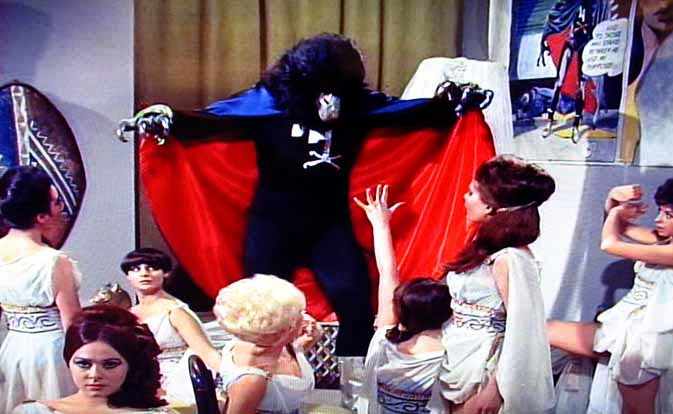
In The Avengers episode "Winged Avenger," someone is killing ruthless industrialists.  Government agents Emma Peel and John Steed find their clawed corpses in locked, upper-story offices.


At first, Emma Peel doesn't notice this comic lying among the papers knocked off the desk of one victim.


But when another ends up dead, on the grounds of his estate, she remembers one panel from the comic, and Steed agrees on the striking similarity.


This leads Emma Peel and John Steed to the offices of Winged Avengers Enterprises, where they find a man dressed up in the Winged Avenger costume, poised to savage beautiful women with his deadly claws.  But even if the killer wore the costume, how did he climb up the sheer walls of office buildings?  And who might have used the costume to murder the heartless businessmen?  The artist who is gradually taking over every aspect of the comic book's production?  The writer who is growing more and more frustrated with his partner?  Or the model, who sometimes leaves the office at the end of the day, so comfortable in the costume that he's forgotten he's wearing it?


"Winged Avenger" features lots of comic book imagery, drawn by Frank Bellamy, a British artist who died too young.  He may be most remembered by fans of the comics version of Gerry Anderson's Sci-Fi puppet TV show "Thunderbirds."  Die-hard Monty Python's Flying Circus fans can also find his artwork in Terry Jones and Michael Palin's children's book Bert Fegg's Nasty Book For Boys & Girls, which satirized British annuals of the period, and recycled Monty Python scripts.  That is, if you can find a copy.

Dragon Dave

Related Dragon Cache entries
Emma Peel & Daleks

Related Internet Links
Watch "Winged Avenger"
Frank Bellamy at Wikipedia

Sunday, January 19, 2014

R2-D2's Car

Weekend Extra

Recently, my wife and I saw our old friend R2-D2.  He signaled us with his mixture of clicks, hoots, and bleeps, and it was great to chat with him for awhile.  I gather Luke Skywalker's not using his X-Wing much these days, as he's busy teaching at the Jedi Academy on Yavin IV, so R2-D2 opted to tour San Diego for awhile.


You know, I don't ordinarily appreciate back seat drivers, but I'd make an exception for R2-D2.

Dragon Dave

Related Dragon Cache entries
I Want My Own R2-D2

Saturday, January 18, 2014

Dalek Singing?

Weekend Extra


Recently, the Daleks surprised me with a birthday treat.  While the Kona Pie was wonderful, the greatest gift was their thoughtfulness.  

I must say, you haven't really lived until you've been sung to by Daleks. Who doesn't enjoy the singing of monotone, mechanized aliens?  

Dragon Dave

Friday, January 17, 2014

The Daleks At Islands

Dalek Friday


Pocket: Okay, Master's gone off to the little Master's room.  What shall we order him?
Denim: I don't know, but I'm fairly sure we won't find it on this page.


Pocket: Master's Pipeline Burger looks mighty fine.  
Denim: Alert!  Alert!  Alert!  Mistress' Maui Burger is tipping! 
Pocket: Don't worry.  I'll save the day.
Denim: Hooray!  Pocket Dalek to the rescue!


Pocket: Honestly, the things I do for my humans!


Denim: They'll enjoy these leftovers.  Say, did Master just ask for the bill?  Didn't you tell the waitress it was his birthday?
Pocket: Perhaps I'd better go and remind her.


Pocket & Denim: Surprise, Master!


Denim: Well, that party didn't last long.
Pocket: The best times never do.  Still, they're worth the effort.

Pocket & Denim Dalek

Thursday, January 16, 2014

Meeting Peter F. Hamilton

Travel Thursday


A highlight of last year's World Fantasy Convention in Brighton, England was meeting author Peter F. Hamilton.  His Night's Dawn trilogy is a monumental saga of literary Science Fiction.  The novels boast a cast list several pages in length, dozens of worlds, governments and ideologies, thoroughly alien races, and exciting adventures that would rival those of Star Wars (should a filmmaker ever adapt the novels for the big screen).  

I found him eminently approachable, courteous, and far more interested in quiet conversation that being the life of the party.  He seemed interested in how I, as a reader, had responded to his books, and perhaps even a little surprised by my enthusiasm for them. This gave me hope that my passion for his trilogy might inspire him one day to write a sequel, or perhaps even another trilogy set in that story universe.

If you enjoy space operas featuring memorable characters, intergalactic battles, and inventive speculation about mankind's expansion to the stars, check out his Night's Dawn saga.  And what will I be doing, you ask?  Why, I'll be seeking out more novels by Peter F. Hamilton, of course!

Dragon Dave

Related Dragon Cache entries
Peter F. Hamilton: The Reality Dysfunction
Peter F. Hamilton on Life, Death, & Purgatory
The Madness of Peter F. Hamilton

Wednesday, January 15, 2014

Kevin J. Anderson's Passion For Storytelling

What I'm Reading Wednesday

I’ve always admired Kevin J. Anderson for his business acumen.  I’ve always been grateful to him for helping expand important Science Fiction universes, such as Star Wars and Frank Herbert’s Dune novels.  Meeting him at conventions and book signings has always proven a great pleasure.  Yet, while I’ve enjoyed his novels, I’ve always felt as if I had missed something crucial in his storytelling.  His novels--filled with exciting plots, richly portrayed worlds, and interesting characters—told me everything I needed to know about that particular story...and nothing about him. 

Some people say that a pastor or priest only has one sermon, and that he repeats that sermon, in infinite variation, every time he stands behind the lectern.  That sermon, and the passion and thought behind it, drove him to enter the ministry.  I suspect the same can be said of authors, as each day’s effort involves sitting down before a blank page, and imbuing it with meaning.  Writing is demanding work, and while a lucky few reside atop the bestseller charts year in and year out, most toil in obscurity, and would make far greater incomes if they devoted their energies and creativity to other pursuits.  In a career spanning a quarter-century, Kevin J. Anderson has written, co-written, or edited well over 100 books.  I wondered what ignited his passion for storytelling, and what fire still burned inside him, fueling his literary efforts.


In Resurrection, Inc., his first published novel, I found the answers I sought.  In the near future, blue collar workers are rapidly being displaced.  Servants, reanimated corpses driven by computer chips and synthetic organs, are filling all jobs involving repetitive tasks.  Francois Nathans, the head of Resurrection, Inc., conceived of reanimating the dead as way to free the living from drudgery.  Now he watches as displaced workers choke streets and welfare offices.  Where is the drive, the enthusiasm for reinvention, the fervor for forging greater futures individually and elevating mankind? 

When he decides that something else must be holding mankind back, his attention turns to religion.  And why not?  It’s been argued that, all too often, when seeking value and meaning for their lives, people choose comfortable beliefs over uncomfortable truths.  So Nathans wonders: might religion be inhibiting humanity from achieving the social progress he desires?  With the aid of Vincent Van Ryman, the son of a business partner, he forges a new religion: neo-Satanism.  He intends to create no more than an elaborate sham.  He wants converts to later see through the religion, and in so doing help them see beyond the falsehood he believes underlie all religions.  Yet people—even those he views as smart and intelligent—keep finding value and meaning in the rituals, services, and scriptures he and Vincent create.    

As usual, Kevin J. Anderson provides readers with a compelling future world, a fast-moving plot, interesting characters, and dramatic situations.  With Resurrection, Inc., he offers us a book that's difficult to put down.  But it’s the ideas behind the story, and the questions they raise, that I'll take away from this novel.  For example: What is the proper role of Faith and Belief?  Is Truth something that exists outside us, that we either accept or reject?  Or is Truth something we create for ourselves, and sometimes even knowingly construct from the most outrageous lies.  For some of the biggest, and perhaps the most compelling lies of all, are not Religions, but Fictions.  Some stories and characters grow so important to us that they become a part of us, and guide us through life in crucial ways. 

In Resurrection, Inc., Francois Nathans learns that what drives others, and what they perceive as truth, is at odds with the passion that drove him to create his company, and fueled his efforts to elevate mankind.  I wonder: in his first published novel, did Kevin J. Anderson share a part of his soul?  Did he hint at the passion that caused him to start writing stories, and still fuels his creative engine?  The novel suggests not only why he writes his stories, but perhaps also why I keep on reading him.  It suggests the reason he’s become one of my favorite authors.  For there must be a greater, better, and more elevated reason than that I simply like the guy.  

At least, that's what I believe.

Dragon Dave 

Tuesday, January 14, 2014

The Link Between The Hobbit & Star Wars

Tolkien Tuesday

One weekend, back in 1977, a friend and his folks took me out to see “Star Wars” in the cinema.  I hadn’t visited my friend with any inkling that he and his parents would take me to my first movie.  It just happened, and in so doing, changed my life forever.  It impacted how I saw the world, what I judged as important, and the type of stories I henceforth sought out.  Still, when it came to storytelling, reading has always been (and I suspect, always will be) my first love.

My most vivid recollection from the Eighth Grade was all my book reports.  What I lacked in technical skills, I made up for by submitting reports on each book I read.  I can’t imagine what my English teacher thought, but she read each one I wrote, and gave me extra credit for all of them, even if she had only assigned us four or eight, and I turned in over twenty.  I can’t tell you all the novels I read that year, but I remember that my expectations of stories changed after seeing “Star Wars.”  Now every story had to be a little bolder, and possess more grandeur, than had previously been the case.

One of my friends was the Eighth Grade Class President, and I had helped him win his electoral campaign by making posters and hanging them around the school.  In addition to hanging out during the week, we occasionally spent weekends at his house, enjoying conversations and embarking on adventures together.  During those weekends, he loaned me a paperback: The Hobbit by J.R.R. Tolkien.   Despite my suspicions to the contrary, he assured me I would enjoy it, and so I opened the cover and started read.  He was right.  Tolkien’s novel wasn’t anything like “Star Wars,” or the other books I had read, regardless of genre.  Yet I fell in love with his characters, his world of Middle Earth, and the way he wrote.  It’s the first time I can remember noticing how an author’s writing style could flow, could draw me into a story, and be beautiful in its own right. 

And so, my friend in the Eighth Grade surprised me with a story that met my heightened expectations of a novel, by handing me a book that was different in every way from the movie I loved.  But that’s the way of life, isn’t it?  So often, it’s the things we either stumble across, or others thrust into our hands—things we neither planned nor sought--that often prove the most important to us later on.  Just like “Star Wars.”


Incredibly, it would take thirty-five years until a filmmaker named Peter Jackson could make a movie version of The Hobbit capable of sitting comfortably beside “Star Wars.”  But that, as they say, is another blog post.

Dragon Dave

Monday, January 13, 2014

The Acupuncture of Mr. Frog

No one enjoys feeling pain.  (Well, okay, most of us don't).  Like it or not, pain is a part of life.  Pain accompanies change, which sometimes we can channel into personal growth and improvement.


Recently, Mr. Frog suffered through a long process of acupuncture. But he's a better frog because of it.  Now he's smart. Dashing. Cool.

He can even look back on the experience and smile.  


You might say that it made him the frog he is today.  

He's even got a new name.  That's right, the frog formerly known as Mr. Frog now goes by the name Prince.  Isn't he regal?

Embrace change.  

Dragon Dave

Friday, January 10, 2014

The Daleks & the Doctor Who Angels

Rusty: I like this Donut Angel that Mistress created for Master.
Pocket: Yes, the aesthetics should supplement its nutritional value, and lead to a productive writing day for Master.


Rusty: Do you think he'll be inspired by the association with the weeping angels in Doctor Who?
Pocket: If not, it might spark a mental connection with the glowing statue in the Seventh Doctor story "Silver Nemesis."
Rusty: Or he may just think of Mistress as his angel, because she made him such a nice looking and tasty breakfast.
Pocket: You know, I don't say this to many new recruits, but in this household troop, you should go far.

Rusty & Pocket Dalek

Related Internet Links
Doctor Who: Blink
Doctor Who: Silver Nemesis