Monday, April 16, 2012

The Significance of Butterflies Part 2


I still can’t get over why, year after year, the butterflies at the San Diego Zoo Safari Park’s “Butterfly Jungle” seem to alight on me, but not on my wife.  Science offers up possible explanations, such as my unique scent or the color of my clothes, but nothing definitive.  Meanwhile, from other aspects of human speculation come other intriguing possibilities. 

One person’s answer in particular struck me.  “Our thoughts and emotions are powerful sources of energy that many people take for granted but are easily distinguished by those entities who live in the realm of the spirit.”  We’ve all heard about spiritual auras.  I’ve even had one woman (ironically at a Bible study), tell me that she could perceive mine.  Whereas she could usually read auras clearly, she said she didn’t know what to make of mine.  Given that I’ve lived for so long in transition, struggling to transform myself into the kind of author I wish to become, I find her words coming back to me afresh.  

While I’d like to believe that tomorrow I’ll be mailing off completed manuscripts, and shortly after that receive a publication contract, that’s clearly viewing the process of metamorphosis too simply.  For I am not a butterfly: a human doesn’t live most of his life as a caterpillar, then suddenly sprout beautiful wings through desire alone.  But I am striving to become a proficient author who can regularly entertain and add meaning to others’ lives.  Perhaps the Butterflies recognize this, and are telling me, in their unique, nonverbal way, “Keep on striving!”


I grew up loving Science Fiction.  While I love all types of Fiction, particularly Fantasy, a part of me always asks, “What can you prove?”  Yet for most of humanity’s existence, people would have regarded the “unscientific” views about the spiritual significance of Butterflies as perfectly valid.  In the twentieth century, Lord Carnarvon’s interest in science, as well as the occult, led him to finance Howard Carter’s excavations, which eventually resulted in the discovery of King Tut’s tomb.  Arthur Conan Doyle, who pioneered the modern science of forensics through his Sherlock Holmes stories, later embraced all manner of spiritual beliefs.  Spiritualism versus Provable Facts: the two seem linked, as if one somehow drives the other.  

Even if I don’t know exactly why the Butterflies find me so fascinating, I’m glad they do.  Who knows?  Perhaps my thoughts, emotions, and drive really do radiate some spiritual power that science will never be able to measure.  As long as it propels me on toward achieving my goal, the suggestion seems as relevant to me as any scientific explanation.

Related Dragon Cache entries

Related Internet Links

Friday, April 13, 2012

The Significance of Butterflies Part 1

A Blue Morpho checks out my hat


Every year, the San Diego Zoo Safari Park brings in a selection of butterflies.  And every year we trek up there, wait in line, then stand around taking pictures of these beautiful creatures for half-an-hour or more.  Why?  I’ll admit, I was reluctant to go this time, as the assorted species seem to vary little each year.  But my wife was looking forward to it, so this Easter weekend we packed up our cameras and headed off to the Park.

Divergent beliefs surround Butterflies.  Some people see them as the Fae manifesting in our world.  Some view them as symbols of the soul.  I find them fascinating for two reasons: 1) Because they undergo such dramatic transformation in their brief lives, and 2) Because they always seem to land on me.

Another friend hitches a ride

That’s not to say that this occurs in the real world.  But inside the enclosure at the Park, the creatures alight on me nearly every year.  Sometimes one will perch on my shoulder or back for the entire time I’m in the enclosure, and I’ll need an attendant to brush it off before I leave.  This time, at least three of them touched down to investigate what this dude with a camera was up to.  

Science might say that they land on me because of my pheromones, or the colors I wear.  Others believe that I am nearing or entering a period of profound change, or than I’m in harmony with nature.  Some even venture that these delicate creatures appreciate my ability to bounce back from disappointments, or that the butterflies are really the souls of the departed coming back to protect me.  

And then there was the suggestion that I simply consume too much butter.  Hmm. 

Time to catch a few rays?

Frankly, I’m not sure what to make of any of the above reasons.  As my wife and I have lived together, eaten together, and done practically everything together for the past two decades, it’s hard to imagine my pheromones are dramatically different from hers.  While we don’t wear matching clothes, we usually dress to complement each other.  Aside from writing this blog, there’s nothing I can point to that represents significant change in my life.  My gardening is usually limited to hedge trimming, and helping my wife plan (and create) new planting beds; it is she who actually works with the plants.  I shelved my over-long space opera after a big-time literary agent declared it unoriginal.  Since then, I haven’t invested as much energy as I should have in submitting my mainstream novel, and have abandoned several novels without finishing them.  I think it’s safe to say that I’m less resilient than I’d like to be.  How about the notion of butterflies being the souls of departed relatives coming back to visit me? Well, I guess I’d prefer to believe that their souls are in a better place (and have better things to do than flit about a Park enclosure for a month).  Still, the latter’s a comforting notion to a loner who’s seen so many of his loved ones die during his (not-so-short) lifetime.

Then again, since my trip last year to England, I’ve discovered that I enjoy eating bread far more than I used to.  Perhaps I should reexamine my butter intake.

"Well, howdy there."

This blog will conclude with The Significance of Butterflies Part 2.

Related Dragon Cache entries

Related Internet Links

An unrelated, just-for-fun link (thanks to Wondermark.com)

Wednesday, April 11, 2012

Stephen Hawking and “The Big Bang Theory”

In the March 30, 2012 issue of “Entertainment Weekly,” an article heralded two special cameos in upcoming episodes of the popular sitcom.  One featured the voice of Leonard Nimoy as Sheldon’s conscience, spoken as if by the character’s beloved Spock action figure.  Last week’s episode featured another of Sheldon’s idols, the world-famous physicist and author Stephen Hawking.  

Most everyone knows the fierce struggle Stephan Hawking has waged against Lou Gehrig’s disease over the past decades.  It’s an amazing struggle of perseverance that he has not only survived so long, but also contributed so much to the scientific community.  In a way he’s become a pop culture hero: an indomitable spirit waging war against his failing flesh, a brilliant mind struggling to convey complex subjects to everyday man.  Some might even view him as an oracle: perhaps, if we ask him just the right question, worded in just the right way, he might choose to tell us some of the secrets of the universe!

In 2001, noted physicist and science fiction author Gregory Benford spent an evening with Stephen Hawking.  As the two men were friends, this was not a formal interview, but a casual conversation.  With you and I, the conversation, no matter how unusual and wide-ranging, might be easily forgotten.  But thanks to Stephen Hawking’s wheelchair computer, as well as an attentive assistant, Dr. Benford received a transcript of their conversation, which he used to formulate a magazine article, and has since reproduced on his blog.  I read along, trying my best to follow the two men as they spoke of such exalted topics as the beginning of the universe, baby universes, and even “onion universes.”  Yet, try as I might, I could not twist my cortex (or any part of my brain) around concepts these men batted around more easily than I would expound on the ideas underlying Fiction, “Star Trek,” or Dragons.  

Perhaps a few drawings would have helped.  As Dr. Benford writes: “I feel that any device is justified to span such an abyss of incomprehension.”

Again, what fascinates me is not just Stephen Hawking’s understanding of the universe, but that he can interact with others so readily.  With just a few hand-movements, Hawking responds intelligently to any question, using words, phrases, and sentences he’s comfortable with.  He’s not willing to just sit back and let his wheelchair-computer (or others) do his communicating for him.  In last week’s episode of “The Big Bang Theory,” he could have just sat there for his scene with Jim Parsons, the actor who portrays Sheldon.  He, or others, could have overlaid the dialogue at a later time.  Instead, as Parson’s reported, “he didn’t want that.  He wanted to be the one doing it during the scene.”

Brilliant physicist, best-selling author, and actor: is there anything that Stephen Hawking cannot do?  I may not have his brilliant mind, but neither do I suffer from his physical limitations.  His example becomes yet one more that powers me in pursuit of my goals.  If Stephen Hawking refuses to let anything stand in his way, why should I?  

Why should you? 

Related Dragon Cache entries

From Gregory Benford’s Blog

Tuesday, April 10, 2012

Steampunk on Earth and Barsoom Part 2

All fiction is a way of taking our minds off the issues of today.  Science Fiction, Fantasy, Mystery, Romance: any flavor of fiction can give us temporary respite from our problems, and even inspire us to improve our lives in myriad ways.  As this blog has shown, I’ve taken what I desired from Fiction and applied it to my life.  Whether it was something big like planning a trip to England, something comparatively small like visiting Poirot’s home, or simply trying a new variety of cheese, I’ve repeatedly looked to Fiction to enhance my life, and found myself better for the effort.  What’s interesting is when other artists notice a trend in popular fiction and make a nod toward it, even if they don’t fully celebrate the movement.  I suspect the filmmakers of making such a nod in the Disney movie “John Carter.”

Dejah Thoris, designer of
Steampunked Blue Ray devices
(not those made by Sony)

While the characters don’t wear Victorian era clothing, or build machines powered by steam, director Andrew Stanton and his production staff must have noticed the rising popularity of Steampunk.   In the red human cities of Helium and Zodanga, every gear is exposed, every machine big and stylized.  Zodangan doorknobs are elaborate brass affairs, more like something a sailor would turn on a submarine.  Dejah Thoris’ Blue Light (Special) machine, with its intricate housing, resembles one of the large light fixtures that Hollywood once used to light film sets.  The airships feature lots of moving metal parts, all of which are crafted to appeal to the eye and polished to reflect the sun’s rays.  I’m not saying that they’ve intentionally Steampunked Barsoom, but neither can I believe that they would have designed it the same way had they made the movie in the 1970s or 80s.  (They’re certainly not taking any design clues from Edgar Rice Burroughs’ descriptions in his novel A Princess of Mars).  Clearly, the influence of the Steampunk movement extends far beyond its immediate focus.

The launch room for NASA's Redstone, Jupiter, and Juno rockets

Our modern technology is streamlined to the nth degree: the more powerful our creations, the more ordinary we make their appearance.  Victorian inventions may have been more fanciful than functional, but at least they looked interesting.  Today’s bland little cellphone allows you to talk to people thousands of miles away, as well as surf the Internet, but is many times more powerful than the huge machines--with all their gears, levers, dials, and lights--that once guided spaceships to the moon.  Is it any wonder that we yearn to make our technological wonders look as powerful as they really are?  

The "Hive Mind" of the once all-powerful
Launch Control system

With my apologies to John Steed and Sherlock Holmes, I don’t plan on purchasing a Bowler or a Top Hat anytime soon.  I can’t imagine exchanging my jeans and T-shirts for the elaborate clothing of a bygone era any time soon.  I’m sure the Steampunk movement will not influence me to redesign the rooms in my house.  I’m not even going to buy a fanciful little adapter kit to Steampunk my cellphone.  Might I intentionally enhance aspects of the novel I’m writing about my dragon to cater to those involved in this popular trend?  Perhaps.  Even if I don’t fully understand the movement, I cannot help but admire the elegance and beauty created by Steampunk aficionados.  In fact, I’m not too proud to rise to my feet and applaud their efforts.  For what others do to bring meaning and beauty to their lives, and hence to the world around us, should not be criticized, but celebrated.

Related Dragon Cache Links

Steampunked Internet Links

Monday, April 9, 2012

Steampunk on Earth and Barsoom Part 1

One dealer's unsold Steampunk apparel
on the final day of Condor


The theme of this year’s Condor was “Men in Black,” as Guest of Honor Lowell Cunningham created the comic upon which the popular movies were based.  But the unstated theme of the convention could have been Steampunk.  More attendees than ever wore Victorian-styled clothing, or carried gadgets that might have been designed by inventors in that era.  What?  Didn’t bring your Steampunk with you?  Dealers sold Steampunk apparel, accessories, add-ons to modern devices such as cellphones, and toys.  At times I wondered if the convention had time-traveled back a century or more.  Certainly the attendees would have looked more “futuristic” in 1912 than they did in 2012.

So what is Steampunk?  This is a question I’ve struggled to wrap my brain around for some time.  While I don’t fully understand it, for me, Steampunk seems to be primarily about looking back to the glories of a previous era.  It celebrates the scientific developments that the late nineteenth and early twentieth century promised.  It glories in the extravagant lifestyle that the aristocracy enjoyed.  It trumpets attitudes and outlooks that our culture might actually embrace, if only modern man valued form over function.  Like the conspirators in the Doctor Who adventure “Invasion of the Dinosaurs,” it does not spend too much time dwelling on the drawbacks of life in that past era.  Instead, like all humans do, the movement draws inspiration from what delights it, and moves on from there.

It is just as well Steampunk does not look to the actual past for its inspiration.  In the nineteenth century, the poor left the country and smaller towns to find employment.  They descended upon London, the cultural center of Victorian England from which the Steampunk movement derives its signature style.  They flooded the workhouses, tramped the filthy streets in search of employment, or starved in its dark alleys.  In her novel Emma, Jane Austen writes, “My poor dear child, the truth is that in London it is always a sickly season.  Nobody is healthy in London, nobody can be.”  In his story “A Study in Scarlet,” Dr. John Watson, writing under the pen name of Arthur Conan Doyle, goes further.  “London, that great cesspool, into which all the idlers and loungers of the empire are irresistibly drained.”  

Needless to say, life in such a city proved dangerous for many.  Facing rampant crime, the understaffed police, overrun by the unwashed poor, bought into the Victorian philosophy that crimes were only committed by the lower orders, not the educated and well-bred gentry.  They could not protect ordinary citizens like you and me; more than likely, they would view us as suspects in any investigation.  Late in the century, “The Illustrated Police News” recorded the sensational details of the Whitechapel Murders.  The police could not protect the women from Jack the Ripper.  Nor did they catch the serial murderer.  (At least director Nicholas Meyer offered us closure ninety years later: in his movie “Time After Time,” we finally learned the identity of Jack the Ripper, how he escaped to the 1970s in H. G. Wells’ time machine, and how his reign of terror was finally ended).  

Nor did the early twentieth century, with its celebration of science, inventions, and industrialization necessarily make London a better place to inhabit.  While the rich and socially-adept Lucia glories in climbing the social ladder in E. F. Benson’s Lucia in London, her husband Peppino grows sick from the cold, the damp, and the pollution.  And in The Man From St. Petersburg, Ken Follett describes the rigid divisions of the social order.  Even if you were fortunate enough to have learned a trade and worked hard to build your business, you could not charge more for your goods or services than the aristocracy would pay.  The rules of fashion might have dictated what type of clothing the rich wore during each period of the day, the week, and for each type of social activity, but a tradesman could not reap the financial benefits of producing superior apparel, such as a finely made shoe or hat.  Life among the lower classes was hand-to-mouth; tradespeople faced too much competition to distinguish themselves and thus improve their social and economic position.  It wasn’t until after World War I that the overcrowding, and the barriers to improving one’s lot, began to fall.  Of course, the glorious fashion sense that Steampunk celebrates then began to die as well.

This entry will conclude with Steampunk on Earth and Barsoom Part 2.

Related Dragon Cache entries

Related Internet Links

Tuesday, April 3, 2012

Woola (and Marley) and Me

Growing up, it seems like I always had a pet.  Whether it was a bird, a fish, or a guinea pig, my parents must have felt as if looking after another would instill in me a sense of responsibility.  I certainly loved them: I don’t remember putting up strong resistance to feeding them or cleaning their cages (or bowls).  Keeping them left their mark upon me, sometimes literally.  One day I fell over the guinea pig cage.  My upper arm plunged into the corner of the wire cage, resulting in a visit to the Emergency Room, and a scar that, while it has faded substantially in subsequent decades, is still clearly visible.

Of all the animals I have owned, I think my favorites were the dogs.  They seemed to have the most personality and vibrancy; they seemed more like people than the other animals I kept.  While I enjoyed listening to my parakeet’s singing, or watching the various types of fish swim around in their tank, or even holding and petting the guinea pig, I really felt like the dogs were my friends.  Perhaps I didn’t always treat them as well as I should have, but then again, we don’t always treat our human friends as well as we should either.

John Carter's loyal friend
(image from Disney's movie promo card)

While I was amused by the depiction of Woola in Disney’s new film “John Carter,” it wasn’t until I read the book that I gained a real appreciation for the character.  In Edgar Rice Burroughs’ novel A Princess of Mars, Woola waddles around “on ten short legs, and squats down like a puppy.”  John Carter describes him as about “the size of a Shetland pony,” but with the “head of a frog,” and powerful “jaws equipped with three rows of long, sharp tusks.”  Perhaps due to having so many legs, he’s described as “the fleetest animal on Mars.”  The “intelligence, loyalty, and ferocity” the species exhibit have led the Tharks to use them for “hunting, warfare, and protection.”  

Having said all this, John does not immediately welcome Woola into his life.  As Sola, John’s keeper among the Tharks, cannot watch over him every minute of the day, she assigns Woola to guard him.  John is allowed to wander the abandoned city the Tharks currently inhabit, but grows tired of Woola’s constant presence.  John bounds away suddenly, and leaps into the upper story of a nearby building.  But perhaps he should have looked before he leapt.  For in this room he is attacked by two great white apes, which nearly kill him before Woola arrives.  Of his rescuer, John says, “I cannot bring myself to call so hideous a creature a dog.”  Nevertheless, his “watch-thing” leaps to his rescue.  Woola is nearly killed in the battle, but he buys John vital time to recover and defeat the apes.  

Mindy guards my collection of
Colin Dexter's Inspector Morse novels

The other weekend I watched “Marley and Me” on DVD.  The movie humorously conveyed Marley’s willful and headstrong nature.  I could also understand how newspaper columns written about such an animal would delight readers.  However, what the movie failed to convey (to me) was how such a rambunctious and destructive animal could win over John Grogan and his wife, or how the couple could justify keeping such a potentially dangerous animal once children came into their lives.  (Someday I’d like to read the book.  According to a Wikipedia article, John Grogan describes Marley as “totally without malice,” and with “a heart of gold”).  Having read A Princess of Mars and watched “John Carter,” I can envision Woola as a fine friend and protector who posts little danger to John’s future family.  As John Carter describes him in the novel, this “dumb brute…held in its poor, ugly carcass more love, more loyalty, and more gratitude than could be found in the entire five million green Martians who rove the deserted cities and dried sea beds of Mars.”

I’ve cared for several dogs in my life, and developed fond feelings for a few special ones who belonged to others.  Naturally, in all that time, I’ve also watched these animals suffer and die.  For the last fifteen years, I’ve continually argued that I’m too busy to own another dog.  I’ve read novels and seen movies and TV shows that depict the strong bond that can form between a dog and his master(s), the most recent of which is the aforementioned “Marley and Me.”  While the character of Woola may not prompt me to own another dog, he nevertheless reminds me of why I regarded them as my friends.

Lucky still guards my front door

Related Dragon Cache entries
(Okay, would you believe somewhat-related?)

Related Internet Links

Friday, March 30, 2012

Actors, Heroes, and Ambition

Disney’s “John Carter” delighted me by reuniting Julius Caesar with Mark Antony.  Or at least it reunited Ciaran Hinds and James Purefoy, who played the two great historical figures in the HBO series “Rome.”  While I typically identify more with the screenwriters or the directors, sometimes an actor seems to really rise above his material and become the character he plays.  Previous to watching the show, Julius Caesar and Mark Antony had been little more than names from the history books: my initial attraction to the series came from the gladiatorial action and world-building of Ridley Scott in his movie “Gladiator.”  But these two actors portrayed their characters so vividly that I wanted to know more about these long-dead heroes that Hinds and Purefoy resurrected on my TV screen.  I especially fell under the allure of Julius Caesar.  As mentioned earlier, I read more about his life, and Rome in general, educating myself about the man who used any and all means at his disposal until he turned Roman society and tradition on its head, with him resting comfortably atop the transformed government.

Screenwriters often compress stories, bringing certain characters to the forefront while eliminating others.  In Disney’s new film “John Carter,” Ciaran Hinds plays Tardos Mors, the Jeddak or ruler of Helium, and the father of Dejah Thoris.  (In Edgar Rice Burrough’s novel, A Princess of Mars, Tardos Mors is her grandfather).  While his role is important, we only meet him at the end of the novel, after John Carter and his forces have destroyed the forces of Zodanga.  In the movie, Tardos Mors (Ciaran Hinds) rises to the forefront as a major character, and in a relationship eerily similar to Rome, is ably assisted by his right-hand man, Kantos Kan (James Purefoy), a Padwar (or Lieutenant) in Helium’s Navy.  In the novel, Kantos Kan plays a much larger role.  When John Carter is captured by a rival group of Tharks, he meets Kantos Kan in prison, and the two become friends.  They fight together in the arena, and after a long day of battle in which they kill off all their attackers, the two concoct a subterfuge so that one is released, while the other feigns death, and escapes the Tharks during the night.  Later, John meets Kantos Kan in Zodanga, where the Padwar has talked his way an important position in order to find and free Dejah Thoris, who has been captured by the city’s leader.  Without Kantos Kan’s help, John Carter would never have rescued Dejah Thoris, united all the rival Thark clans, and freed Helium from Zodangan forces.

Since watching “Rome,” I’ve enjoyed watching Ciaran’s acting in films like “Road to Perdition,” “Miss Pettigrew Lives for a Day,” “Miami Vice,” and the last two Harry Potter films.  James Purefoy’s work I’ve seen less of: his most memorable role for me came when he played opposite the incomparable Jeremy Brett in the Sherlock Holmes episode “The Boscombe Valley Mystery.”  (In a Wikipedia article, it’s suggested that he might have played James Bond in “Goldeneye,” had Pierce Brosnan not won the role).  In the second series of “Rome,” Mark Antony takes on more of the limelight after the murder of Julius Caesar.  While a great man, it soon becomes obvious that he lacks whatever it was that made Caesar so spectacular.  He gradually falls in power and stature as Octavian (later Augustus) rises.  I felt at the time that Caesar’s absence left a gap that could not be filled, and consequently didn’t enjoy Season Two as much as the first.  But part of what made Caesar so special to me was the fierce loyalty he inspired in his men.  Without Mark Antony’s unswerving devotion, would I have fallen so heavily under the spell of Julius Caesar?

My favorite story about Julius Caesar comes not from the TV show, but from the historian Plutarch.  Caesar had already accomplished remarkable deeds, had risen to positions of power in Rome, and won the love of the common people.  While working in Spain, Caesar was reading a history of Alexander the Great when he broke into tears.  His friends asked him what was wrong.  “Do you not think it cause for grief that Alexander at my age was already king of so many nations, and I as yet have accomplished nothing remarkable?”  

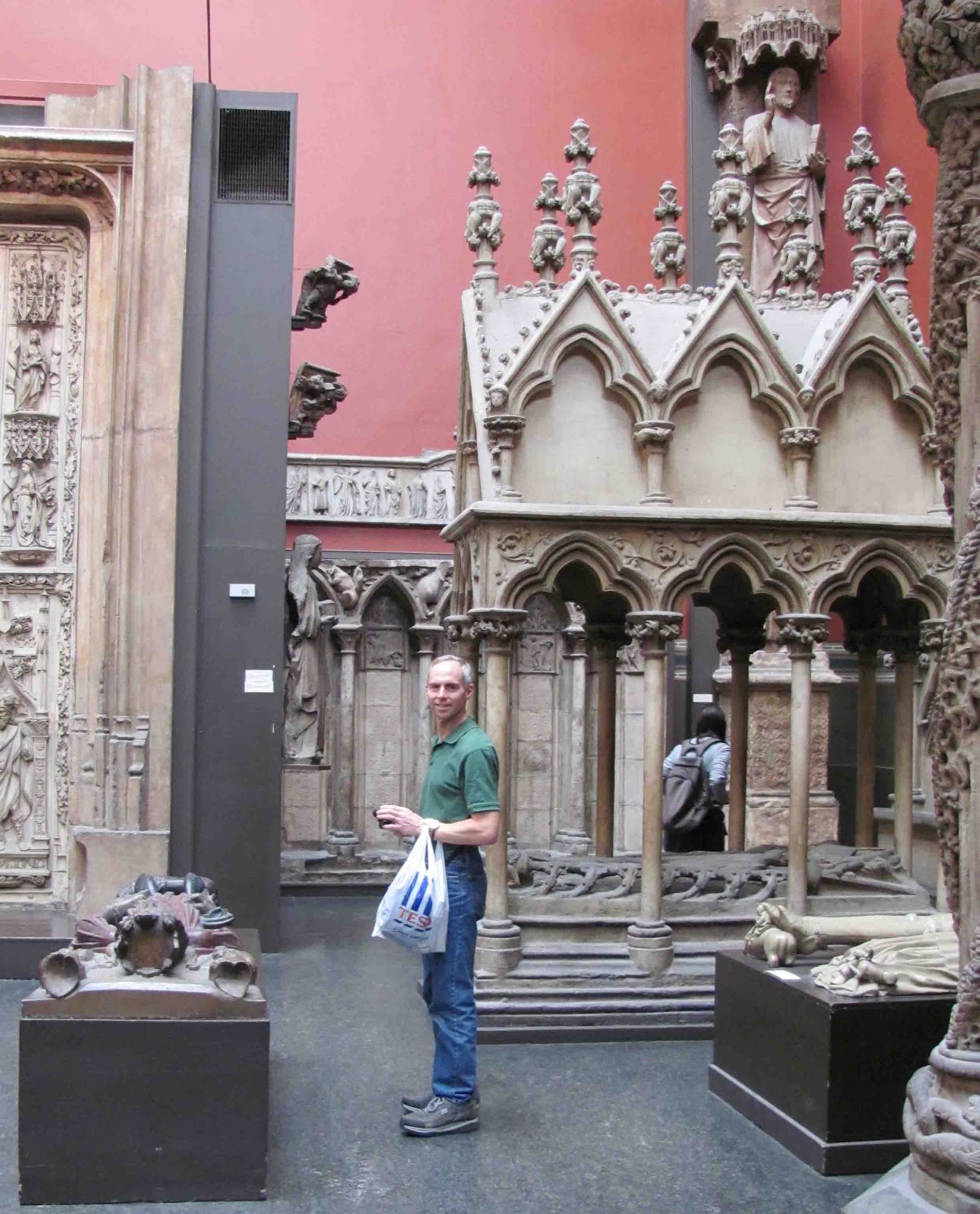
Dwarfed by other's achievements
in London's V&A Museum

This is often the way I feel: my accomplishments, what few I can call my own, feel as nothing compared with those of my heroes.  Yet perhaps part of the reason for my current lack-of-success is due to how highly I regard authors like Edgar Rice Burroughs, Gregory Benford, Robert Silverberg, and Kevin J. Anderson.  I look at what they’ve achieved, and I say, “I could never do all that.  If I could only accomplish half of what they’ve done, or even a quarter, I’d be satisfied.”  What’s becoming clear to me is that, like Julius Caesar and Mark Antony, my literary heroes have never been satisfied.  They work until they drop, always reach for the next rung of the ladder, and always strive to top their previous achievements.  

Perhaps, in order to achieve the success I desire, I must adopt such an attitude.  Part of me argues that if I do so, I’ll have to give up any sense of satisfaction with what I eventually achieve.  I don’t know how to respond to that argument.  All I know is that I’m not satisfied with where I’m at now.  For too long I’ve aimed to be lesser.  Perhaps it’s time to strive to become something infinitely greater.

Related Dragon Cache entries

Related Internet links

Tuesday, March 27, 2012

Edgar Rice Burroughs of Mars


Edgar Rice Burroughs’ original novel may be titled A Princess of Mars, but the author does not center his story upon heroine Dejah Thoris.  Nor does he spend significant time giving the backstory of everyone the protagonist meets on his adventures.  Instead, the major character in the book is indisputably John Carter.  He reaches Mars, where he is captured by the Tharks (not little green men, but six-limbed, fifteen-foot-tall green men).  When the Tharks capture an airship from the city of Helium (populated by normal-sized, red-skinned humans), John falls instantly in love with Dejah.  Everything he does thereafter is geared to win her love, free her from captivity, and return her to Helium.  Instead of yearning to return to Earth, John Carter embraces his changed circumstances for what they are, not what he would like them to be.  In doing so, he reminds me of Number One in “The Cage,” such a strong female character that she repelled women who previewed the original “Star Trek” pilot in the 1960s.  

An omnibus edition from the
Science Fiction Book Club

A Wikipedia article suggests that an animated feature film adaptation was planned in the 1930s, but ultimately rejected by MGM.  Mention is made of the highly successful live-action Flash Gordon serials produced by Universal during the same decade.  Having revisited two of the serials this year (the thirteen-episode “Flash Gordon: Space Soldiers” and the fifteen-episode “Flash Gordon’s Trip To Mars”), I imagine that a “John Carter” adaptation, given a similar treatment for people of that era, would have stayed closer to Burroughs’ original plot structure than the new movie.

Another cherished SFBC omnibus
of adventures on Mars, 

also known as
Barsoom.

Alas, I cannot judge what might have been, but only what is.  While I enjoyed rereading a novel I haven’t read in three decades, I cannot say that I found the book difficult to put down.  It took me roughly two weeks to read the one hundred-and-eighty page novel, as opposed to a week for the three hundred page Heat Rises, the third novel by the eponymous Richard Castle.  Does this mean that A Princess of Mars is less compelling that a modern mystery written by a fictional novelist?  More than likely, my relationship with the original material has less to do with its merits than where I am in my life.  My interests have expanded and evolved since I was a teen.  In my High School days, my discovery of Edgar Rice Burroughs proved monumental.  A Princess of Mars prompted me to read more of the Mars series, the Venus series, and his Tarzan novels, along with numerous other works.  His fiction inspired me to write, and my first, fumbling efforts occurred during that period.  His ability to spin stories of adventure, featuring strong, intelligent heroes and beautiful heroines, as well as his prolific storytelling abilities, made me want to model my life and talents upon him.  Even now, thirty years later, I find that I cannot be dispassionate or objective about Edgar Rice Burroughs.  For he played his part in molding me into the man I am today.

These SFBC editions are made extra-special
by cover art and interior illustrations
 from the incomparable
Frank Frazetta

While Disney’s new “John Carter” movie may not rival the success of such franchises as “James Bond, “Star Wars,” or “Flash Gordon,” it’s a fun, enjoyable movie that I’ll no doubt watch again in the future.  I just hope that children who see the movie enjoy it enough that they search out Edgar Rice Burroughs’ original work in bookstores and libraries.  For, while his novels may have aged, they’re still worth reading.  

Some might even find his stories inspiring.

Of course, after reading this,
I had to buy a paperback of
 Tarzan novel #13,
Tarzan at the Earth's Core!

Related Dragon Cache entries

Internet Links