Showing posts with label H. G. Wells. Show all posts

Thursday, April 2, 2026

War of the Worlds: Thunder Child HC Preview


As Miriam and her husband gaze up at the heavens through a telescope, they seek confirmation about recent activity on the surface of Mars. Simon and Miriam believe Mars is a dead world. Even if Humans had vessels that could travel through space, the distance between their planet and Mars seems too vast to cross. 

Still, Simon and Miriam can't help but dream about meeting people from another world. What will happen when their dreams become reality? And will Simon and Miriam survive an encounter with the aliens that, unlike Humans, they believe must have evolved beyond the need for war?

Here's all the info from Titan Comics: 


War of the Worlds: Thunder Child

Author: Matthew Hardy and Rob Jones

Artist: Kevin Castaniero

Publisher: Titan Comics 

HC, 144 pages, FC, $24.99

ISBN: 9781787749597

On sale June 2, 2026


A dramatic tale that runs parallel to the events of H.G. Wells’ classic novel, The War of the Worlds.


The War of the Worlds: Thunder Child follows the exploits of the crew of the eponymous ironclad torpedo ram, the HMS Thunder Child. Sitting alongside the events of Wells’ novel, the story takes place against a backdrop of strange occurrences and creeping terror, all leading up to the Thunder Child's final heroic showdown with the invaders from Mars.


This is a terrifying and thrilling tale soaked in blood, recriminations, sacrifice and loss, the first act in a new take on the well-known science-fiction classic with a unique cast and its own story to tell. A story of the horrors and conflicts of the crew as they experience the first desperate days of the Martian invasion and face the possible collapse of the British Empire and civilisation itself – threatened both from the stars… and from within.


Now, let's take a look inside:


Pre-order it now from Amazon, Barnes & Noble, Books A Million, and Forbidden Planet for the UK and Europe.   


Thanks to Titan Comics for sharing this preview with us.


ABOUT TITAN COMICS


Titan Comics, a Titan Publishing Group company (which includes Titan Books, Titan Magazines, and Titan Merchandise), is the comic book arm of the Titan Entertainment Group, and its sister company is the pop culture retail chain, Forbidden Planet. Titan Comics offers comics and graphic novels from the world's most renowned properties, alongside creator-owned comic books from new and established talent, as well as classic graphic novels remastered for a brand-new audience.


Titan Comics publishes a variety of genres through its imprints: Hard Case Crime (world-renowned pulp-crime publishing), Statix Press (critically acclaimed translated comics and graphic novels), the new Titan Manga (exciting manga and anime-based titles), and Titan Nova (new young readers imprint).


For more information, visit https://www.titan-comics.com.


For further information, follow Titan Comics on Facebook, X, Instagram, and BlueSky.


Monday, March 30, 2020

Rick Steeves on Social Distancing

Sacramento Airport, St. Patrick's Day 2020

Recently, world traveler and TV presenter Rick Steeves has observed that travel has become extremely touristy. Instead of venturing into the unknown to make interesting discoveries, tourists swamp the most popular sites for Instagram moments. 

"Look where I am!" they say. "That's one off the bucket list!

Meanwhile, places off the beaten track, that could prove fun and inspiring destinations, and where tourism could really benefit the locals, go relatively unvisited. This sort of herd mentality, of having to go where everyone else goes, makes no sense to me. Don't people want to experience adventure and discovery anymore?

Besides, where's the fun of sitting in traffic, waiting in line, or being limited to a designated amount of time in a given location because it's such a popular destination? I suppose it's easier to impress your friends with photos and tales of the places you've been, if they are places they'll instantly recognize. But is that was travel is supposed to be about?


On my return flight, I was struck by how empty Sacramento Airport felt. Few restaurants had patrons. Most stood empty. I saw one person walking away from the counter at Starbucks, while Peet's Coffee & Tea was staffed, but seemingly closed. Hardly anyone waited for flights. Most of the chairs at the gates were empty. 

By now, admonitions to wash your hands, wipe down any surfaces you touch, and keep your distance from others were in the news. So we found an unoccupied area at the gate, disinfected the seats and sidetables w/ wetwipes, and pulled out our ebook readers. Within a few minutes, a woman plunked down next to us. Seemingly oblivious to us, she talked on her phone loudly and continuously enough to make reading impossible.


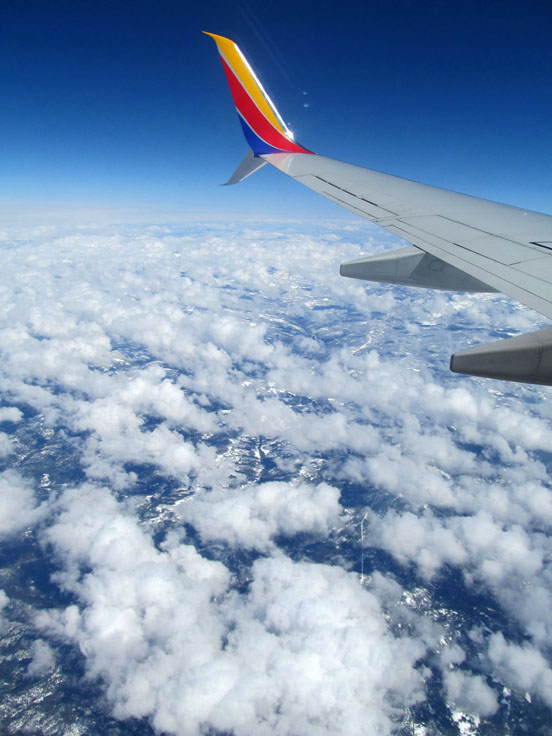
With people canceling or changing their travel plans, most airlines canceled flights. Despite only having thirty passengers, Southwest Airlines demonstrated their mission of customer service by not canceling our flight, or rescheduling all their flights to fly full. Instead, they kept to their schedule, operating at a loss to not inconvenience their passengers. 

The flight crew advised everyone to spread out, and leave plenty of space between themselves and others, in order to inhibit the potential spread of Coronavirus COVID-19. Being among the first to board, my wife and I took a row around a third of the way back. We disinfected out seats and tray tables, and strapped in. 

Despite warnings from government health authorities and the Southwest staff, passengers filled up seats and rows in front, beside, and behind us. Again: the herd mentality. When a family filled up the row directly in front of us, we abandoned our seats, and left our carry-ons where we had stowed them.


The view ahead on our Southwest flight

A little behind the wings, we found a row with no one else close around. We disinfected the seats and tray tables, and got comfortable. By the time boarding had finished, only six others had joined us from the wings back. This left 145 empty seats on the plane, with 22 people clustered up front.


The view behind

On our trips to England, we've visited many popular places, such as Westminster Abbey and Stonehenge. But most of the places we traveled to were places few international travelers go, such as the town of Bideford, where Charles Kingsley set his novel Westward Ho!, and Chagford, a historic stannery town featured in The Tinner's Corpse, a novel in the Crowner John mystery series by Bernard Knight. Some places, such as Cromer, have grown more interesting since our visit. Through my reading, I've accompanied characters on their visits to the seaside town in Tono-Bungay by H. G. Wells, Limitations by E. F. Benson, and So Disdained by Nevil Shute.


No one knows how Coronavirus COVID-19 may alter our world. Times like these make us reflect on our lives, and what really matters. Perhaps we should contemplate how Rick Steeves' observation relates to us. At the very least, it makes sense to adopt easy habits such as cleaning your hands, disinfecting surfaces, and keeping more distance from others than usual. 

Dragon Dave

Related Links
Rick Steeves' Blog

Wednesday, March 7, 2018

2017 In Review Part 2

Last week, I listed all the novels I read in 2017 on the right. Here's the final post on those I felt compelled to tell you about.


Jeffrey Archer's house:
 the Old Vicarage, Grantchester 2017

Shall We Tell The President by Jeffrey Archer
A taut political thriller set in Washington DC, written by a former politician who worked at the highest levels of British government. I found it interesting how he knows so much about the workings of the American government and its law enforcement agencies. I visited the author's house in Cambridge last year. 


St. Edmundsbury Cathedral 2017

In Mary's Reign by Emma Orczy
A romance involving renowned Protestant-hater Mary I, the daughter of Henry VIII, a young man at court, and two women who look startlingly similar. I visited Bury St. Edmunds this year. It was a rainy day, so we had little time to explore the town. So we spent it largely inside the cathedral. Had I read the novel before I visited the town, I might have ventured out to nearby St. Mary's Church, where she was buried.

Paddington Helps Out by Michael Bond
The answer, in case you are wondering, is No. One can never get enough of Paddington Bear.

Five Hundred Years After by Steven Brust
I'm most familiar with Brust's stories about Vlad, the former assassin and underworld figure, who is on the run from his fantasy-world equivalent of organized crime. He drops lots of hints about how his world came to be, with it's mix of witchcraft and sorcery. This one leads up to a pivotal event in the world's history, and involves the ancestors of Vlad and his friends (and perhaps a few of his longer lived friends). 

The War in the Air by H.G. Wells
A bicycle repairman helps extricate a man and a woman from a downed air balloon on a windswept beach. Then the air balloon takes off again, and whisks him off to Germany. The army finds him, along with plans for a proposed airplane. He is brought on board a zeppelin, and transported across the ocean to the United States, where the fleet of German zeppelins devastate New York. A strangely prophetic novel, written three decades before World War II.


Big Ben 2011

The Clockwise Man by Justin Richards
While I'm a Doctor Who fan, I've never really liked the TV versions of the Ninth Doctor and his companion Rose. But I liked their characterization in this book, as they investigate attacks on people in early twentieth century London. The story featured displaced European aristocrats, who had to flee to England for their lives, much like Baroness Emma Orczy. And the climax occurs inside Big Ben, an English landmark I'd very much like to tour, but probably would never be allowed inside. 

The White Company by Arthur Conan Doyle
Unlike his Sherlock Holmes adventures, this is a 14th Century historical novel based partly in Minstead, England. It's really a series of misadventures featuring a young man who grows up believing he will become a monk, but falls in love with a noblewoman, becomes a squire, and eventually a knight and a landowner. As it happens, Minstead sits roughly halfway between Brighton (which I visited in 2013), and Lyme Regis (which I visited in 2015). Arthur Conan Doyle must have liked the town, as he was buried there.


E. F. Benson's House in London 2013

The English Way of Death by Gareth Roberts
An adventure in 1930s England, featuring the 4th Doctor and favorite companions Romana and K-9. There's some interesting nods to the Mapp and Lucia series by E. F. Benson. It takes place near the Victoria and Albert museum, where E. F. Benson lived, and also out on an English beach, where a strange brick bathing hut serves as an entry portal to another dimension. 

Winnie The Pooh by A.A. Milne
A fond look back at childhood stories, and a reminder that an important and beloved novel can be whimsical and lighthearted.

New York 2140 by Kim Stanley Robinson
Global warming has left many of the world's coastal cities underwater. Large swathes of New York City now stand in the intertidal zone. Skyscrapers have been fortified to withstand the conditions, and life goes on as usual, with intrigues, big business, and disasters. Homeless people live in boats on the water, scavenging to get by. Others who can't afford housing stay in tents atop the skyscrapers. The novel features a woman who travels around the world in a blimp, transplanting endangered animals to  regions where climate shift will allow them to survive. Another thread involves a search for buried treasure from a ship that sank off the coast during America's Revolutionary War. There are references aplenty to Herman Melville, including a lost story or novel which might also be recovered. But mostly it's a story about the centuries-old history of the city, and a thoughtful vision of its potential future.

A Mississippi River Boat in England?
Horning 2017

The Confidence Man by Herman Melville
The Canterbury Tales on a Mississippi River Boat. The theme is how much are you willing to trust, and believe in, your neighbor. Will you choose to believe in a good cause, based only upon a stranger's word? This is a tiresome read, and most of the time I was plodding through it. I don't recommend it. Nonetheless, it is one that challenged my outlook regarding the "good causes" people ask me to help, whether they be legally organized charities, or the scruffy, unwashed person on the street.

A Son of the People by Emma Orczy
A Hungarian Lord of the Manor tries to build a modern mill, using principles he's read about in England. But the local serfs are fearful that his advancements will leave them out of work, and they rebel by setting fire to the fields. While the rich lord is foreword-thinking, he's stupid about money, and ends up owing everything to a greedy Jewish moneylender. A peasant, who has worked hard and invested wisely, comes to his aid, and asks for his daughter's hand in return. This semi-autobiographical novel makes for an interesting study of life at the time in Europe, the interaction of the classes, racism, and the inevitable march of technological progress.

I'd be honored if any of my (eventual) published novels were to prove as noteworthy as the above listed titles.

Dragon Dave

Wednesday, February 28, 2018

2017 In Review Part 1

Last year I read some wonderful stories by some amazing authors. You can peruse the entire list off to the right. I'll touch on a few of the more meaningful journeys in this post.

The Highlanders by Gerry Davis
The novelization of a 1960s Doctor Who TV serial. It takes place in an era when the English fought the Scottish for who would be king of the United Kingdom. It's where the 2nd Doctor meets Jamie, a Scottish Highlander who is fighting the English Redcoats. As an American, it's a reminder of the time when the British and the colonies didn't agree who should rule part of Britain. The story aired on TV during the 1960s, when the British were in the process of disbanding their empire. It seems equally relevant today, given Britain's desire to abandon the European Union via Brexit, and with Scotland recently voting over whether or not to leave the U.K.

King Soloman's Mines by H. Rider Haggard
The Bible records the lavish extent to which Soloman built the Jewish temple. Other verses say that he built equally lavish temples for the gods of other lands, such as those his foreign wives worshipped. While Soloman is revered for building the first Jewish temple, the money he spent on it, and the labor he demanded of his people, led to the breakup of the Jewish kingdom. The novel's hero Allan Quartermain has become a cult hero, the subject of books, movies, and comics. Haggard wrote more novels about him, but this was his first: the search for the fabled diamond mines in Africa that Soloman used to fund his lavish building program. What I found most interesting are 1) how he kills so many animals for sport (or, in the case of elephants, for their ivory), and 2) how he convinces thousands of people to go to war in order to save the life of himself and his friends.


Cambridge 2017

Case Histories by Kate Atkinson
I discovered detective Jackson Brody via the TV adaptations. Atkinson's novel is very different from the TV versions. For one thing it's set in Cambridge, as opposed to the TV version, which is set in Scotland. Another interesting features involves the highly sexualized nature of Atkinson's story. There's nudists bathing in the River Cam, a woman who sells her soul (and body) to find her place in society, and another woman who decides to become a lesbian. The main plot involves the identity of a dead girl, with the culprit being a child molester. Even more startling is Jackson's fear that his young daughter will be corrupted by an increasingly sexualized society. This was a polished, literary work, as much a novel of character as a mystery. Agatha Christie it is not.


Lovejoy & Lady Jane Felsham punting on the River Cam

The Judas Pair by Jonathan Gash
The first Lovejoy novel set in the English county of East Anglia, which itself is made up of the smaller counties of Norfolk, Suffolk, and Essex. (This makes East Anglia a super county to live in, I guess. Ask Jonathan Gash--he lives there). The Lovejoy of the novels is very different from the TV version. He isn't afraid to use violence to get what he wants. He's also less averse to stealing, if he deems the situation warrants it. Yet the book focuses even more on antiques, and the peculiarities there of, than the TV show. The Judas Pair is a set of flintlock dueling pistols, and the novel covers the complexities of the guns in far greater detail. The story, likewise, is far more complex and layered. I'm not sure Lovejoy of the books could ever be called the James Bond of antiques, but it would be interesting to compare Gash's novels with Fleming's. Intriguingly, the TV version also has Lovejoy visiting Cambridge, and punting on the River Cam, which doesn't take place in the novel.


The beach in Aldeburgh, a popular seaside destination.
Suffolk 2017

In the Days of the Comet by H. G. Wells
Europe is poised on the brink of war. The coast of the English county of Suffolk is being bought up by property developers. English industry is run entirely by corporations and property developers. Then a comet passes through Earth's atmosphere without destroying the planet. The exchange of gases change how people regard their place in the world, and sets them on a path to treat others in a more equitable fashion. While the story is clearly idealistic and utopian, it does suggest that Wells foresaw the labor union movement. 

Buck Rogers in the 25th Century by Addison E. Steele
Did I really read this novel last year? Hm. Can't remember anything about it. Sorry.

Hospital Station by James White
An entertaining novel about a Human medical doctor on a space station. He treats more aliens than humans, and each has biological, gravity, and atmospheric requirements that make coexistence difficult. A very entertaining precursor to S.L. Viehl's recent Stardoc series.

The Trouble with Tribbles by David Gerrold
The author tells how he sold his first story to television, from his original story proposal, to his pitch session, to story development, and finally to the filmed version of the beloved Star Trek episode. It covers his interaction with the Star Trek cast and production staff, from Leonard Nimoy to Gene Roddenberry. It's an inspiring book, when you consider that Gerrold sent the production team his story idea as an unpublished author. Through Star Trek, he went on to have a successful career in TV and as a literary author.  

In Farleigh Field by Rhys Bowen
A murder takes place during World War II in an English Manor. Something fans of "Downton Abbey" might enjoy.

Annie of Albert Mews by Dee Williams
This novel also takes place in WW2, in an area of London called Rotherhithe. Annie grows up in a conservative, nonreligious household. Her friend is less moral, becomes a nightclub singer, and inevitably pays the consequences for her actions. Annie's first love dies in the war. She joins the Salvation Army, much to her parents' chagrin. She is almost raped, she nearly dies amid the bombing, and eventually is evacuated to the countryside. An involving historical novel of how life changed in Britain during WW2. (Some Sherlock Holmes adventures take place in Rotherhithe. I'd be interested in visited the area some day).


The god Amun protects the Egyptian King Tarharqa.
The British Museum 2013.

The Gates of Kamt by Emma Orczy
Explorers discover a lost civilization of ancient Egyptians, untouched by the modern world. A fun romp by the author of the Scarlet Pimpernel series, written in the style of H. Rider Haggard.

More About Paddington by Michael Bond
One can't get enough of Paddington Bear, right?

Given an abundance of time, I'd write more about all the books I read last year, not just the ones I noted. I'll finish this list of last year's most notable books in my next post.

Dragon Dave

Thursday, December 22, 2016

Traveling with H.G. Wells, Jane Austen, and Arthur Conan Doyle

In November, I read several graphic novels, lots of comics, and a book on geology. I also read three novels. The first, by H. G. Wells, transported me to Switzerland. Or, at least, so it seemed. 

Supposedly, A Modern Utopia takes place on a planet like Earth in another solar system, but the descriptions of the landscape, and the picturesque villages, reminded me of Switzerland. In many ways, it reminded me of one of his earlier novels, The Wheels of Chance. In that novel, his protagonist, a young draper, sets off on a bicycle holiday in the south of England. His descriptions of the landscape are so vivid, so evocative, and so overwhelmingly beautiful that it made me want to follow the hero's bicycle journey with my wife. In A Modern Utopia, I felt as though he was transporting me to Switzerland. It's a country I would very much like to visit some day, and Wells spoke just as passionately about his surroundings in this idealized world as he did in The Wheels of Chance

After A Modern Utopia, Jane Austen returned me to some familiar sites in her novel Persuasion. The story begins in a manor house in Somerset, a county in southern England. In fact, it's the same county in which the real-life manor in the TV series To The Manor Born is located. 


As in the TV series, Austen's protagonist Anne, through no fault of her own, is forced to leave her beloved country home due to the fiscal mismanagement of a family member: in this case, her father. So she travels to stay with a family friend, then another member of her family, and this second visit takes her to Lyme Regis. 


While she and her party tour the seaside resort, a crucial event in the story takes place on the Cobb. This is a long walkway or pier, and perhaps the town's most striking feature. 

Jane Austen's characters then make their way to Bath, a setting she used in Northanger Abbey, which I read in October. Sadly, she doesn't offer much description of Bath in Persuasion. Austen painted a more vibrant view of the historic city in Northanger Abbey. (Also, Charles Dickens set part of his first novel The Pickwick Papers there, which I read earlier this year). Still, reading about Anne's visit to Bath made me want to travel there. It was a fashionable resort town in Austen's time, and remains a popular town for tourists today.

Finally, I returned to England for The Memoirs of Sherlock Holmes. This second collection of stories took me back to London, the great town's suburbs, and other towns in rural England. Then for the last story, "The Final Problem", Arthur Conan Doyle returned me to Switzerland, as Holmes and Watson seek to evade the clutches of the evil Professor Moriarty. As all Holmes aficionados know, Holmes and Moriarty have their final confrontation at a very real place: Reichenbach Falls. Having seen many dramatizations of this beloved story, I enjoyed reading Doyle's words, and following the characters' journey through Switzerland. 

Ah, the places great stories can take us!

Dragon Dave

Monday, February 1, 2016

Pride And Prejudice And H G Wells: Part 2

In H. G. Wells' novel, Love and Mr Lewisham, our protagonist unexpectedly reunites with Miss Henderson in London. Although Mr Lewisham is still smarting from the blows to his academic hopes, he has landed in a school for science teachers. While his prospects have fallen, he still holds high hopes for the future. Yet he finds himself as deeply attracted to her as before. While she begs him not to pursue her, he cannot restrain himself. She eventually relents, and lets him into her life. They spend their dates walking along the streets of London, or enjoying the parks. 


Mr Lewisham and Miss Henderson wandered along
the Serpentine arm-in-arm, over sixty years before
WOTAN took over the Post Office tower
in the Doctor Who story "The War Machines."

As their romance builds, his scholastic endeavors suffer. Eventually he gives in to his feelings and marries her. What little money he has saved quickly slips from his bank account. 

Of all his early novels, H. G. Wells reputedly worked hardest on Love and Mr Lewisham. He wished to tackle a serious subject, and he touches upon some notable social trends in England at the turn of the twentieth century. Despite Mr Lewisham's academic capabilities, one wonders if he could have achieved the goals he sought, without money and family to properly back him. His rejection of religion, and his steadfast belief in the superiority of science and socialism to guide mankind surprise him by acting more as impediments to his career than the pluses he had anticipated. Yet Mr Lewisham and Miss Henderson clearly love each other, despite never having been properly introduced. They thrill to the fact that they have found each other, even if, in doing so, they have violated society's expectations. 

As he demonstrated in his classic science fiction novels, H. G. Wells clearly had his eyes on the power of science and socialism to transform the world for the better. Yet I can't help but think that, like Mr Darcy, H. G. Wells felt society needed to be ordered and regulated by properly appointed gatekeepers, who would moderate social interaction between young people. Mr Lewisham and Miss Henderson might have waited forever to be properly introduced by people such as the master of his school, or her relations. Had Mr Lewisham honored the social contract, he might have entered and graduated from the universities and programs to which he had sought admittance. Even if he had ended up at the school for science teachers in London, he could easily have fallen in love and married Miss Heydinger, one of the female students there who admired him, and shared his interests in promoting science and socialism. 


After he fails to graduate,
Mr Lewishaw confesses that he is secretly married,
and says good-bye to Miss Heydinger,
on a quiet bench in Battersea Park.

His pursuit of Miss Henderson cost Mr Lewisham a respectable academic future. Consequently, he lost any hopes of earning more than a pittance for the rest of his life. Still, like Mr Darcy in Pride And Prejudice, who won Elizabeth Bennett's hand after rescuing her family from disgrace, Mr Lewisham earned his wife's enduring love. I have little doubt that, if you approached Mr Darcy or Mr Lewisham, and questioned either on this topic, both would tell you that the adoration of a faithful wife is one of the most precious treasures a man can possess.

That is, at least in Mr Darcy's case, assuming that you and he had previously been properly introduced.

Dragon Dave  

Wednesday, January 27, 2016

Pride And Prejudice And H G Wells: Part 1

In his novel Love and Mr Lewisham, H. G. Wells introduces us to a young teacher at a boy's elementary school in rural England. Mr. Lewisham holds great academic aspirations, but he is poor, with no family or friends to support him. Although he earns forty pounds a year, he must pay thirty on room and board to his landlady. So every hour he is not at school, he sits in his tiny attic room, at a small desk made of boxes, and studies. 

Perhaps Mr Lewisham studies too hard. For one day he catches sight of Miss Henderson, a young woman who is visiting some relatives. Her beauty shines like the rays of the afternoon sun upon the coldness of his isolated existence. Suddenly he loses interest in studying. All he wants to do is be with her.

A chance meeting with Miss Henderson in the country lane only deepens his ardor. When the head of the school sees them together, he reprimands Mr. Lewisham. But the young man refuses to take his cues from the older school master. Although it is never stated, Mr. Lewisham knows he should never have spoken to Miss Henderson, or walked along beside her in the country lane, as they have yet to be properly introduced by her family or his academic superiors. 

Unable to control his passion, Mr Lewisham later refuses to take over a class for another teacher. This is because the headmaster wishes to take along another teacher, to a party being given by Miss Henderson's relatives. What if his colleague and Miss Henderson fell in love? Knowing her schedule, Mr Lewisham uses his free time that afternoon to meet with Miss Henderson again. When he realizes that she returns his affection, he convinces her to spend the rest of the afternoon together. Consequently, she doesn't return to the house by the time she promised, and misses the party. Likewise, he fails to oversee a scheduled class later that afternoon. Although they merely talk and walk through the surrounding farmland, and have tea in a nearby village, when they return that evening, Mr Lewisham and Miss Henderson find their reputations are in tatters. 


Taking tea with my wife,
in a cafe along the Serpentine in London,
while under the careful supervision of the Daleks.

Miss Henderson is looked down upon by all the other women in the village. They see her as a fast woman, someone of low morals. Her relatives confine her to their house after that, and never let her out of sight when they go out. Meanwhile, Mr. Lewisham finds the head of the school unwilling to forgive his absence that afternoon. Without his superior's recommendation, his applications to the universities, and the prestigious programs he hoped to enter, come back rejected.

In Jane Austen's novel Pride And Prejudice, self-important clergyman Mr Collins insists upon speaking to Mr Darcy at a ball. As Mr Collins holds close ties to Lady Catherine de Borough, Mr. Darcy's aunt, he feels sure of a warm welcome. Instead, Mr Darcy feels affronted, and rebuffs Mr Collins' attempts at conversation. While Mr Darcy might have spoken more kindly with Mr Collins, and even tolerated a little of the vicar's prattle, he is conscious that they have yet to be properly introduced. Under those circumstances, Mr Darcy feels it would be improper to speak with Mr Collins.

What do you think? Would society function more smoothly, and people get along more peacefully, if you and I refrained from speaking to people we had not yet been introduced to by our family and civic superiors? Or is that just a meaningless aspect of society that we have, quite rightly, dispensed with?

One thing's for sure. Had Jane Austen and H. G. Wells had access to the Internet, Facebook and Twitter would have functioned far differently than they do today.

Dragon Dave

Thursday, March 26, 2015

The Link Between H. G. Wells & K. W. Jeter

Today is the birthday of K. W. Jeter. I know him best as the author of a trilogy of Star Wars novels, centered around the bounty hunter Boba Fett. Most of the literary community know him as the man who coined the term Steampunk in a letter to Locus magazine. His early novel, Infernal Devices, which I read last year, took me on a journey through dark and seedy Victorian London communities. It featured elaborate robots designed to replicate the actions of priests and lay leaders in Church of England worship services. (Unfortunately, these automatons leave mass injury and destruction in their wake). As a bonus, it also featured elaborate clocks that portend the end of the world.

Or at least, that's my best summary of it. There's lots of other fun aspects to it, involving boats, planes, and selkies, and if you're interested I'll let you discover those on your own. Interestingly, today's readers, inured to modern conventions, often remark there's not enough "Steampunk" in it. As I don't make a habit of reading this niche genre, I cannot comment on that. What I can tell you is that this early K. W. Jeter's novel entertained me, and left me sufficiently intrigued about certain plot points (especially selkies) that I turned to Wikipedia and gained a better knowledge of the world. 

So, I guess you could call that a recommendation for Infernal Devices.

Now I'm heading down a path to read another of his novels. While researching this year's trip to England, I realized that I might have time to stop by one H. G. Wells landmark. This dovetails with earlier plans for our 2013 trip (sadly abandoned) to visit another key Wells location. This, along with several Classics Illustrated adaptations of H. G. Wells' stories that I recently picked up, sent me to my bookshelf. 


For my first H. G. Wells reading experience in decades, I selected The Time Machine. So far, I've noticed that this short novel differs from George Pal's movie version in significant ways. What's struck me most strongly so far is that the Morlocks, hairy creatures in the film, are depicted as white ape-like creatures with large bulbous eyes in the novel. 

Although I didn't plan it at the time, as I began reading The Time Machine, I realized which novel I should read next. It's been sitting in my bookshelves since Christmas, when I received it as a gift. It's entitled Morlock Nights, a sequel to H. G. Well's classic novel. And it's author? None other than celebrated Star Wars and Steampunk author K. W. Jeter. So it would seem that another novel has joined the ranks of books pressing for my immediate attention. 

Happy Birthday K. W. Jeter. I can't wait to read your book!

Dragon Dave

Tuesday, March 10, 2015

Adventures in Cake and Comics

Last weekend, my wife decided that she wanted an adventure. Not a sail-around-the-world-in-a-weekend type of adventure, just a fun outing that was totally unplanned, and could therefore reap unexpected delights. As we had slept in on our day off, we naturally took time for a leisurely breakfast before deciding exactly what to do with our day. Then, we set off for our adventure!

First event of the day: carting our empty cans and bottles the recycling yard. This was a place forty-five minutes away. We've gone other places, but like this one the best. It's next to a tool shop we used to frequent, back before a series of events forced my grandmother into the hospital, then to be watched over by family, then sent into a nursing home, and then, gradually, to drift away from us until...well, you know. Like any war, the fighting and unwillingness to compromise in my family altered or killed numerous aspects of our lives. One of those was our woodworking. Still, even if some parts of our lives are irretrievably destroyed, we're hoping to resurrect the woodworking. Although we entered with no plans to buy anything, we left the store with a wood-and-brass mortise gauge. A cool tool in my hot little hands, courtesy of the wad of cash burning a hole in my pockets. Either the stupidest decision of my life, or an investment in my future. Hopefully the latter.

Of all the culinary delights in life, one my wife and I enjoy are our visits to Panera Bread. I'm talking our local one--we'd never visited another. But we found another by the tool shop, and it proved superior, in every way, to our local. And the coffee cake, our favorite treat: a big hunk to share and to savor, before we resumed/continued our adventure. (Sorry, no cake photo).

Over lunch, we decided to visit two comic book shops up in Temecula and Murrieta. So even though it was early afternoon, we headed up that way. 


On a recent trip to a local store, I picked up several old Classics Illustrated issues. One was an adaptation of H. G. Wells' novel The War of the Worlds. I brought this with us, and as my wife drove, I read the comic aloud. Printed in the 1970s, the artwork is crude by modern standards, but the story made pleasant reading, and my wife was able to glance at the occasional drawing. It made a pleasant interlude before we arrived at the first comic book shop.

Mostly we were just curious what these two stores had in their old, discounted stacks, but we were also hoping to pick up the variant cover for Rocket Raccoon Issue 8, drawn by Marvel colorist Justin Ponsor. Although we didn't find it, we found several missing issues in series we collect, and completed the four-part story "Hulk Vs. Iron Man," part of Marvel's major Original Sin event.


In "Hulk Vs. Iron Man," the Watcher's eye reveals many secrets and past events our heroes would rather not have faced. One of those involve the intertwined past of Tony Stark and Bruce Banner. I've read through Issue 2 now, and as it's a complex story, I won't attempt to summarize it in this post. It's co-written by Mark Waid, who writes the current Indestructible Hulk series, and Kieron Gillen, who writes the current Iron Man series. I've really enjoyed Waid's intelligent take on the Bruce Banner/Hulk situation, and what I've read so far leaves me intrigued about Gillen's take on Tony Stark/Iron Man. I'm glad I found the missing issues, so I can finish this four-issue story.

For dinner, we decided to be equally indulgent, and stopped for dinner at Weinerschnitzel. We shared a healthy dinner of chili cheese hot dog, chili cheese burger, chili cheese fries, and for dessert, soft serve ice cream cones. (Hey, we can always eat our vegetables later, right?) Then it was time to head back to San Diego, our adventure completed.

Or at least, so we thought. As we drove down the I-15, we decided to stop in North County Fair mall, and see if we could find that variant cover issue for Rocket Raccoon #8. Sadly, just like every other store, they didn't have it in stock, so we decided to give in and purchase the issue with the regular cover, along with Issue #9, which had just arrived in stores.


This cover is fun, as you can see, and offers an accurate reflection of the series. My wife and I don't collect many ongoing series, but Skottie Young's irreverent and low-key writing have won us over. I especially enjoyed the first four issues, which formed a nice homage to the stories Bill Mantlo wrote about Rocket back in the 1980s. Since then, the artists have changed, and the stories have been less epic, but they've all been fun. The issues never sit around long before they get picked up and read. When the next issue comes out, we read the electronic version on our computers, to refresh our minds on the story, then go out to buy and read about Rocket's latest adventures. 

That night, for whatever reason, we didn't sleep all that well, so we got up early in the morning and went to the gym for a workout. Then we came home and went back to sleep for a few hours. When I woke up I found myself alone in bed, and a pleasant aroma permeating the house. I headed into the kitchen, where I found a coffee cake baking in the oven. (Sorry, no cake photo). Sometimes an adventure can reap unexpected rewards, and this usually proves the case of scrounging through discount comic boxes. In this case, I also had a cool-looking and potentially useful tool, some new stories to read, pleasant memories, cash left over, and best of all, homemade coffee cake to savor. Can you think of a more pleasant way to cap off an Adventure in Cake and Comics?

Dragon Dave