Showing posts with label Chelsea Quinn Yarbro. Show all posts

Wednesday, November 4, 2015

Chelsea Quinn Yarbro: Moving On & Rebuilding

In Chelsea Quinn Yarbro's historical novel A Flame in Byzantium, Olivia waits in her home in Constantinople. She has delayed her escape from the city to hear from her lover Drosos, who Emperor Justinian has recently recalled from Alexandria. Frantic with worry, she sends her servants out to find him. 

Eventually, Drosos ends up in her house. Instead of rejoicing in their reunion, he repeatedly asks her to send him away. He asserts that she must not be seen with him, or associate with him in any way, lest his disgrace (and accompanying suspicion) also fall upon her. She refuses to send him away, pledges to remain by his side always, and takes him to her bed to comfort him. 

Sadly, something deeper and darker than a concern for her well being lies behind Drosos' protests. In the act of their lovemaking, she attempts to bite him as usual, in order to draw strength and sustenance from his blood. This proves the final straw that breaks Drosos' regard for her, someone who never embraced his idealist view of the emperor. Drosos shoves her away, and proclaims her secret nature as a vampire to her entire household. 


The riches of ancient Egypt are celebrated
in the British Museum.

She realizes then that Drosos is irrevocably broken. The ideals and philosophies he treasured were shattered by the Emperor's orders to destroy the libraries of Alexandria, and so he despises everything around him, including her, the woman who--despite her different, supernatural nature--he once loved. So she allows him to go his own way, still hoping he can find a means of repairing his broken nature. As for herself, she must carry on, and find a means of surviving the threats posed by her enemies in Emperor Justinian's court. She has centuries more of life to look forward to, and she is determined to forge a new future for herself somewhere else.

We can all learn a lot from Olivia's determination to move on and rebuild her life. Even if she is a vampire

Dragon Dave

Monday, November 2, 2015

Chelsea Quinn Yarbro on Adapting Our Beliefs

People once believed in protective house gods,
and Ugallu, the storm-demon,
depicted on this ancient Assyrian stone panel
in the British Museum.

In Chelsea Quinn Yarbro's novel A Flame in Byzantium, Captain Drosos of the Byzantine army puts off carrying out Emperor Justinian's orders to burn the Libraries of Alexandria for as long as long as he can. He sends back letters requesting clarification of his orders, and looking for any excuse not to destroy all this precious, accumulated knowledge. But finally he receives orders both explicit and final. He can delay no longer. He must raze these libraries, or someone else will assume command and do it for him.

With a heavy heart, Drosos follows Justinian's orders. As he watches the great libraries burn, he cannot believe that the Emperor knew the significance of his orders. In earlier discussions with Olivia, he argued that they must give the Emperor the benefit of the doubt, and trust his judgment in all things. He had been selected by God to lead all of Byzantium in the correct path to follow. He was the divine representative to humanity. How could he order such senseless destruction?

After his recall to Constantinople, he tries to suggest that Justinian misunderstood the situation, or had been ill-advised. The Emperor takes his comments for a lack of loyalty, and like General Belisarius, releases him from his command. Drosos wanders Constantinople in despair, having lost his military commission, the respect of society, and the trust of his emperor.

Drosos' life becomes a tragedy, because he steadfastly refuses to adapt his beliefs and principles in view of changing circumstances and others' actions. Like Drosos, we often clutch ideals to our chests long after the world has proven that they no longer apply to present circumstances. Refusing to release outdated beliefs can leave us irrelevant and alienated. Even if we're not vampires.

Dragon Dave

Wednesday, October 28, 2015

Chelsea Quinn Yarbro on the Power Books Wield

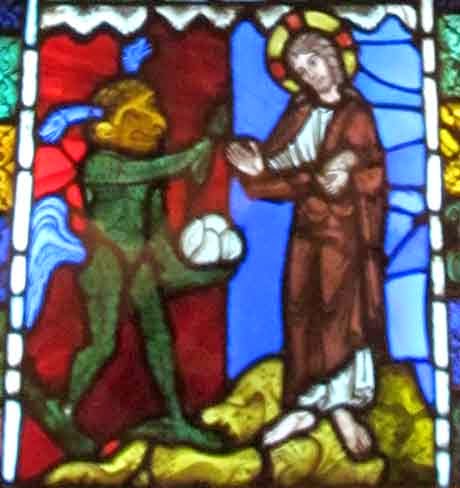
A 12th Century stain glass panel from a Church in France.
Might Satan be tempting Christ to read a novel involving vampires?
Victoria & Albert Museum, London.

In A Flame in Byzantium by Chelsea Quinn Yarbro, General Belisarius' enemies in Emperor Justinian's court grow so convinced of his guilt that they contact one of his household servants. After threatening him with torture and a grisly death, he agrees to spy for them. This man, who resents his lowly position in life as a servant, let alone being castrated during childhood, goes through the General's library, and reports back on the books in his collection. A treatise on military tactics used in other lands? A book on all known breeds of horses? Books on World Geography or History? Well, Belisarius has traveled extensively, and met many foreigners. Inevitably, he has read their books, and been influenced by their teaching. If those books weren't written by Byzantine citizens, then they must surely be suspect. Who knows what dangerous philosophies, undetectable to the unwary, might lurk within those pages?

At least that's the position of the Court Censor and his staff, after hearing the report from Belisarius' slave. These advisors slowly exert their influence on the Emperor, who orders Captain Drosos, instead of his general, to command an army contingent in Alexandria. This historic city is one of the foremost of Egypt, and is known the world over for its extensive libraries. Egypt is also home to Coptic Christianity, a proponent of Monophysitism. So one day Drosos receives orders from his Emperor: he must burn the libraries, to prevent the spread of heretical teachings through seemingly innocuous scholarly works on subjects like Mathematics, Science, and History. As he believes his Emperor rules by divine right, he does so. But watching all that accumulated knowledge and art going up in flame infects him like a cancer, slowly eating away at him, until all that remains is the husk of his former self.

But then, all books hold power, nonfiction and fiction alike. Reading and studying them influence people in all sorts of unforeseen ways, hopefully for the better, but sometimes for the worse. Those books might be a textbook on Math or Biology, a graphic novel, an cozy mystery, or a story about vampires.

Dragon Dave

Monday, October 26, 2015

Chelsea Quinn Yarbro on Religion Part 2

Instead of despising their former beliefs,
4th Century Roman Christians celebrated them
in artwork like this Symmachi panel
displayed in London's Victoria & Albert Museum.


In Chelsea Quinn Yarbro's novel A Flame in Byzantium, the high officials in Emperor Justinian's court may seek to protect their faith, but they hardly seem to be living up to its ideals. They see the world through a prism in which only their view of the divine--their beliefs--are true, and all others are heresy. A popular brand of Christianity, Monophysitism, is currently gaining converts in Byzantium, and threatening to infiltrate the Emperor's household. This must be protected against at all costs. So any approach that could aid in the defeat of Monophysitism, or any view of life and the world other than those they embrace, is a valid approach. 

As court officials do not trust Belisarius, they cannot rely on him to support their wise counsel to the Emperor. So they use their influence with Justinian to suggest that Belisarius might use his popularity with the army to mount a bid for Justinian's throne. The fact that he is a friend to Olivia, a woman whom they already deplore, gives them something else to work with. As he is his own man, not theirs to control, these defenders of the faith begin manufacturing evidence to incriminate him in Justinian's eyes. Even if it means besmirching the honor of a loyal servant such as Belisarius. 

But then, this is a society that uses religion to justify slavery, the castration of the children of slaves, and prevents people from rising above the caste into which they were born. No wonder Olivia refuses to adopt their ways, or for that matter, their brand of religion. 

Like Olivia, Chelsea Quinn Yarbro has chosen her own unique path to religion. Instead of accepting a traditional, ready-made religion such as Christianity, hers involves channeling spirits, astral planes, karma, and philosophical concepts like monads. In order to share her spiritual experience with others, she has written a series of nonfiction books. The first, Messages From Michael, also serves as the name of her group's website. There readers of her stories (or anyone else) can gain a greater understanding of her approach to the divine. 

One of her group's central teachings is that all life is a choice. Or, to quote from the group's website:

You cannot not choose. To say "I will not choose; I will do nothing" is a choice to do nothing. Rather than regard choices as terrible burdens and impositions, you would release much of your fear if you would realize that you are making choices all the time, and the process, rather than overwhelming you, is in fact the means to freeing yourself from the bonds of fear. Of course, you may choose to deny or ignore this as well. That is as much a choice as anything else in life. 

That's a teaching that sounds perfectly valid and useful in living out my life today and planning my future. If only it didn't spring from a belief system so radically different from my own! It sounds good on the surface, but it must be suspicious. Hm...maybe it's safer to choose to reject it, and spend the next few minutes reminding myself why it has to be wrong, and her beliefs must be wrong, and...

Ever wonder why those you seek to influence refuse to accept the validity of your views on life? Some of us will probably wonder about that all our lives. But then, it's always easier to see the hypocrisy in others than inequities in our treasured beliefs, or the inconsistencies in the way we put them into practice. Who knows? They seem so different from us: they might well be vampires!

Dragon Dave

Related Internet Links
www.messagesfrom.michael.com

Friday, October 23, 2015

Chelsea Quinn Yarbro on Religion Part 1

Urns to house Olivia's native soil,
courtesy of the Museum of London

In A Flame in Byzanium by Chelsea Quinn Yarbro, Olivia flees the chaos and destruction of Rome for the ordered and civilized world of Constantinople. She finds a world there vastly different from her expectations. One difference proves pivotal to how people in her adopted city view the world, and that is their religion.

As a vampire, Olivia has take her own approach to everlasting life. She has brought with her containers of her native soil, which somehow sustains her undead body. She acknowledges the power and validity of others' religion, but refuses to be a hypocrite, and bow to others expectations of conduct, or make untrue declarations of her beliefs. As such, the leaders of Constantinople view her as degenerate, just like the Christian laity and clergy of Rome. 

The Christian Church of the first few centuries after Christ, was far more diverse than what exists today. Yet it changed as religious leaders narrowed down what believers were allowed to read, think, and practice. Many have argued that this effort to focus Christianity on its essentials was necessary to help it survive after the fall of the Roman Empire. Yet, as in Yarbro's novel A Flame in Byzantium (and also in False Dawn), all too often belief's in one's rightness have been used as an excuse to hurt and even kill others. 

Conformity has its place in any human society. But, unlike the days of ancient Rome, civilization is no longer crumbling. Today, people expect religions to find ways to accept, celebrate, and honor the beliefs of all those who seek to love, respect, and serve others. Even if those others talk, dress, and act so differently that, at first, they seem degenerate. 

Who knows? Those other people might even be loving, respectful, and charitable vampires like Olivia.

Dragon Dave

Wednesday, October 21, 2015

Chelsea Quinn Yarbro on Cozy Horror

Count Dalek-ula says
False Dawn is nothing like A Flame in Byzantium.
Uh, hold on. Is that a werewolf?

One aspect of Agatha Christie's mysteries is how her victims are murdered, sometimes horribly. But from my limited reading experience of her work, she rarely portrays the act of violence itself. Instead, Poirot or another detective discovers the body, and then goes off to talk with his friends or the suspects in a calming, civilized fashion. In the case of Miss Marple, this may be over tea and scones. Some people have labeled her work Cozy Mysteries. Perhaps that's the secret behind her fiction's astounding longevity. I'm sure lots of other authors of her time wrote more gritty, disturbing mysteries. But readers of all ages and sensibilities can enjoy her stories, because the underlying mysteries are so compelling. 


Count Dalek-ula says, "I like Cozy novels,
but Jammie Dodgers are cozier than other sandwich cookies."

So please, Master, buy me some Jammie Dodgers.
(Or you could find your life become decidedly
less cozy!)

If A Flame in Byzantium is in any way representative of Chelsea Quinn Yarbro's Horror fiction, perhaps this is the secret behind that community's affection for her stories. The novel certainly stands out, with Olivia unlike any other vampire I've ever encountered in fiction. I enjoyed learning what was happening in sixth century Rome and Constantinople, two bustling centers of civilization when barbarian hordes were sweeping the globe. 

But then, I enjoy reading the occasional historical novel. Even if it's a Cozy Horror novel featuring vampires.

Dragon Dave

Monday, October 19, 2015

Chelsea Quinn Yarbro on Sedate, Cultured Society

A Roman room for entertaining visitors,
courtesy of the Museum of London, England


In Chelsea Quinn Yarbro's novel A Flame in Byzantium, one of the things that surprised me was how ordinary her protagonist Olivia seems. Becoming a vampire has granted her a long life, and she has to be careful when she visits others' homes, or attends parties, that she kindly rebuffs all attempts to offer her food or drink. So she excuses her non-indulgence with protestations as to her "delicate constitution." As a vampire, she seems to exist on blood, but this is a minor point for most of the novel. Drosos makes mention of her biting him when they make love, but as an army officer, he's stationed outside Constantinople for most of the story. She's carted boxes of her "native earth" from her villa in Rome, and she somehow draws strength from this. But really, little attention is paid to her vampirism throughout the five hundred pages of the story. More than anything, she hungers for the affection and love of Drosos, and when she realizes that the tide of public opinion is turning against her, and that she should flee Constantinope, she stays behind in the hopes of being reunited with Drosos. Aside from her affection, she regards the blood she has taken from him as a bond between them, one that she would gladly repay by sharing the rest of her life with him.

In introducing General Belisarius, and focusing on his struggle to hold Rome against the Ostrogoth invaders, I had anticipated battle scenes on the order of JRR Tolkien or Robert E Howard. Given the politics and undercurrents sweeping through Byzantine politics, I expected to find the streets of Constantinople awash in blood, as happened several times in HBO's "Rome" TV series. Yet with a few exceptions, any fighting, deaths, or tortures occurred off-the-page, and were merely remarked on later in the narrative, or by one of the characters. What Yarbro instead focuses on is the customs and protocols the characters must observe, and how people of various strata in society interact with each other. So when something terrible happens, for the most part we don't witness it. Instead of the gritty and graphic struggle-for-life I remember from False Dawn, A Flame in Byzantium gives us a sense of how these people lived out their everyday lives. We see what they eat and drink, the comforts that surround them, and those they interact with. Along the way, we witness how the actions and choices affect others, or eventually rebound against them. But aside from a few scenes, the story unfolds in a cultured and sedate manner, more like the PBS adaptation of "I Claudius" than HBO's "Rome." 

But then, we all like wise, cultured, and loving protagonists. Even if they are vampires.

Dragon Dave

Monday, October 12, 2015

Chelsea Quinn Yarbro on Defying Others' Expectations

An Italian vase in the British Museum
shows the Greek Hero Theseus
defending his home city of Athens
from an invasion of Amazons.


In Chelsea Quinn Yarbro's novel A Flame in Byzantium, Olivia might have escaped the Ostrogoth invaders by moving from Rome to Constantinople, but as a woman and a widow, she enjoys few rights in Byzantine society. She must name Belisarius as her legal guardian. While he remains in Rome, she must petition for an exception to the rules every time she wishes to procure household staff, or do anything significant involving money or people. Thankfully, she is allowed to hire workers to furnish her new home. But when her bondsman discovers that goods from her plundered Roman villa have ended up in Byzantium, she cannot charge the sellers with theft, or compel the authorities to investigate the piracy.

Nor does she make the friends there that she anticipated. Drosos visits her a few times, but as an army officer, he has no control over where he is stationed. Belisarius returns home eventually, but as he has failed to secure Rome, he now lives in disgrace. For a time, Belisarius' wife Antonina moved in elite circles, and allowed Olivia to accompany her. But after Belisarius was recalled, and the death of her friend, the Empress Theodora, she finds herself alone and lonely, with no desire to leave her house.

Constantinople had seemed her best hope for the future: a redoubt in a world that seems to no longer value culture, stability, or civilization. Yet everyone there views her with suspicion. She refuses to remarry, join the Byzantine Church, or dress and act like a typical Byzantine woman. Her Roman practices and interests cause her to be branded a licentious, unprincipled unbeliever. They invent stories about her, shun her, and implicate her in scandals. The Court Censor orders her servants to spy on her (under threat of torture and death), and plant books proscribed by the Emperor in her library. His soldiers search her villa, carry away precious furniture and heirlooms, and claim their plunder as evidence. He relentlessly pursues a legal case against her. She can not even leave Constantinople, at least not openly. She would be arrested by soldiers along the road, or those guarding the docks. 

Nevertheless, Olivia refuses to relinquish her principles, way of life, and everything she holds dear. In this way, she becomes a person we can respect and emulate. Even if she is a vampire.

Dragon Dave

Friday, October 9, 2015

Chelsea Quinn Yarbro on Financial Planning

Roman coins used in England,
courtesy of the Museum of London.

What if you could live forever? Would you want everyone else to know that you were immortal? And how would it be to watch society change, and everyone you know die, as the years pass into centuries?

These questions swirl around Olivia Clemens, a noblewoman in Chelsea Quinn Yarbro's novel A Flame in Byzantium. When she was young, her Emperor Nero was both beloved and feared. Like those before and after him, he built Rome into an architectural marvel, a city that spread its civilizing influence throughout the territories it had conquered. People of different lands embraced a shared currency, read the same literature, and exchanged goods and ideas through trade. Her relationship with the vampire St. Germaine greatly extended her life, and throughout the centuries, she has clung to the culture, traditions, and standards she values. But now she finds the Roman Empire crumbling around her, and she must flee her beloved homeland or risk slavery or death to the relentless Ostrogoth invaders. For she may be a vampire, but she can still die.

Thankfully, Olivia has somewhere to escape to: Constantinople, that other center of Christianity and culture, in a world where barbarians seem intent on destroying everything of value. Better yet, she has someone to orchestrate her safe passage there: Belisarius, one of Byzantine Emperor Justinian's most valued generals. As an unexpected bonus, she meets Drosos, one of Belisarius' men, who seems kind and attentive to her. Amid so much change, she finds herself inordinately attracted to this young army officer. So as she frees her slaves, packs up her possessions, and sets sail for her new home, she looks forward to enjoying the comforts of another fine city and the new friendships she will forge. It will serve as a refuge until Belisarius and his army can drive away the Ostrogoths, and secure Rome for the Byzantine Empire.

It's just as well that she's learned to save her money, and invest it wisely. But then, it makes sense to prepare for every contingency. Especially if you're a vampire. 

Dragon Dave

Wednesday, October 7, 2015

Catching Up with Chelsea Quinn Yarbro

Count Dalek-ula says
"Catching Up with Favorite Authors is Fun!"

Chelsea Quinn Yarbro's contributions to the Horror genre have been honored in numerous ways. In 2003, she was awarded the status of Grand Master at the World Horror Convention. Two years later, the International Horror Guild named her a living legend. Last year, the World Fantasy Convention gave her a Life Achievement award. 

My previous reading experience with her was minimal, just one novel that I read thirty-five years ago. In False Dawn, two protagonists trek across a post-apocalyptic northern California, in search of a refuge, a sanctuary where they can begin again. Back in those Cold War days, all of us lived with the possibility of a nuclear war. That future seemed imminent, unavoidable. So those of us who loved Science Fiction stories looked past that, and imagined what the future might hold for humanity, once the superpowers had done their best to bomb all of us out of existence. I had fallen in love with the movie "Logan's Run," found stories like Roger Zelazny's "Damnation Alley," and was hungry for more of the same. Her novel made a strong impression on me, and led me to read it again recently.

I found False Dawn every bit as powerful as I remembered.

Yarbro's muse seemed to take her in other directions after that, most notably in Horror. Her most famous creation is the Saint Germaine cycle. These novels fuse two genres, historical and vampire stories, into one. As I've recently grown interested in learning about ancient Rome, I viewed A Flame in Byzantium as an opportunity to catch up with Chelsea Quinn Yarbro. This novel, the first in a trilogy devoted to vampire heroine Atta Olivia Clemens, follows Olivia's move from Rome to Constantinople, the center of the other great civilization of her era. I found it an enjoyable novel, rich in historical detail and character development, if a little slow (at times) in pace. The novel gave me a chance to see what Yarbro had been up to during all those years we had walked separate paths (she as author, me as reader), and why the Horror community loved her so much.

But then, it's always nice to catch up with a writer whom you've not read for a long time. Even if she writes (primarily) about vampires.

Dragon Dave

Friday, September 25, 2015

Getting Wacky Again

Occasionally, a friend from elementary school would invite me to spend the weekend with him. My parents generally granted such invitations, provided the friend's family went to church on Sunday mornings. While staying with one friend, his family stopped by a store, and he introduced me to a pack of trading cards he collected. They were called Wacky Packages, and the cards sported stickers with fun takes on existing products. I loved the humor and imagery, and soon was using all my spending money to buy packs wherever I found them.

One store that always had them for sale was a little local market near my grandparents' house. So every time I went to visit my grandparents, I visited the store, which I called the Wacky Store, and added more stickers to my collection. I have no idea if I ever assembled a complete collection. That wasn't the point. I merely collected them because they made me smile and laugh. My grandfather was also a collector, and his chief love was collecting stamps. During one summer vacation, I spent several days in his den, working beside him on my collection. While he busied himself with arranging his stamps in books, I ordered all my Wacky cards into neat rows and columns, and then affixed the stickers to a poster board. This I taped to the wall of my room when I returned home, and for many years gained great pleasure in looking up at that poster board, and enjoying the wit and whimsy of the authors and artists who had created my beloved Wacky stickers.

Wash'n Fly
Little Towels Ghosts Use to Wash their Sheets
Approved by Gravediggers
Scares Dirt Away!
Fightens as it Whitens!

After awhile, my stickers began curling off the poster board, and you can only use so much tape to keep stickers on a board before the poster begins to look tacky, and in need of retirement. By then, Wacky Packs had long disappeared from market shelves, and I went on to spending my money on and collecting other things (such as, surprise surprise, books). Little sign of this once great collection of mine exists today, beyond this lone sticker affixed to the cover of my Sonatina Album for the Piano. But stories about how I collected Wacky Packages stuck to my family history, and were repeatedly recalled amongst family members. Unsurprisingly, these stories generated smiles and laughter among those who recounted them, as well as those who listened.

Imagine my surprise when, on a recent trip to the store, I saw a box of these:


Unlike those packs of yore, which probably cost me fifteen cents or a quarter, these new Wacky Packages, produced by Topps, and dated 2015, cost a dollar. As the package stated that it contained four cards, this meant each Wacky Sticker was now a quarter. Given how much we spend on such luxury items as books, DVDs, and comics, and considering the not insignificant sums we spend on travel to such exotic locales as Florida, Hawaii, and England, I pointed these out to my wife, but hesitated to pick up a pack. But my wife, who has long heard such tales recounted by myself and other family members, didn't hesitate. She immediately announced that we must pick up two: one for me, and one for her. 


2 Musketeers
Make Do with Two
33% Less Secure
Includes Pink Slip
Hey, it's a tough economy...

Hand-Picked
Pik-Nits
All-Natural
Hair Strand Bugs
No Trans Gnats
Flea Free

Bake Like Ape-Rofessional!
Great Fur Cookies. Fur Cakes. Fur Pies.
CHIMPERIAL

Hairy Margarine

Finally, a fast food that's GOOD for you!
LONG JOHN'S LIVER
onions not included

FRESHNESS GUARANTEED!!
(Packages straight from John's body, fresh to your plate).

Doubtless many will not appreciate the humor of these new Wacky Packages. But the stories they tell still resonate with me. The 2 Musketeers bar speaks to current issues in the economy. The Pik-Nits and Chimperial remind me of my great love for the Planet of the Apes movies, as well as the original novel by Pierre Boulle. The Long John's Liver seems tailor-made for me, as my mother often served me liver when I was growing up, and my favorite fish restaurant today remains Long John Silver's. 

In addition to awakening a host of pleasant memories about the food and household products from my youth, the Wacky stickers also remind me of the great stories I've read recently. The Pik-Nits reminds me of a scene from False Dawn by Chelsea Quinn Yarbro, in which Thea, despite her fear of proximity and being touched, finally allows Evan to cut her hair after it has grown so long, thick, and straggly that she finds it impossible to run a comb through it without breaking off the teeth. And the old sticker, as I look at it (and smile), reminds me of Death Warmed Over, the humorous horror/detective novel by Kevin J. Anderson. I can definitely picture Dan Shambles, the famous zombie private investigator, using a product like Wash'n Fly to clean his clothes and trench coat. (Or perhaps he would use it to wash any linens his girlfriend needs, as she was murdered before the events depicted in the novel, and now works as a ghost-receptionist in his office).

Despite all the fun these new Wacky Packages have given me, I think I'm going to have to be careful about how often I visit that store. After all, it's not like I need to be spending money on yet another hobby. 


Celebrating National Talk Like A Pirate Day
at Long John Silver's

And hey, it's not like I'm all that wacky a guy. Right?

Dragon Dave

Monday, September 21, 2015

Chelsea Quinn Yarbro's Grand Adventure

Three decades ago, I joined the Science Fiction Book Club. This is one of the novels they sent me.


I have no idea why I chose this novel as one of my four selections. The other books I chose were collections, and the author of each would become important to me in the decades to come. That's not to say that I've ever regarded False Dawn, by Chelsea Quinn Yarbro, as unimportant. But I never read any of her other novels until recently. And unlike the other novelists--Roger Zelazny, Anne McCaffrey, and Harry Harrison--Chelsea Quinn Yarbro never wrote any follow-ups to this story.

This has been a big reading month for me, at least in terms of the books I've finished. (Some books, such as Westward Ho! by Charles Kingsley, are longer, and necessarily take longer to finish). Nor have I finished False Dawn: I've only gotten fifty pages in thus far, about a quarter of the book's length. As you can probably tell by the cover, it's a tough, gritty novel, which paints a decimated future akin to those depicted in the Mad Max films. In this future world, genetic engineering has cause mutations that have destroyed governments (at least in the United States), agriculture, and the human race. It follows two protagonists: Thea, a woman who was raped by one of the roving motor cycle gangs, and Evan, a man who once ruled the motorcycle gangs, and seemed intent on killing mutants like Thea.

Instead of giving us the history of the characters and this future world, Yarbro makes us assemble a picture of this devastated world from sparse clues. Thea understandably can't stand being touched by a man, yet she builds crossbows and wields them with deadly accuracy. Evan carries his weight as her companion, despite having lost an arm, and does most of the cooking for them. Both are touched by the effects of genetic engineering. Thea has nictating membranes, a translucent or transparent eyelid that protects and moistens the eyes while maintaining visibility. The motorcycle gang that kicked Evan out might have cut off his arm with a power saw, but his arm and hand gradually grows back as the weeks of their journey pass. Both these mutations are thoughtful, perhaps even desirable adaptations to the human body, which have their presence in existing animals, reptiles, and birds. But other humans aren't so lucky. They're called the Untouchables, and even the motorcycle gangs avoid them. Many regard these Untouchables as lepers, but they're really people who bear undesirable mutations, and end up looking like their molecules got reassembled incorrectly in one of the transporters in Star Trek. 

The plot of False Dawn unfolds as a great land-journey. Unlike Frodo, Sam, Merry, and Pippin in JRR Tolkien's The Lord of the Rings, Thea and Evan are not setting out to destroy a magical talisman. They simply wish to survive. They've heard of a place of sanctuary near Gold Lake, the largest of a series of lakes in Plumas County, California. They unite in Chico, shortly after Thea shoots a dying rape victim to prevent her from being eaten alive by wild dogs. They follow a route of power lines, across terrain so difficult to traverse it prevents the wild dogs and the motorcycle gangs from following them. Then skirt what would be the scenic cliffs above Feather River Canyon, were the land not so blighted. We're only gradually learning about Thea and Evan, and both have reasons to pull back from each other. Yet necessity drives them to travel together, on foot, through the Northern California wilderness. What will occur when they reach Gold Lake? Will they choose to stay together? Will they find the community they seek? Evan after all this time, I seem to remember how the novel ends. But my memory has played me false before, so I read ahead, wondering what will happen next, and learning more about Thea, Evan, and this future world with each new page.

This grand adventure I'm sharing with Thea, Evan, and Chelsea Quinn Yarbro was prompted by charting out the birthdays of authors I've read in the past few years. Ironically, Yarbro shares her birthday, September 15, with Agatha Christie. Unlike Christie, it's doubtful that I'll ever create a blog dedicated wholly to Yarbro. But then, you rarely know what stories will become significant to you in the future. I read Agatha Christie in my youth, yet her stories gradually grew more important to me as time rolled on. With False Dawn, even though the story falls outside (Far outside!) the realm of the stories I usually inhabit, I kept that novel, while getting rid of many others, because I wanted to read it again. And now I am! I'm returning to that grand adventure Chelsea Quinn Yarbro took me on three decades ago.

I couldn't be happier.

Dragon Dave