Showing posts with label Charles Kingsley. Show all posts

Monday, March 30, 2020

Rick Steeves on Social Distancing

Sacramento Airport, St. Patrick's Day 2020

Recently, world traveler and TV presenter Rick Steeves has observed that travel has become extremely touristy. Instead of venturing into the unknown to make interesting discoveries, tourists swamp the most popular sites for Instagram moments. 

"Look where I am!" they say. "That's one off the bucket list!

Meanwhile, places off the beaten track, that could prove fun and inspiring destinations, and where tourism could really benefit the locals, go relatively unvisited. This sort of herd mentality, of having to go where everyone else goes, makes no sense to me. Don't people want to experience adventure and discovery anymore?

Besides, where's the fun of sitting in traffic, waiting in line, or being limited to a designated amount of time in a given location because it's such a popular destination? I suppose it's easier to impress your friends with photos and tales of the places you've been, if they are places they'll instantly recognize. But is that was travel is supposed to be about?


On my return flight, I was struck by how empty Sacramento Airport felt. Few restaurants had patrons. Most stood empty. I saw one person walking away from the counter at Starbucks, while Peet's Coffee & Tea was staffed, but seemingly closed. Hardly anyone waited for flights. Most of the chairs at the gates were empty. 

By now, admonitions to wash your hands, wipe down any surfaces you touch, and keep your distance from others were in the news. So we found an unoccupied area at the gate, disinfected the seats and sidetables w/ wetwipes, and pulled out our ebook readers. Within a few minutes, a woman plunked down next to us. Seemingly oblivious to us, she talked on her phone loudly and continuously enough to make reading impossible.


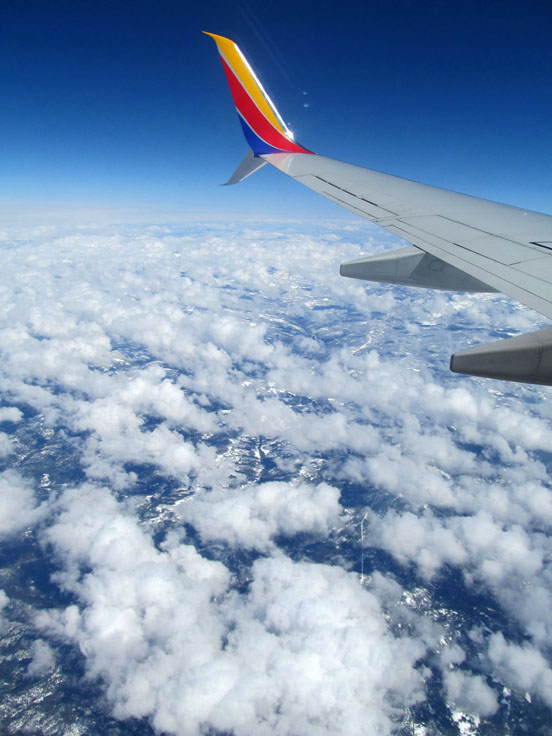
With people canceling or changing their travel plans, most airlines canceled flights. Despite only having thirty passengers, Southwest Airlines demonstrated their mission of customer service by not canceling our flight, or rescheduling all their flights to fly full. Instead, they kept to their schedule, operating at a loss to not inconvenience their passengers. 

The flight crew advised everyone to spread out, and leave plenty of space between themselves and others, in order to inhibit the potential spread of Coronavirus COVID-19. Being among the first to board, my wife and I took a row around a third of the way back. We disinfected out seats and tray tables, and strapped in. 

Despite warnings from government health authorities and the Southwest staff, passengers filled up seats and rows in front, beside, and behind us. Again: the herd mentality. When a family filled up the row directly in front of us, we abandoned our seats, and left our carry-ons where we had stowed them.


The view ahead on our Southwest flight

A little behind the wings, we found a row with no one else close around. We disinfected the seats and tray tables, and got comfortable. By the time boarding had finished, only six others had joined us from the wings back. This left 145 empty seats on the plane, with 22 people clustered up front.


The view behind

On our trips to England, we've visited many popular places, such as Westminster Abbey and Stonehenge. But most of the places we traveled to were places few international travelers go, such as the town of Bideford, where Charles Kingsley set his novel Westward Ho!, and Chagford, a historic stannery town featured in The Tinner's Corpse, a novel in the Crowner John mystery series by Bernard Knight. Some places, such as Cromer, have grown more interesting since our visit. Through my reading, I've accompanied characters on their visits to the seaside town in Tono-Bungay by H. G. Wells, Limitations by E. F. Benson, and So Disdained by Nevil Shute.


No one knows how Coronavirus COVID-19 may alter our world. Times like these make us reflect on our lives, and what really matters. Perhaps we should contemplate how Rick Steeves' observation relates to us. At the very least, it makes sense to adopt easy habits such as cleaning your hands, disinfecting surfaces, and keeping more distance from others than usual. 

Dragon Dave

Related Links
Rick Steeves' Blog

Monday, June 13, 2016

Henry Kingsley on Little Rebellions

This is a book I mentioned in the May Reading Roundup posts. 
Westminster Abbey,
a church directly responsible to the Queen,
and a symbol of England's status
in the spiritual realm.


After reading The Babe by E. F. Benson, in which the character of the Babe finds inspiration and determination in Henry Kingsley's novel Ravenshoe, I decided to indulge my curiosity. I downloaded latter novel as a free eBook onto my Kindle. Then, I began reading it. And reading it. 

And reading it.

Like Westward Ho! by his brother Charles, Ravenshoe is a long, doorstopper of a novel. Or at least it seemed so, while reading it on my small, illuminated screen. The narrator's voice intrudes at times, a little more heavily than I would like. Still, it's an involving novel about life among the various classes of life in England in the mid 19th century. Lovers of Charles Dicken's meditations on the nitty-gritty of life across the vast social spectrum, and devotees of such TV series as Downton Abbey, may find this novel offers another lens though which to gaze back upon an earlier era of British life.

The Ravenshoes have a long family history, going back to 1066, an important time in English history. Throughout all the centuries, they have remained staunchly Catholic. A priest resides on the Ravenshoe family property, where he conducts services in the family church, and instructs the children in their religious education. But in the early 19th century, one man breaks with tradition. He is Densil Ravenshoe, the family heir. After the death of his first wife, he travels through Europe. When he returns, he brings back home a Protestant wife. 

You might wonder why Densil would do such a thing. It's not as if he has decided to renounce his own Catholicism. So why should he make trouble for himself like this? The thing is, that in his youth, he went away to Oxford, and began mixing with a crowd of people who espoused different beliefs and values than his Catholic priest. Although the priest came after him, convinced him to conform to expectations, and return home, Densil obviously resented being asked to tow the line. This, years later, was his act of rebellion. Still, talk about making your life difficult. Not only that, but putting the woman you've fallen in love with into a difficult situation. And all to get back at a priest who had "put him in his place" in his youth.

Thankfully, such an act resides entirely in the land of fiction. I mean, none of us would ever act out in such a way, right?

Dragon Dave

Tuesday, May 31, 2016

E. F. Benson's Reading Tastes

E. F. Benson drew heavily upon the old adage "write what you know." As he attended Cambridge, it makes sense that he would tell a story about undergraduate life there. As he lived, for a time, in Chelsea, it made sense that the Babe would bicycle in nearby Battersea Park. 


102 Oakley Street, Chelsea, London,
a residence of E. F. Benson.

One thing I hadn't realized, until I read The Babe, was how diverse E. F. Benson's reading was. As the Babe spends his evenings out and about in London with his friends, he extolls the virtues of "The Yellow Book", a magazine which rocked contemporary Victorian cultural values. While many of the stories it published were from conservative writers, including H. G. Wells, it nonetheless had a salacious reputation. It is also linked with Oscar Wilde, who suggests that the magazine is a major corrupting influence on the title character in his novel The Picture of Dorian Grey

Once the Babe returns to Cambridge, he throws himself into studying for his tripos. But he takes out time to read Ravenshoe by Henry Kingsley, the brother of Charles Kingsley. Despite his interest in progressive contemporary literature, he apparently adores Henry Kingsley's novel, as E. F. Benson says he already knows it by heart. Meanwhile, his study partner Reggie picks up Gerald Eversley's Friendship, a novel by James E. C. Welldon, who like Charles Kingsley and E. F. Benson's father, rose to prominence in the Church of England. But while Reggie finds his novel depressing, the Babe tells him what he loves about this study of boys boarding at a school named St. Anselms. When Reggie asks for a synopsis, the Babe readily gives it to him. 

When preparing for our vacation in Devon last year, I thought I was out of my mind to plan a trip around a forgotten author like Charles Kingsley. At the time, he seemed to bear no correlation between E. F. Benson, or any of the other English novelists which I knew and loved. But having read Charles Kingsley's novels Yeast, A Problem, and Westward Ho!, as well as Wilde's The Picture of Dorian Grey, it's interesting to read The Babe, and realize how interconnected all these English authors are. While many better remembered authors like Agatha Christie focusing solely upon plot and characters, less remembered authors like Benson and Kingsley tell you so much about the times in which they lived, and the stories that mattered to them.


Often, I think that my reading is too diverse, that I should confine myself to one genre, such as Science Fiction and Fantasy. Then I read E. F. Benson, and I realize that his tastes were as wide as mine. No wonder I enjoy reading him so much.

Dragon Dave

Monday, May 9, 2016

E. F. Benson & Charles Kingsley on Collecting Butterflies

England's Dartmoor National Forest:
A great place to capture Butterflies.

"I hate water except when it’s a hot bath. Water is meant not to drink, but to heat and wash in.”

“Babe, do you mean to say you have hot baths in the morning?”

“Invariably when the weather is cold, and a cigarette, whatever the weather is. I am no Charles Kingsley, though I used to collect butterflies when I was a child.”
--from The Babe by E. F. Benson

Like the title character in The Babe, Georgie in E. F. Benson's novel Mapp And Lucia also likes to collect butterflies. He's a man who is fascinated by everything: every aspect of our world fascinates him, with the possible exception of sex. For him, that's a topic best left undiscussed. Even after he and Lucia marry, in the later books, one gets the feeling that theirs was a sexless marriage. But that's part of Georgie's charm: he's a little boy who never quite got around to growing up.

A search regarding Charles Kingsley and Butterflies sent me to an essay entitled "The Unconscious Naturalist," part of a selection of essays written by Charles Kingsley, another English author who was fascinated about every aspect of our world. Unlike Georgie, he was presumably interested in sex, as Mary St Leger Kingsley, who wrote under the pen name Lucas Malet, succeeded her father in becoming a popular Victorian author. In any event, here's the passage on Butterflies from Charles Kingsley's essay:

At a foreign barrack once, the happiest officer I met, because the most regularly employed, was one who spent his time in collecting butterflies. He knew nothing about them scientifically--not even their names. He took them simply for their wonderful beauty and variety; and in the hope too--in which he was really scientific--that if he carefully kept each form which he saw, his collection might be of use someday to entomologists at home.

Collecting butterflies used to be a hobby practiced by English gentlemen of culture and refinement. They were most like introduced to this hobby during childhood. Growing up in America, in a far from aristocratic family, I remember being instructed in how to collect butterflies. Today, with our concentration on preserving the natural world, you don't hear a lot about collecting butterflies. Instead, we build playgrounds near zoo exhibits, and hope children learn to appreciate animals while they're playing on a lifelike facsimile.

Isn't it ironic how most of us live in cities, spend most of our workdays indoors, spend much of our free time on our computers, laptops, and smart phones, and then preach the virtues of nature conservation to our children? I suppose it's a very different thing to promote capturing and killing any animal or insect as a hobby, when we live in a world of six billion people, versus the quarter of that who lived in Arthur Conan Doyle's time. But does posting photographs of butterflies on Instagram, and sharing videos of Butterflies on Facebook really constitute a superior way to teach children about their world?

Dragon Dave

Wednesday, May 4, 2016

Charles Kingsley & E. F. Benson on the Importance of Bathing: Part 2

The front yard of The Church House Inn
in Charles Kingsley's birthplace of
Holne, England


"I hate water except when it’s a hot bath. Water is meant not to drink, but to heat and wash in.”

“Babe, do you mean to say you have hot baths in the morning?”

“Invariably when the weather is cold, and a cigarette, whatever the weather is. I am no Charles Kingsley, though I used to collect butterflies when I was a child.”
--from The Babe by E. F. Benson


Apparently, the washing that The Babe is referring to in E. F. Benson's novel refers to a character in The Water Babies, a Charles Kingsley novel that I have yet to read. A quick Google search led me to a preview of a book called If Walls Could Talk: An Intimate History of the Home by Lucy Worsley. Here's a short passage from Worsley's book:

The poor little chimney sweep in Charles Kingsley's Victorian children's story The Water Babies learned that he could only go to heaven if he kept himself clean. He needed to "work very hard and wash very hard" before he could be considered worthy.

According to Worsley, Charles Kingsley wrote this at a time in which the public attitude toward bathing was changing. Although it seems odd to us today, the people of Kingsley's day were only beginning to realize that regularly cleaning the body could promote health and prevent illness. Many still felt that bathing was a wasteful use of water, if not downright dangerous, as it could cause people to catch a cold or some more debilitating illness. 

This was the second Charles Kingsley reference that the Babe offers in E. F. Benson's novel, and unlike the first, which I understood, this one I decided to investigate. I'm glad my wife suggested that I read another novel by E. F. Benson, as his stories always bring me such pleasure. The Babe certainly offers a nice change of pace, after immersing myself for so long in Shirley by Charlotte Bronte. 

As with Bronte and Kingsley, Benson liberally peppers his novels with references that I feel compelled to check out, such as the Charles Kingsley association with bathing. As with bathing, researching those references takes time, but leaves me feeling as if I learned something important. Unfortunately, hunting down those references can prove equally dangerous as bathing, as it takes time away from my fiction writing, just like catching a cold, the flu, or some other illness. 

As with anything else is life, E. F. Benson's novels offer a wealth of knowledge and delight. Yet they can also prove dangerous, as my example of research, and writing these two blog posts, has demonstrated. Therefore, I must caution you when approaching any of the Benson's novels: Read with care!

Dragon Dave

Monday, May 2, 2016

Charles Kingsley & E. F. Benson on the Importance of Bathing: Part 1

The Church House Inn in Holne, England,
where Charles Kingsley wrote his 1863 novel
The Water Babies

Recently, my wife suggested that we watch the TV series based on E. F. Benson's novel Mapp & Lucia, and that I should read another E. F. Benson novel. While I'm not sure what prompted this suggestion, I enjoyed watching the TV series again. I also enjoyed reading The Babe, a novel E. F. Benson wrote in 1897. Like his previous novel, Limitations, it affords us a view of undergraduate life at Cambridge University in England. This time, however, Benson's tale is more humorous and colorful. While it's not a perfect comparison, the novel reminded me The Adventures of Verdant Green by Cuthbert M Bede, which takes place at Oxford, England's other great university town.

Just as interesting and quirky as Verdant Green's friends, the title character of The Babe is a celebrated rugby player who drops colorful quotes in casual conversation, and lives a life of easy and comfort while, perhaps, he should be studying. Here's one such quote:

I hate water except when it’s a hot bath. Water is meant not to drink, but to heat and wash in.”

“Babe, do you mean to say you have hot baths in the morning?”

“Invariably when the weather is cold, and a cigarette, whatever the weather is. I am no Charles Kingsley, though I used to collect butterflies when I was a child.”
--from The Babe by E. F. Benson

If you've been following my blog, you'll know that last year's trip to England took me to several places mentioned in Charles Kingsley's 1855 novel Westward Ho! These included Bideford and Clovelly, the latter a town on the coast of Devon where he spent his childhood. My wife and I also visited the tiny village of Holne, located on the outskirts of Dartmoor National Forest, where he was born. There we saw a church with a Charles Kingsley stain glass window, and a rare public house owned by the Church of England. Inside, the bartender kindly showed us the Charles Kingsley room, where the writer reportedly wrote part of his children's novel The Water Babies, and shared with us a little of his affection for the story.

The bartender never mentioned anything about Charles Kingsley's attitudes on bathing, but the tiny room had its own fireplace, and smoke from that fire must have seeped into Kingsley's clothes while he wrote. So perhaps, after a few hours of writing, especially in the winter, he might have felt he needed a bath. But that's what writing, and reading a great story is like. After immersing yourself in another world, you awaken in this one, and realize that you need to do something to enhance your life.

Bathing is a small way you can do that, I suppose. Personally, I much prefer travel, although bathing is cheaper, which means I can do it more often. Still, if I were to total up the cost of each day's hot water...

Dragon Dave

Wednesday, October 14, 2015

Humor & Whimsy in Clovelly


The picturesque English village of Clovelly, along the northwest coast of Devon, is a tourist trap in the best sense of the word. Although they provide a parking lot, and you can park as long as you want for free (Yes, Parking really is totally free!), you then enter a visitor center where you must pay an admission fee. Along with a large gift shop, the visitor center boasts a cafe where you can buy lunch, drinks, or enjoy your afternoon tea. The best part of the visitor's center is a movie room, which is decorated on all sides by human-sized dioramas illustrating all aspects of life in the village. Then the room darkens, and the movie tells you more about Clovelly's past and present.


Upon leaving the visitor center, you walk down the main (Or should I say only?) street of Clovelly. It's a steep descent, and you need to watch your footing on the cobblestones. But at least you don't have to worry about cars, trucks, motorcycles, or even bicycles passing you. Unlike most modern English towns and villages, Clovelly is still ruled by the family that has lived for generations in the nearby manor. They may not be the Cary family, as depicted in Charles Kingsley's novel Westward Ho! But they've decided to preserve the historic appeal of their village by ruling that only humans and animals shall walk the streets (Sorry, the street) of Clovelly.

I wonder how they feel about pogo sticks?


Sleds like this are a common sight. They help shop owners, residents, and donkey's carry items up and down the hill, and help the milk man deliver everyone's daily pint, yogurt, and clotted cream.

Yum, clotted cream...


Of course, that doesn't mean that folks in Clovelly don't get tired of walking up and down that hill. (Especially after having tea and scones with that delicious clotted cream). Visitors likewise revel in making those steep descents and ascents. So local businesses thoughtfully provide visitors with no end of shops offering homemade fudge, ice cream, and all other sorts of goodies. I'm not sure if all that refreshment makes walking easier or more difficult, but it's their attempt to help keep everyone's spirits up. 

In Clovelly, there's no distinction between residents and visitors. It's everyone against the hill. So residents decorate the fronts of their homes with flowers, whimsical displays, and humorous mottos. 


Signs such as these read:
Please: No Singing, No Dancing, No Swearing.
This is a respectable house.


Happiness is being owned by a cat.

I can only please one person per day.
Today's not your day,
and tomorrow doesn't look good either.


After all, complaining just drags every one's spirits down, right? And no one ever wants to get dragged down, especially not in historic, picturesque, clinging-to-the-side-of-the-hill Clovelly.

Dragon Dave

Monday, October 5, 2015

Pursuing Jesuits with Charles Kingsley at Clovelly

In Charles Kingsley's Elizabethan Era novel Westward Ho!, one person Amyas Leigh distrusts is his cousin Eustace. This has less to do with the fact that Eustace and his father are Catholic, than it does with the fact that Eustace often lies to him. One thing that Amyas, his brother Frank, and his friend Will Cary discover is that Eustace is secretly working with the Jesuits. One evening, the brothers follow him, and discover Eustace meeting two Jesuits who have landed in the dead of night along the shores of Clovelly, a village a short ride from Bideford, along the northwest coast of Devon in England.


While Queen Elizabeth allowed her subjects to practice Catholicism, she forbade missionary activity is forbidden. So the Jesuits lie about their names and identities when they sneak into England. They also hide the tracts they have smuggled in. 

Through Amyas' life and adventures, Charles Kingsley links religion with nationalism. The Pope has blessed Spain's efforts to invade England, depose Queen Elizabeth, and forcibly convert all British citizens back to the true faith. Given that, it's not difficult to understand how most English citizens of this era might have viewed their fellow Catholics as disloyal and unpatriotic. 

Tension and fighting between England and Spain will ultimately culminate in the Spanish Armada. Compared to that massive attack on England, the nighttime landing at Clovelly at first seems an entertaining but insignificant event in Kingsley's novel. But the discovery of the Jesuit landing, and the resultant fight, will alter the course of Eustace's life, and by extension, significantly affect Rose's future. Before, he may have wrestled over his love for Rose (Yes, he loves the Rose of Torridge as well) and his yearning to join the Jesuits. The encounter, and resultant fight, force Eustace down a road leading to heartache, treason, and death.


It's easy to walk along this rugged, forested coast, and imagine Amyas, Frank, and Will Cary defending England against a small incursion of tract-carrying Jesuits.


So thick are the trees, bushes, and flowers outside Clovelly that, at times, all sight of the coast and the ocean disappears. Beware the temptation to venture off the path though, or you might find yourself unexpectedly falling into the sea. If that happens, you'd better hope a few of those evangelical Jesuits are trying to beach their little boat along this rugged Devon shoreline. Sometimes, we all need a helping hand, even if that hand belongs to a tract-wielding Jesuit.


Along the coastal walk, one place to stop and rest is this heaven-sent gazebo.


There, beneath angels' wings, you can rest, eat your lunch, and imagine pursuing Jesuits with Amyas, Frank, and Will. 


Or you can follow my wife's lead, and take a moment to sketch some of the beauty surrounding you, amid a landscape little changed since Charles Kingsley wrote Westward Ho! in 1855.

Dragon Dave

Friday, October 2, 2015

Charles Kingsley on Loving the Rose of Torridge

In Charles Kingsley's epic novel Westward Ho!, young Amyas Leigh is drawn to a local beauty named Rose. But he's only a young teen, with so many plans he wants to accomplish. Chief among those is going out to sea. Eventually he becomes a sailor, and the sea faring life turns out to be everything that he had dreamed. Yet every night he stands on watch, or walks the deck of his ship, he stares out across the ocean waves, and up at the starry sky. Always, his thoughts return to Rose. He meditates on her beauty. His admiration for her virtues increases. When he returns to Bideford after his first tour at sea, he has one plan: to win Rose's heart, and marry her.

Where Amyas is burly, strong, and boisterous, his brother Frank is slim, elegant, and refined. Frank has toured Europe, tutoring the children of aristocrats, and even served in the royal court. You could not imagine more dissimilar brothers. You might think that such different people wouldn't get along. Yet when he learns the celebration the townspeople of Bideford are planning to welcome Amyas back from his first tour out at sea, he begs permission to leave the royal court and return home to the family farm outside Bideford.

There, despite all the wealthy beauties he has known in London, he too falls head-over-heels in love with Rose. 


A house on a hill overlooking Bideford

Mrs. Leigh is a quiet, trusting woman, whom both brothers adore. When Amyas and Frank discover that each wishes to win the same woman, suddenly each views the other as an enemy. They take to fighting. Then they notice the pain they are causing their mother. So they decide to sit down and talk the situation through. 

Neither Amyas and Frank wishes to cause the other pain. Yet there is only one Rose, whom they both love! Despite Amyas' wealth of experience, and Frank's impressive education, neither can decide who has the best claim to Rose's affections. So they travel down to Bideford, to discuss the situation with their friends.

There they discover that their friends adore Rose too. They also desire her! Perhaps this should not surprise Amyas and Frank so. Such is her famed beauty, that she has gained a certain celebrity status. She is known as the Rose of Torridge, named after the gleaming waters of the river that passes through Bideford, and gives the town its link to the sea. 


The Rose of Torridge,
A restaurant along the riverfront in Bideford.

It was one thing to debate who had the better claim to Rose's affections, when Amyas and Frank imagined that they were her only two suitors. But as they learn how strongly each of their friends admire her, they realize they can not cause all their friends the pain of losing her. So instead of each insisting upon claiming his own happiness, they form the Society of the Rose, swearing together that none of them shall possess her, until each should, for whatever reason, relinquish his devotion to her.  

It's hard to imagine people making such a sacrifice for their family and friends. Most writers probably wouldn't even attempt to make the reader believe that their protagonists could be so admirable. But then, Westward Ho! is an unusual novel. And Charles Kingsley, a priest who consistently preached and wrote of the need for better living and working conditions among the English poor, seems a very unusual author. 

Dragon Dave

Monday, September 7, 2015

Boatbuilding & Hill Climbing in Appledore


I wasn't sure what to expect when we pulled into the visitor lot in Appledore. Charles Kingsley had mentioned the town in his novel Westward Ho!, but not in any great detail. We could have visited the maritime museum, located conveniently across from the parking lot. But it was mid afternoon when we arrived, and I wanted to see what the town looked like today, versus merely walking around in rooms and perusing displays. 

Not knowing how much there was to see, or how much time to allot for our exploration, we paid for two hours, and started walking.


A few blocks downhill took us to the river. Or rather, where the River Torridge flows when the tide is sufficiently high. We walked along the riverfront, enjoying the views, and stopped in at a little bookstore called Walter's Emporium to peruse the selection. Lots of great books on offer, but nothing I had to have. This was an important consideration, as the interior of my suitcase was not infinite (unlike Doctor Who's TARDIS), and I needed precious space for many must have items such as Wagon Wheels, Clotted Cream Toffees, and boxes of Yorkshire Tea. So we continued our walk along the quay.


In Westward Ho!, Amyas Leigh prepared and provisioned his ship in his home town of Bideford. When he and his crew were ready to take off on their adventure, they sailed down the River Torridge to Appledore. There, amid great celebration, they made their official departure. Shipbuilding still goes here, and I suppose lots of vessels still set sail from Appledore. But obviously, their captains must time the launches for when the tide is well and truly up.


Appledore boasts a picturesque riverfront, with shops, pubs, and vendors to cater to the visitor's needs. But we found ourselves sated with the views across the river.


Across the river lies the picturesque village of Instow, but even if I had brought my drawing kit with me, I lacked sufficient time to complete a drawing. So I contented myself with enjoying the view.

Everyone sees the world differently. Artist Ashley Jackson, for example, finds wind farms not just unnecessary, but also unsightly. Personally, I think they add interest and elegance to the landscape. Perhaps I should draw one sometime, and pour into the artwork all my admiration for these examples of green energy production. 

What do you think? Would someone buy a sketch of a wind farm? Would you?


By the time we reached the end of the riverfront (where, ironically, we found a more conveniently placed carpark offering cheaper rates), my wife and I faced a dilemma. More than half of our two allotted hours had passed. Should we retrace our steps, or attempt to find a shorter route back? Either way would necessitate a walk up a fairly steep hill. In the end, we walked about halfway back along the seafront, then ventured up, up, up a narrow street that promised to take us in the direction we needed to go. And it did, until it dead-ended. So we had to backtrack a little, which meant more walking down and then uphill again. Oh joy! 

Thankfully, we found our way back to the visitor lot, and with a few minutes to spare. 


Believe me, as we walked up (and down, and up) that steep hill, we were rueing the time we had spent exploring that little bookstore in Appledore. But then, there will always be things in life that you simply must do, even if you regret them later. Don't you agree?

Dragon Dave

Friday, August 28, 2015

How We Almost Curtailed Our British Adventure: Part 2

Walking the Long Bridge in Bideford, England

As I said in Part 1, our GPS unit was clearly malfunctioning. Lacking adequate maps, we had to follow the M road in the general direction of Amesbury, our destination for the night. We could only hope that we would reach it before darkness. 

Thankfully, England enjoys long summer days. Far longer, it would seem, than our stores of patience. At least, that is, after a twelve hour plane ride, and a couple hours of sleep.

Although we don't usually use rest areas, we pulled off in one this time. Given our troubles, we headed inside, where we used the restrooms, and asked a salesman in one of the shops for directions. Thankfully, he confirmed that we were following the correct route, and suggested an off ramp that would take us into Amesbury. From there, hopefully we could reach our hotel.

Are you familiar with English rest areas? Many of them resemble strip malls in the United States, and cater to a traveler's every need. In addition to the toilets and a gas station, this one had several fast food establishments, a coffee place, and a bookstore. Although we had never seen one during previous trips, this one had a large atlas, available for five pounds. We opened its pages, and found it gave us just the highly detailed information we desired. While it might not replace the street-by-street directions of a properly-functioning Satellite Navigation System, this old school book seemed like a godsend. We couldn't have been happier as we pulled back onto the M road, and continued our journey. That night, despite the wonky instructions of our GPS unit, we found our hotel. After hauling our suitcases up several staircases, we were finally able to relax in our comfortable room.

Later, we discovered that somehow, perhaps months ago during the planning stages of our trip, as we entered our destinations into the system, it had somehow got switched over to Pedestrian Mode. We switched it back to Driving Mode, and after that, we never had a problem again. In fact, this year's driving was even more pleasurable than before, given that we now had two available means of navigation handy.


Another view from the Long Bridge

Staying home and pretending to travel doesn't force one to face those fears and overcome them. Besides, it's often in navigating your way through any complications life throws into your path that make any journey an experience you treasure later on. Now I can look back on that difficult driving experience and smile. Plus, we've got an additional navigation aid, that will surely come in handy on a future visit to England.

Still, it's taken me awhile until I could write about that experience, which probably gives you an idea of how frustrating and bewildering we found it.

Does travel make a difference in one's life? It's hard to quantify an answer like that. All I know is that being in Bideford, really being in this north Devon town I had read about in Westward Ho!, to which I had already traveled vicariously through Charles Kingsley's eyes, soul, and pen, proved a meaningful experience that could never be enjoyed by the armchair adventurer. I don't know about you, but for me, that's a reason to travel. 

Now if you'll excuse me, I'm going to relax in my comfortable armchair and do a little reading. Right now, being an armchair adventurer sounds really appealing.

Dragon Dave

Wednesday, August 26, 2015

How We Almost Curtailed Our British Adventure: Part 1

The riverfront in Bideford, England

I once corresponded with a couple who never traveled anywhere. Aside from the occasional day trip, they never ventured far from home, and never spent the night elsewhere. They claimed that they could get all the benefits of travel from the comfort of their armchairs, either by watching a TV program, or reading about faraway places in books and online. Their approach saved them the monetary costs, the hassles and exertion, and all the planning that real-world travel demands. 

Needless to say, fears accompany any untried venture. And even with the best of planning, there are things that can go wrong during any trip. As happened during this year's trip to England.

As we pulled out of Heathrow Airport in our rental car, we had trouble following the instructions given by our satellite navigation system. We had bought the unit during our first visit to England, back in 2011, and it was old and out of warranty. Still, we had thought it would be fine for our trip. Instead, it started giving us all these strange instructions. When we missed a turn off, it kept on wanting us to backtrack instead of recalculating an alternate route. In an attempt to turn around, we got on one of the M roads (the British equivalent of freeways in the United States. There it really went wonky, telling us to turn off in places where there was no off ramp. Plus, the M road was full of traffic, which meant that we were headed nowhere, and almost certainly in opposite direction from that night's destination, really fast.

We had never found a good map book or atlas of England on our previous trips. Google Maps had changed the way it operated, so while I had calculated the estimated miles between destinations, I hadn't been able to print detailed directions. This left us to rely on our satellite navigation unit. But even after we got off the M road, and headed in what we believed was the right direction, the system still seemed wonky, telling us to go in a counter-clockwise (instead of the correct clockwise) direction around roundabouts, and turn off the roundabouts using lanes that would have us driving on the right side of the road (instead of the left). 

Somehow, by relying on the faulty unit, we managed to start heading in the right direction. But we were so frustrated by this time that, had my wife suggested we return the rental car, and try to use buses and trains for our journey, I would have agreed. It would have made our vacation much more expensive, and limited our options, but really, what were our options at this point? Could we really reach all the places we desired, without adequate maps, and a GPS system that was clearly malfunctioning?

We thought we had planned adequately for this adventure, but clearly we had not, and lacking an adequate means of navigation, was this what we could expect every day of trip? Does that sound like a vacation to you?

Dragon Dave

Monday, August 17, 2015

A Feeding Frenzy on a Bideford Barge

After enjoying the Burton Art Gallery, and walking the streets of Bideford, I noticed many of the shops were closing up. So we headed back to the car, thinking of stopping off at the local Morrison's supermarket before we headed back to our lodging in Milton Damerel. But I knew it would take us a minimum of an hour to get back, and as we still had plenty of light, I suggested we return to the barge so I could finish my sketch. 

Reclaiming our table from lunch, we enjoyed another alfresco meal. Then I got busy with my drawing. When we had last been here, the old ship next to the barge had been untouched by the water.


Now the River Torridge had surrounded the time-worn vessel in its loving embrace.


It was easy to think of Charles Kingsley's description of the gleaming white houses of Bideford as I worked.


Others no doubt found their surroundings equally inspiring.


After awhile, the cook, who was finishing up his day's labors in the hot kitchen, came on deck and banged a bucket of scraps against the rails. He wanted to attract the attention of the ducks nearby. But if they took note of his signals, they failed to respond. So he dumped his container of scraps overboard.


Needless to say, they did not go to waste. 

Is this what you call a feeding frenzy?

Ultimately, my holiday sketching work ethic overcame even my wife's patience, and so finishing my sketch would have to wait until another day. I worked on it, a little each day, until I was satisfied with it. 


It may not be the greatest achievement of all time, but it reminds me of my visit to Bideford whenever I look at it. And that, far more than any pride in my artistic abilities, makes me smile.

Dragon Dave