Showing posts with label London. Show all posts

Monday, March 22, 2021

Douglas Adams: Mostly About Family

Grantchester, a village outside Cambridge, England

In Douglas Adams' novel Mostly Harmless, the fifth installment in his Hitchhiker's Guide series, the spaceship Arthur Dent is traveling aboard crash-lands on an alien world. Inhabitants of a nearby village accept Arthur, and he discovers that they've never heard of sandwiches. So Arthur assumes the role of Sandwich Maker for his village. This gives him an important role in the community, and he hires an apprentice to keep up with customer demand. 

After Trillian and Zaphod dropped out of the series in book three, we never learned what happened to them in book four. In Mostly Harmless we learn that Trillian has traded in her vagabond status for a career as an interstellar reporter. On her way to covering the next big news story, Trillian stops off on Arthur's adoptive homeworld, and introduces him to their daughter Random. 

As Arthur never had a close relationship with Trillian, you can imagine his surprise at Trillian's bombshell.
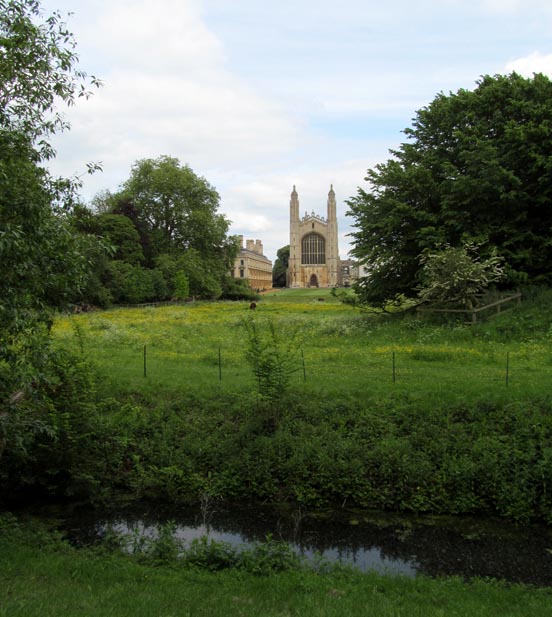
King's College, Cambridge, England


It seems that sometime after both Zaphod and Thor left her, Trillian decided she wanted a daughter. She reached out to the interstellar gene banks for a compatible match. As Arthur had sold his genetic material to travel aboard spaceships in First Class, she was able to get the requisite genetic material from a fellow Earthling. Now she has a daughter she's never has time for, as her interstellar reporting duties prevent her from having a stable homelife. 

During his travels, Arthur had thought he was getting something for nothing. Now, he realizes that, well, there's no such thing as a free lunch. Whether it includes sandwiches or not. 

She may have just arrived, but Trillian doesn't have time to stop and catch up with Arthur. Nor can she be bothered to bring Arthur with her, so they can function as a family while she's covering stories across time and space. Instead, she announces that she's leaving Random with Arthur because, well, she's his daughter too, and he should share in the responsibility of raising Random. One moment Arthur is content, if not completely happy, in his new life as chief sandwich maker for his village. The next, he's a father who must work to connect with a daughter who is a complete stranger to him.

Grantchester Common, Grantchester, England


Random has never had much of a relationship with her mother, as Trillian was always on the go for her job. So she's never really known where she fits in, and doesn't get along with others. How can she be expected to feel love for this man, and honor him as her father? After all, from her perspective, she's never even had much of a mother. 

There's no such thing as a perfect family, and even in the best of times, maintaining healthy family relationships can be difficult. Douglas Adams' parents divorced when he was young, so he knew how difficult it can be to build a happy and nurturing family. He had a complicated relationship with English barrister Jane Belson, whom he married in 1991 after several breakups and a broken engagement. As Mostly Harmless was published the following year, I imagine Adams drew upon his own childhood, as well as his on-again/off-again relationship with Jane Belson, in crafting the complicated dynamics between Arthur, Trillian, and Random in Mostly Harmless.

Dragon Dave 

P.S. Two years after Douglas Adams published Mostly Harmless, his wife Jane gave birth to a daughter.


Monday, March 15, 2021

Douglas Adams: Mostly Trisha


London, England

While Douglas Adams' first four novels in the Hitchhiker's Guide series appeared roughly a year apart, eight years elapsed before the fifth appeared. I'm not sure when I purchased Mostly Harmless, but I'm guessing it was several years following publication. Sadly, the first time I read it, I never really got into the novel. One thing I remembered as I reread it was my initial reaction that the novel was overwritten, featuring scenes that just seem to go on and on...and on.

Mostly Harmless is longer than any of the previous installments in the Hitchhiker's Guide series, and seems concerned that the changes and paradoxes created by people traveling through time. As an interstellar reporter, Trillian zips back and forth through time. If the events she covers get altered by herself or other travelers, and cause history to be rewritten so that the events she covers never actually happened...well, you can see how all of spacetime could become muddled.

Arthur and his girlfriend Fenchurch leave Earth and travel through space together. One day she just...disappears. Arthur never learns why she simply ceased to exist. Apparently, it's a remote--but very real--danger of hyperspace travel. Forlorn, Arthur continues traveling--not as a hitchhiker, but a paid passenger--and sells his genetic material to upgrade to First Class. 


London, England


Meanwhile, Ford Prefect notices that his original expansive entry on Earth is now included in his copy of the electronic travel book at the heart of this series: the Hitchhiker's Guide. After traveling to the guidebook's headquarters, he discovers that the Vogons, who destroyed Earth in the first novel to create a hyperspace bypass, are now in charge. 

In some ways, the change in management has proven beneficial. Under the previous management, secretaries often edited travel correspondents' reports. Thus, his entry covering Earth history, culture, and cuisine was reduced to "Mostly Harmless."*

Sadly, not all change is beneficial. Ford learns this firsthand, when the Vogon management attempts to kill him. Still, at least they merely shoot their weapons at him, rather than subjecting him to their poetry.


Buckingham Palace, London, England


We also met a woman called Trisha, a TV news reporter on Earth (which, remember, isn't supposed to be around, after the Vogons destroyed it in the first book). Trisha once met Zaphod at a party, but turned down his invitation to explore the universe. She has always regretted not going off with him in his spaceship. So when another spaceship lands in London, she makes sure that she is the one to interview the aliens. 

I enjoyed Trisha's journey in Mostly Harmless. We can all relate to regret over paths not taken. Her experiences in the novel are the kind that First Contact chasers dream about. She may have missed out on her first opportunity to travel and experience new things. Still, when that next opportunity came her way, she was ready!

Dragon Dave

*Even after all these decades, I'm still interested in reading the intergalactic guidebook. Perhaps now that the Vogons are in charge, it will soon become available for Earthlings to purchase. Just please, Vogon managers: no poetry!


Monday, March 8, 2021

So Long Douglas Adams, and Thanks for all the Fish

A Road near Holmfirth, England


Douglas Adams' fourth novel in the Hitchhikers Guide to the Galaxy series is the shortest of all, and proved a surprising favorite. I thought it featured some of the best characterizations of any installment in the series, and told a beautiful love story. Like all the best bedtime stories, it begins with a dark and stormy night in England.

In So Long, and Thanks for all the Fish, Arthur Dent returns to England after hitchhiking throughout the galaxy. Unlike the first three novels, in which he was always dragged into an adventure by a character like Ford Prefect or Slartibartfast, he's charting his own course this time. Somehow the Earth exists, even after it was destroyed by the Vogons in book one. As Arthur walks along a highway in the rain, a car stops to pick him up. So now he's hitchhiking on a planet familiar to him, even if it shouldn't exist.

Back in his familiar British surroundings, Arthur falls in love with a troubled soul. Her name is Fenchurch, and she is troubled because she sees things she shouldn't, and exhibits talents her fellow humans do not possess. Arthur is drawn to her, and learns that she has seen visions of Earth's destruction by the Vogons, which somehow, on Earth, or at least this Earth, has not taken place.


In the previous book, Arthur developed a new ability. Or rather, he fell into it. It's a superpower many comic book characters exhibit, and if you haven't read the series recently, I won't spoil it for you. Let's just say that, in pursuing Fenchurch, he discovers that she also has this superpower. Finally, after all his travels, Arthur has found a kindred soul.

In the first three novels Arthur often came off as rather muddle-headed, and unable to grasp the importance of the situation he was thrown into. Zaphod constantly belittled him, Trillian looked down on him, and Ford lost patience with him more than once. Yet here, on this still spinning Earth, he becomes, if not a hero, at least the strong protagonist who always belonged at the heart of this series. 

Holmfirth, England


Events usually loom larger than the characters in Douglas Adams' Hitchhikers Guide series. So after all his travels, In So Long, and Thanks for all the Fish, the way Arthur finally finds the place he can finally call home, and the person with whom he can share it, is what I most remember.

Dragon Dave

P.S. My late friend, Marvel colorist Justin Ponsor, held a deep and abiding love for Douglas Adams. Although he wasn't much of a reader, he surpassed me by reading every book Adams ever wrote. He told me how sad he became, when he reached the last sentence of The Salmon of Doubt, Adams' final unfinished novel, and the words just...stopped. 

At Justin's funeral, his sister referenced his love for Adams' stories, and concluded her talk with "So long Justin, and thanks for all the fish." Apparently, some readers have found in the title of this Douglas Adams novel a humorous way to say good-bye. For the most part, saying good-bye is, I think, a skill I lack. While the Hitchhiker's Guide series seems to end here, apparently Adams couldn't say good-bye to the series either. Thus many years later, he published his final installment, Mostly Harmless.


Monday, May 18, 2020

Driving from London to Brighton with Genevieve


The 1953 movie "Genevieve" starts in the Temple area of London, where Alan, a young barrister, leaves work for that weekend's London To Brighton Veteran Car Run. He goes home to work on a 1904 Darrocq, which has been in his family for decades. While his friend Ambrose, an advertising salesman, has the money to have his 1905 Spyker professionally maintained, Ambrose does all the work on his beloved car.


Any car that arrives at the finish line in Brighton by 4:30 pm wins a medal. Unfortunately, Alan and his wife run into trouble. After performing several repairs en route, they don't arrive in their car Genevieve until much later. 


In 2013, we enjoyed seeing these old cars arriving in Brighton. After seeing how many mechanical problems these historic cars can suffer in the movie, I can understand why many cars that start from London each year don't arrive in Brighton.


Although the rules of the club that sponsors the rally forbid their members from racing, Alan and Ambrose have a falling out, and place a bet on who will return first to London. They wager one hundred pounds on the outcome. Alan and his wife already suffer marital friction because of the time, energy, and money he devotes to Genevieve. His impulsive bet makes this worse, as the young couple only have one hundred-and-twenty-five pounds in the bank.


Alan and Ambrose's bet stipulates that the first car across Westminster Bridge wins. I won't spoil the outcome of the movie for you. But it was interesting to learn that the 1904 Darrocq in "Genevieve" still runs the rally every year. Hopefully, it doesn't suffer as many breakdowns, and finishes the rally more often than not. Perhaps I saw it in 2013, crossing the finish line.

Alan's Darrocq and Ambrose's Spyker can be seen at the Louwman Museum in The Hague. The city is known for the world-famous International Court of Justice. If Alan ever had to travel to The Hague to pursue an important case, I wonder if he would have driven there in Genevieve?

Dragon Dave

Related Links
Genevieve at the Louwman Museum


Wednesday, December 5, 2018

Baroness Emma Orczy: Walking With A True Woman


In the early chapters of Baroness Emma Orczy's 1911 novel A True Woman, Louise Harris and her fiancé Luke de Mountford take a walk through Battersea Park in the Chelsea district of London, England. I can't remember if they actually walk across it, but Orczy mentions nearby Albert Bridge. And why not? It's beautiful! Just be careful if you walk across in a large group. You'll see signs posted reminding your party to break step every now and then. Otherwise, the bridge might collapse, and dump you into the river Thames!

As they stroll through Battersea Park, Luke mentions to Louise that a newfound relative is visiting London. Apparently one of his uncles had a son, and he's visiting London for the first time. The man doesn't seem to want anything more than to connect with his family. But Louise is aghast that Luke hasn't mentioned this man before. If his claims are true, the newcomer will replace Luke as the inheritor of the family fortune.


I can imagine Luke and Louise walking through the placid, tree-lined walkways of Battersea Park. Surrounded by such tranquility, Louise would have contemplated how the possibility that Luke might not inherit his surviving uncle's money would change their future plans. Up until now, Luke has devoted his life to being his uncle's right-hand man, managing all the family's investments and finances. He has no inheritance of his own, no income to fall back on. In this age of gentility, Luke would fall far below Louise's position in society. From society's standpoint, he would have nothing to offer her.

Sadly for Luke and Louise, this is exactly what happens.


Despite scientists' declarations that the fog that used to choke London's streets in a thing of the past, fog as thick as pea soup flows into London a few months later. It swarms around famous landmarks like Picadilly Square, and dampens the enthusiasm of crowds waiting to see the latest plays in the theatre district. Luke, now dispossessed, drives Louise and her father to an embassy party in her father's car. As he's no longer invited to such high society functions, he boards a city bus. After watching from afar for far too long, he has decided to confront his usurper in the man's club. He may no longer control the family finances, but he must convince the man to send their ailing uncle off to Spain for his health.

A few hours later, the usurper is found stabbed through the throat in a horse drawn cab. The cab driver cannot attest to the identity of the person who boarded the cab with the usurper, so thick with the fog. The next morning, Luke's walking stick is found in nearby Green Park. Secreted inside the walking stick is a stiletto knife. The blade has blood on it.

My wife and I walked past Green Park after visiting the Prime Minister's residence back in 2011. I remember a nice flat green expanse of lawn. But it was the evening, and we were hungry, so we didn't have time to explore it. If we had, I suppose we might have found someone's walking stick, and become an integral part of a murder investigation!

Luke is put on trial for his cousin's murder. Despite months of public pressure, Louise has refused to break her engagement to Luke because he lost his fortune. As she loves him, and believes in him, she attends the inquest. During a break in proceedings, they join with the fashionable set by walking the Ladies Mile in Hyde Park.


My wife and I explored Hyde Park in 2013. We saw the Rotten Row, where people rode their horses. E. F. Benson mentions the Rotten Row in several of his novels, such as Dodo, A Detail of a Day and Scarlet And Hyssop. While the Rotten Row stretches across the south area of Hyde Park, the Ladies Mile ran along the North. We had a great time exploring this historic park, along with our fellow walkers, cyclists, and horseback riders.

Thankfully, I wasn't suspected of murder at the time. This made it easier for my wife and I, as we didn't have to ignore everyone around us gossiping about the mountain of evidence against me. But then, my wife is a true woman. Had I been under suspicion, my wife would have stuck by me, just like Louise did with her beloved Luke.

Dragon Dave

Tuesday, May 31, 2016

E. F. Benson's Reading Tastes

E. F. Benson drew heavily upon the old adage "write what you know." As he attended Cambridge, it makes sense that he would tell a story about undergraduate life there. As he lived, for a time, in Chelsea, it made sense that the Babe would bicycle in nearby Battersea Park. 


102 Oakley Street, Chelsea, London,
a residence of E. F. Benson.

One thing I hadn't realized, until I read The Babe, was how diverse E. F. Benson's reading was. As the Babe spends his evenings out and about in London with his friends, he extolls the virtues of "The Yellow Book", a magazine which rocked contemporary Victorian cultural values. While many of the stories it published were from conservative writers, including H. G. Wells, it nonetheless had a salacious reputation. It is also linked with Oscar Wilde, who suggests that the magazine is a major corrupting influence on the title character in his novel The Picture of Dorian Grey. 

Once the Babe returns to Cambridge, he throws himself into studying for his tripos. But he takes out time to read Ravenshoe by Henry Kingsley, the brother of Charles Kingsley. Despite his interest in progressive contemporary literature, he apparently adores Henry Kingsley's novel, as E. F. Benson says he already knows it by heart. Meanwhile, his study partner Reggie picks up Gerald Eversley's Friendship, a novel by James E. C. Welldon, who like Charles Kingsley and E. F. Benson's father, rose to prominence in the Church of England. But while Reggie finds his novel depressing, the Babe tells him what he loves about this study of boys boarding at a school named St. Anselms. When Reggie asks for a synopsis, the Babe readily gives it to him. 

When preparing for our vacation in Devon last year, I thought I was out of my mind to plan a trip around a forgotten author like Charles Kingsley. At the time, he seemed to bear no correlation between E. F. Benson, or any of the other English novelists which I knew and loved. But having read Charles Kingsley's novels Yeast, A Problem, and Westward Ho!, as well as Wilde's The Picture of Dorian Grey, it's interesting to read The Babe, and realize how interconnected all these English authors are. While many better remembered authors like Agatha Christie focusing solely upon plot and characters, less remembered authors like Benson and Kingsley tell you so much about the times in which they lived, and the stories that mattered to them.


Often, I think that my reading is too diverse, that I should confine myself to one genre, such as Science Fiction and Fantasy. Then I read E. F. Benson, and I realize that his tastes were as wide as mine. No wonder I enjoy reading him so much.

Dragon Dave

Monday, May 23, 2016

As Time Goes By in Battersea Park

In E. F. Benson's novel The Babe, the title character complains early in the novel that he often goes against the rules of the university, but none of the Cambridge staff ever punish him. They just shrug, say, "Oh, that's just the Babe," and let him off for his offenses. Later, on his river outing, we learn that he has been punished for several offenses, and is gated, which means that he needs to be back in his rooms by ten pm. So naturally he plans on a long day out on the river, and if he gets back by the expected time, well, that would be fine by him.

Instead, as the boat travels back through darkness, it strikes the edge of the bank, the Babe tumbles into the water, and he returns to the dorms swathed in a tablecloth. 

This is too much for the university leaders, who pack him off early, meaning he doesn't take his exams for that term, and necessitate his taking a tripos (a tougher exam) in the next term. So he goes off to London, where each day he rides his bicycle around Battersea Park each morning, then gets together with his friends each evening, and tells them all how unfairly the university staff has treated him. 

In 2013, my wife and I visited Battersea Park in London. It was a cold, cloudy day in November, and not many people were strolling through the park. I don't remember anyone riding their bicycles through the park, nor were children out playing. But the absence of crowds probably had most to do with school being in session, and people working during the week. (We visited nearby Hyde Park on the weekend, and it was packed). In any case, we had the park to ourselves, and were in no mood to complain.


In an episode of the TV series "As Time Goes By," there's an episode in which Jean and Lionel take a rowboat out on the lake in Battersea Park. As the characters are middle aged, and Lionel is out of practice at rowing, he finds the exercise more difficult than he anticipated, and the rows end up coming out of their stays and falling into the water. This results in the man who rents the boats getting in another boat, and towing them back to shore. Lionel then spends the rest of the day bemoaning his advancing years, and wishing he was younger, so he could share an even longer life together with Jean.

I liked the idea of rowing a boat across the lake, but sadly, the office was closed, and the boats were all put away. So my wife and I had to be content with strolling through the park, and enjoying our solitude together. It was a quiet, peaceful time, in which the only company we got was from the local duck population, who came out in their great numbers to admire our sandwiches, chips, and cookies. So we watched them crowd around us, and enjoyed our time together, even if we wished we could have taken a boat out on the lake. 


Then we left the park, climbed aboard a nice warm bus, and headed off to our next adventure.

Dragon Dave

Wednesday, April 27, 2016

Charlotte Bronte on Horatio Nelson

In Charlotte Bronte's novel Shirley, the title character visits her old family schoolroom. There she talks with her nephew, who seems in low spirits. He's a weak boy, who needs physical assistance to get around. Yet he can't help but notice the tall, handsome men who swirl around Shirley, desirous of gaining her attention. He sees before him a life he can never have. He will never be strong. He will never gallop across the fields on a horse. He will never twirl a beautiful young woman across a dance floor. Hence, he believes he cannot hope to marry well, or gain the affections of a woman who desires a strong, virile husband. When he shares his concerns with Shirley, she reveals how differently she sees the world, and how she finds value in others.

"You need not be sorrowful. Have I not often told you who was almost as little, as pale, as suffering as you, and yet potent as a giant and brave as a lion?"

"Admiral Horatio?" 


"Admiral Horatio, Viscount Nelson, and Duke of Bronte; great at heart as a Titan; gallant and heroic as all the world and age of chivalry; leader of the might of England; commander of her strength on the deep; hurler of her thunder over the flood." 

"A great man. But I am not warlike, Shirley; and yet my mind is so restless I burn day and night—for what I can hardly tell—to be—to do—to suffer, I think." 

"Harry, it is your mind, which is stronger and older than your frame, that troubles you. It is a captive; it lies in physical bondage. But it will work its own redemption yet. Study carefully not only books but the world. You love nature; love her without fear. Be patient—wait the course of time. You will not be a soldier or a sailor, Henry; but if you live you will be—listen to my prophecy—you will be an author, perhaps a poet."

Shirley may not be a great lover of poetry, but she sees her nephew's strengths, and encourages him to achieve his potential. As England is bogged down in the Napoleonic Wars, she points to one of her country's foremost leader: Horatio Nelson. As she points out, he may not boast the most impressive, desirable figure, but people respect his leadership, and are grateful for how he has protected their country. 

Even today, people still look up to this heroic figure. At least they do in London, when they visit Trafalgar Square.


Out of all the great leaders of England, Charlotte Bronte's character Shirley picks out Horatio Nelson as a role model. 


I wonder what could have piqued her interest in the man?

Dragon Dave

Related Posts from Loving To The Manor Born
A Memorial to Horatio Nelson
Horatio Nelson and the Bronte Sisters

Monday, March 7, 2016

A Wealth of Humor & the British Museum

A Greek temple in the British Museum

Last month, I went out to the cinema to see "Zoolander 2." Although it was completely silly, I enjoyed the original "Zoolander," starring comedian Ben Stiller and was really looking forward to the sequel. Unfortunately, like "Night at the Museum 3," which was set in the British Museum, the nonstop gags were so completely over the top that I could never believe in the underlying reality of the story. The movie should have had a lot to make me love it. Like "Night at the Museum 3" and "Paddington," "Zoolander 2" was set in places I would like to visit someday, such as New York City and Rome. Instead, I merely watched it, and laughed with (or at) it.  But I was never into "Zoolander 2." The sequel was just a lot of gags to me. 

Sadly, the movie didn't even make me believe in the places where it was set. After seeing "Zoolander 2," I feel no greater desire to travel to New York City or Rome than I did before. That seems like another missed opportunity for the filmmaker. For even if you don't particularly bond with a character or a story, a TV show or film can often make a viewer want to visit a given location, based on how the place is presented. A person can even fall in love with a TV series or movie they initially disliked, simply because they believe in that particular place, and have come to love it.

Filmmakers set out to make a movie that everyone will want to see, and work hard to cram in as many laughs, or explosions, or dramatic moments as they can. Yet undergirding everything must be a good plot, and believable characters and situations. Sometimes a filmmaker needs to sacrifice a few gags, a few laughs, a lot of visual dazzle, or great dramatic moments in order to tell that story. Otherwise, it's just fake, and falls flat, no matter how much you like the lead actor, or the idea behind the story. 

This becomes especially important when you've got a movie featuring a star comedian, and other big name comedians in secondary roles. Everyone wants to get their jokes, gags, and silliness in the movie. Yet too much humor can stop a plot cold, and knock the viewer out of the story, as proved the case, at least for me, in "Zoolander 2."

If a filmmaker can restrain himself (or herself), and cut out everything that's good that doesn't service the story, he has a chance of doing what "Paddington" did for me: draw me into a live-action story centered entirely around an animated bear who can walk, talk, eat marmalade, illegally emigrate from Peru to England, fight off a malicious taxidermist, and find an adoptive home there. If he can do that, he can probably do one more thing that "Night at the Museum 3" and "Zoolander 2" failed to do: make me want to see the place where the film was set, such as London's Natural History Museum in "Paddington."

Do you agree with me? Have you ever found yourself re-watching a TV series or movie in which you didn't like the characters or the story because you found the place where it was set appealing?

Dragon Dave

Friday, March 4, 2016

Night at the British Museum

An Egyptian bust in the British Museum


Last year, I saw "Night at the Museum 3" in the cinema. I had looked forward to seeing the movie, as the story was set in the British Museum, which I had visited a few months previous. While the production featured a scene in the iconic atrium of the British Museum, most of the museum interiors looked completely different, as did the nature of the exhibits on display. I can only conclude the producers set the film in the British Museum for two reasons: 1) because the British Museum equates with England in viewers' minds, and 2) so they could make a statue of King Arthur come alive. 

Had I not visited the museum previously, I suspect I would have dismissed the movie as harmless fun, fueled by a passable reason for a plot, and lots of gags. Instead, it seemed odd to me that the filmmakers didn't make a movie about what's actually in the British Museum. The museum features a wealth of history which they could have built on to make a gripping, and funny movie. Instead, "Night at the Museum 3" seemed fake, unreal. It's not as if I wished to find fault with the movie. I love Ben Stiller movies. I've enjoyed most of the Ben Stiller movies I've seen. But as I watched that day in the cinema, I simply could not suspend my disbelief. 

Thus, the movie was something occasionally laughed at (or with). But it was never something I was into. But then, I suppose I should have been prepared for that, for while I had thoroughly enjoyed the original movie, the second left me dissatisfied.


Like "Night at the Museum 3," the movie "Paddington," based on the character and book series written and created by Michael Bond, was set in London. As with "Night at the Museum 3," part of the action takes place in a famous London museum. In the case of "Paddington, key scenes take place in the Natural History Museum. I've never visited the Natural History Museum, so I cannot say how much of the movie was filmed there. What I can tell you is that, unlike "Night at the Museum 3," I found "Paddington" completely gripping. It picked me up and took me along for the ride. I wasn't just watching it, I was into it. It remains one of my three favorite films released in the past two years.

What are your favorite films of the past two years? Do any of them feature destinations you would like to visit? Or are they special because you've already traveled there, and the places hold special memories for you?

Dragon Dave

Wednesday, March 2, 2016

Neil Gaiman & the British Museum

The iconic atrium of the British Museum

On our first visit to England, my wife and I walked around London, stopping at all the places on that day's itinerary. In the afternoon, and after getting lost (and getting directions), we finally arrived at the British Museum. Then a strange thing happened. We realized we had other places we wanted to see more, and only so much more time remained to us that day. So we got no farther inside than the iconic atrium before we turned around and headed off.

Later, while reading the novel Neverwhere by Neil Gaiman, I came to regret that decision. Although his fantasy takes place mostly within the London Underground, a few scenes featured his characters into the British Museum. That reminded me of our abortive attempt to see the museum. Thus, when we planned our next trip to England in 2013, we made sure we set out a day for the British Museum.

I can't say that subsequent visit brought the novel to life more vividly for me, or made the story more important to me. I cannot tell you why the novel made me feel like I needed to visit the British Museum in the first place. It's not as if I'm particularly a museum lover. I visit museums rarely, if ever, at home. All I can tell you is that, while a fantasy, Neil Gaiman's novel became real enough, and important enough, to make me want to see this particular museum. 

Most of us live where we want to live because we like where we live. We've chosen to be there. Yet sometimes, a particular story becomes so important to us that it pulls us to a place we would never otherwise visit. How does that happen? How does an author weave such magic? 

Where have your favorite stories taken you?

Dragon Dave


Monday, February 1, 2016

Pride And Prejudice And H G Wells: Part 2

In H. G. Wells' novel, Love and Mr Lewisham, our protagonist unexpectedly reunites with Miss Henderson in London. Although Mr Lewisham is still smarting from the blows to his academic hopes, he has landed in a school for science teachers. While his prospects have fallen, he still holds high hopes for the future. Yet he finds himself as deeply attracted to her as before. While she begs him not to pursue her, he cannot restrain himself. She eventually relents, and lets him into her life. They spend their dates walking along the streets of London, or enjoying the parks. 


Mr Lewisham and Miss Henderson wandered along
the Serpentine arm-in-arm, over sixty years before
WOTAN took over the Post Office tower
in the Doctor Who story "The War Machines."

As their romance builds, his scholastic endeavors suffer. Eventually he gives in to his feelings and marries her. What little money he has saved quickly slips from his bank account. 

Of all his early novels, H. G. Wells reputedly worked hardest on Love and Mr Lewisham. He wished to tackle a serious subject, and he touches upon some notable social trends in England at the turn of the twentieth century. Despite Mr Lewisham's academic capabilities, one wonders if he could have achieved the goals he sought, without money and family to properly back him. His rejection of religion, and his steadfast belief in the superiority of science and socialism to guide mankind surprise him by acting more as impediments to his career than the pluses he had anticipated. Yet Mr Lewisham and Miss Henderson clearly love each other, despite never having been properly introduced. They thrill to the fact that they have found each other, even if, in doing so, they have violated society's expectations. 

As he demonstrated in his classic science fiction novels, H. G. Wells clearly had his eyes on the power of science and socialism to transform the world for the better. Yet I can't help but think that, like Mr Darcy, H. G. Wells felt society needed to be ordered and regulated by properly appointed gatekeepers, who would moderate social interaction between young people. Mr Lewisham and Miss Henderson might have waited forever to be properly introduced by people such as the master of his school, or her relations. Had Mr Lewisham honored the social contract, he might have entered and graduated from the universities and programs to which he had sought admittance. Even if he had ended up at the school for science teachers in London, he could easily have fallen in love and married Miss Heydinger, one of the female students there who admired him, and shared his interests in promoting science and socialism. 


After he fails to graduate,
Mr Lewishaw confesses that he is secretly married,
and says good-bye to Miss Heydinger,
on a quiet bench in Battersea Park.

His pursuit of Miss Henderson cost Mr Lewisham a respectable academic future. Consequently, he lost any hopes of earning more than a pittance for the rest of his life. Still, like Mr Darcy in Pride And Prejudice, who won Elizabeth Bennett's hand after rescuing her family from disgrace, Mr Lewisham earned his wife's enduring love. I have little doubt that, if you approached Mr Darcy or Mr Lewisham, and questioned either on this topic, both would tell you that the adoration of a faithful wife is one of the most precious treasures a man can possess.

That is, at least in Mr Darcy's case, assuming that you and he had previously been properly introduced.

Dragon Dave  

Wednesday, January 27, 2016

Pride And Prejudice And H G Wells: Part 1

In his novel Love and Mr Lewisham, H. G. Wells introduces us to a young teacher at a boy's elementary school in rural England. Mr. Lewisham holds great academic aspirations, but he is poor, with no family or friends to support him. Although he earns forty pounds a year, he must pay thirty on room and board to his landlady. So every hour he is not at school, he sits in his tiny attic room, at a small desk made of boxes, and studies. 

Perhaps Mr Lewisham studies too hard. For one day he catches sight of Miss Henderson, a young woman who is visiting some relatives. Her beauty shines like the rays of the afternoon sun upon the coldness of his isolated existence. Suddenly he loses interest in studying. All he wants to do is be with her.

A chance meeting with Miss Henderson in the country lane only deepens his ardor. When the head of the school sees them together, he reprimands Mr. Lewisham. But the young man refuses to take his cues from the older school master. Although it is never stated, Mr. Lewisham knows he should never have spoken to Miss Henderson, or walked along beside her in the country lane, as they have yet to be properly introduced by her family or his academic superiors. 

Unable to control his passion, Mr Lewisham later refuses to take over a class for another teacher. This is because the headmaster wishes to take along another teacher, to a party being given by Miss Henderson's relatives. What if his colleague and Miss Henderson fell in love? Knowing her schedule, Mr Lewisham uses his free time that afternoon to meet with Miss Henderson again. When he realizes that she returns his affection, he convinces her to spend the rest of the afternoon together. Consequently, she doesn't return to the house by the time she promised, and misses the party. Likewise, he fails to oversee a scheduled class later that afternoon. Although they merely talk and walk through the surrounding farmland, and have tea in a nearby village, when they return that evening, Mr Lewisham and Miss Henderson find their reputations are in tatters. 


Taking tea with my wife,
in a cafe along the Serpentine in London,
while under the careful supervision of the Daleks.

Miss Henderson is looked down upon by all the other women in the village. They see her as a fast woman, someone of low morals. Her relatives confine her to their house after that, and never let her out of sight when they go out. Meanwhile, Mr. Lewisham finds the head of the school unwilling to forgive his absence that afternoon. Without his superior's recommendation, his applications to the universities, and the prestigious programs he hoped to enter, come back rejected.

In Jane Austen's novel Pride And Prejudice, self-important clergyman Mr Collins insists upon speaking to Mr Darcy at a ball. As Mr Collins holds close ties to Lady Catherine de Borough, Mr. Darcy's aunt, he feels sure of a warm welcome. Instead, Mr Darcy feels affronted, and rebuffs Mr Collins' attempts at conversation. While Mr Darcy might have spoken more kindly with Mr Collins, and even tolerated a little of the vicar's prattle, he is conscious that they have yet to be properly introduced. Under those circumstances, Mr Darcy feels it would be improper to speak with Mr Collins.

What do you think? Would society function more smoothly, and people get along more peacefully, if you and I refrained from speaking to people we had not yet been introduced to by our family and civic superiors? Or is that just a meaningless aspect of society that we have, quite rightly, dispensed with?

One thing's for sure. Had Jane Austen and H. G. Wells had access to the Internet, Facebook and Twitter would have functioned far differently than they do today.

Dragon Dave

Monday, August 31, 2015

The Screech Owls in Hyde Park

While I enjoyed Westward Ho! immensely, I'll admit that Charles Kingsley's erudite and verbose prose did leave me somewhat fatigued. Thus, for my next reading adventure, I went in search of a novel just as entertaining, but shorter and less demanding than Amyas Leigh's incredible journey. 


Attack on the Tower of London suited my needs perfectly. I've never read any of Roy MacGregor's stories, or for that matter any of the other novels in the Screech Owls series, but Roy's easy reading prose, simple character introductions, and his way of introducing the current story got me instantly involved. I particularly enjoyed meeting Travis, the captain of the children's Ice Hockey team, as the team flew on their Air Canada plane to London. 

It seems that sports officials in London are trying to rouse interest in an inline skating hockey championship. To found a league in their own country, they select a team from children in England, then announce an international competition. Any team from another country can be selected, and their trip will be completed paid for. Although the Screech Owls have never formally played hockey on inline skates, they all ride them for fun, and play impromptu inline street-hockey games in their off time. They also know that their coach, who would have gone on to a career in the National Hockey League had he not suffered a debilitating injury, loves English history. So the team members send in several entries, each time stating why (in a slightly different way, and in fifty words or less), they believe they are worthy of being chosen. Who wouldn't fall in love with a bunch of 12 and 13 year old kids who like their coach so much that they want to give him that kind of experience?

Additionally, the competition takes place the week after Halloween, which is the same week my wife and I stayed in London back in 2013.

Much of the critical action in the novel takes place in the Tower of London, which despite having made two visits to that city, I have yet to see. But one location the Screech Owls visit I could relate to, and that is Hyde Park. This large park, with the adjacent Kensington Park, serves as a huge green area in the center of this densely populated urban environment. On our visit in 2013, we walked through the two parks, watching all the leaves changing color on the trees, the meticulously groomed flower beds, the swans and birds swimming on the Serpentine (a river), and all the people out walking, chatting, playing, boating, or riding horses. Naturally, it rained on us, so we ducked into a little restaurant for a cup of tea and a bun, but then the rain went away, and everyone, including us, emerged, and the parks once more filled with people.


Unlike us, the Screech Owls enjoy good weather during their stay in England's capital. The competition organizers set up a rink in Hyde park, and as the Screech Owls arrive, their competition, the Young Lions of Wembley, are already warming up. 

It was a lovely day, the sun shining and the light breeze plucking the odd dead leaf from the trees and sending it spinning down. There were so few leaves on the ground, however, that Travis wondered if they had sweepers hiding behind the big trunks waiting for one to land so they could race out and be off with it before anyone noticed. He had never seen such a beautifully kept park.

I agree with you, Travis. Hyde Park (along with Kensington Park), is a beautiful place to be. Even in November, when it's cold out.

To the memory of
Queen Caroline
wife of George II
for whom
the Long Water
and the Serpentine
were created
between
1727 - 1731


Although Roy MacGregor wrote Attack on the Tower of London for children, I enjoyed accompanying Travis and his friends on their British adventure. From skimming the titles in the series, it looks like the Screech Owls' adventures take them to interesting places in their native Canada, several states in the U.S., and at least one European country. So, all in all, I don't think I'd object too strongly to reading another book in the series. Or for that matter, any other book in the series. But then, that's the magic of a well told story: it appeals to all children, regardless of sex, race, culture, or age.

Dragon Dave

Wednesday, June 3, 2015

Oh, The Places We've Seen: Part 4

Sadly, this year's trip to England will skirt the wonderful, bustling city of London, one of the great metropolises of the world. (In case you're interested, on the day we arrive in Heathrow, instead of taking the underground to London, we'll be driving our rental car in the opposite direction, toward the historic rock formation of Stonehenge). So I thought I'd reminisce with this series of posts about some of the great places we've visited on our previous trips to England, and in this post I continue from Part 3, still concentrating on the city of London.


On the day we cruised the River Thames, we boarded the river taxi from a dock located directly across from Millbank Tower. Tony Blair rented this building, for two years, to house the Labour Party, and it was from here that he launched the victorious 1997 campaign that swept the Labour Party into power. 


As the former Prime Minister said in his memoir, A Journey, the party had been out of power so long that it had to learn how to rule again, instead of just criticizing everything the majority party (the Conservatives) did. Had Jean Price, the protagonist in the TV series "No Job for a Lady," been an MP during that time, she would have found her day-to-day mode of operating changed considerably. 


It's a real shame they didn't film a sequel series, like they did with "Yes, Prime Minister." While Tony Blair accomplished much during his ten years in Number 10 Downing Street, his failure to orchestrate the return of such an educational and entertaining sitcom (or Britcom) remains a regrettable blot upon an otherwise enviable record. 

Millbank Tower also holds an important place in Doctor Who. While it features in no Dalek stories (at least none of which I am aware), it served as the headquarters of Tobias Vaughn, who uses the might of his company International Electromatics to help the Cybermen take over the world in "The Invasion." Later, it housed the World Energy Conference, which a strange alien race hopes to disrupt in "Terror of the Zygons." In order to achieve this, they send a dreaded Scarasen, better known as the Loch Ness monster, to attack the building.


Thankfully, the Doctor manages to outwit the Zygons, thereby saving Millbank Tower, and allowing this important conference to continue. But then, what else would you expect from such a wise and able Timelord?

Dragon Dave

Related Dragon Cache entries
The Dreaded Scarasen of the River Thames

Related Internet Links
Watch the trailer for "No Job for a Lady"
Watch "Terror of the Zygons: Part 1"
Watch "The Invasion: Part 1" (Note: this is a reconstruction of a missing episode using still photos and short film sequences. If you buy the DVD, you can see an animated version of this episode).