Showing posts with label Julius Caesar. Show all posts

Tuesday, September 9, 2025

Caesar’s Spy Vol 1 Review


Writer: Jean-Pierre Pécau

Artist & Colorist: Max Von Fafner

Translator: Marc Bourbon-Crook

Letterer: Lauren Bowes

Publisher: Titan Comics

Hardcover Price: $24.99

Release Date: September 23, 2025


Davico Sanian and her people are returning home. But before they reach it, Germanic bandits ambush them. Confusion erupts within the melee, as a stranger wades into the fray and slays the attackers. Davico Sanian, the daughter of the Helvetti chieftain, thanks their savior. When Sanian invites the stranger to their village, he comes along. Who is Sanian’s benefactor? And how will he affect her life? Let's grab our swords and maces, leap into Caesar’s Spy Vol 1, and see!


Story

The newcomer calls himself Coax. He is a Gaul who worships Sol Invictus. Irika worries about Sanian’s fascination with the newcomer. His name means Crow, he worships a popular Roman god, and he speaks Latin in his sleep. But like Sanian, the chieftain welcomes Coax warmly and invites the Gaul to live with them.


Coax brings dire news. Those Germanic thugs who attacked Sanian are only a foretaste of the future. The Germanic clans are gathering. By winter’s end, he believes they will invade and wipe out the Helvetii. But Coax has some pull with the Romans. If he speaks to them, perhaps they will agree to let the Helvetii pass through their lands and find a safe place to resettle.


As Jean-Pierre Pécau follows Coax's life, he also provides glimpses of Coax's past. Coax may not have been rich or powerful. Yet despite their awkward introduction, Julius Caesar saw potential in Coax. Caesar didn't have to help the powerless Gaul. But he senses Coax's potential in Caesar's Spy Vol 1. So Caesar made a pact with Coax, and the former slave, gladiator, and pirate swore his loyalty to him.


Julius Caesar saw past differences in wealth and status. He knew how to win the loyalty of his soldiers and maintain an effective fighting force. By discovering what made Coax tick, Caesar found a powerful servant who would do extraordinary things for him. As Cicero tells Pompey at his villa, if Julius Caesar wins, the Republic dies. People like Coax helped him do that.


Art

Sanian’s plaited blonde hair and sculpted body radiate divine beauty. She sleeps in a rough wooden cabin softened by furs. Unlike Irika, who paints her face and twists antlers into a headdress, Sanian seems comfortable in her golden skin. Her smooth features resemble the masks that symbolize the theatre, and doubtless influence her followers.


By contrast, Coax is rough and imperfect. He exudes strength, yet his densely muscled body lacks symmetry and refinement. Coax frames his face with long, wild hair in Caesar's Spy Vol 1. His exuberant mustache is likewise untamed. The Gaul protects his shoulders and forearms, wears an animal’s head on his shoulder, and sports a cape. A gladius and a mace hang from his belt.


As Coax confronts allies, participates in a religious ceremony, investigates conspiracies, meets with famous historical figures, and assists in Caesar's slaughters, Max Von Fafner compares the well-equipped legionnaires with the tribal armies. From slave markets to the gladiatorial ring, sailing vessels and boats crewed by ranks of rowers, Coax’s journeys take him across Roman-controlled lands. Like Samian, Julius Caesar's sculpted features and blonde hair seem too perfect for this world in Caesar's Spy Vol 1. But then, both seek positions of power, while Coax is content to serve.


Lauren Bowes places black uppercase letters in white boxes. Off-camera dialogue inhabits boxes without arrows. The font imbues the dialogue with a hand-written look, while the size varies from small to large in this story about power and vengeance. Thanks to Titan Comics for providing a review copy.


Final Thoughts

The Romans captured Coax’s parents amid Spartacus’ revolt. The young Gaul watched as the Romans crucified them. Yet Coax eventually partners with Julius Caesar to conquer the Gauls. While serving his leader behind the scenes, Coax makes powerful enemies who will incite civil war. Caesar’s Spy Vol 1 shows how Julius Caesar used people like Coax to navigate the intrigues and shifting alliances that helped the Roman Republic function, until Caesar used military power and popularity to transform it into an empire.


Rating: 9/10

To look inside see my preview of Caesar's Spy Vol 1.

Thursday, April 26, 2012

Addicted to a Good Book

I’ll admit that I’m a compulsive reader.  Somehow, I just can’t control myself.  A whim will strike me so powerfully that I cave in.  Perhaps it’s a book I read long ago and, suddenly, I realize I must read it again.  Maybe it’s a book I bought several years ago, but somehow it never got placed in the stack by my bed.  Or perhaps it’s one I’ve just purchased or received as a gift, and it just can’t wait!  In any case, I’ll open this particular book that two minutes ago I didn’t have to read, immerse myself for a chapter or two, and then awaken to the fact that it will now have to compete with all the other great stuff I’m enjoying.  

Take, for example, my current bedside stack.  I’ve loved the Lovejoy TV series for twenty years.  Now I’m digging the Jonathan Gash novels that launched it.  Even though I’m reading out of order, my wife bought me the latest installment, Faces in the Pool, and I had to honor her gift, right?  Then there’s Dune, perhaps my favorite novel of all time.  For nearly thirty years, I’ve been intrigued by aspects of the backstory that Frank Herbert built his novel upon.  Although I bought it several years ago, I’m finally reading The Butlerian Jihad by his son Brian Herbert and cowriter Kevin J. Anderson.  Enough, you say?  Perhaps it should be, but it’s not.  We’re planning our next trip to England, this time to Yorkshire, so I’m working my way through the James Herriot books.  Currently, I’m enjoying All Things Wise and Wonderful.  

Then there are the books I’ve temporarily taken a break from.  Plutarch’s Lives and The Conquest of Gaul by Julius Caesar currently head that list.  I recently finished Dinosaur Summer by Greg Bear, and I enjoyed it so much that I had to start in on one of those old Tor Doubles that have sat in my bookshelf for...awhile.  It contains his novella “Hardfought,” as well as a story by Timothy Zahn.  It's good, just too complex for me right now.  After hearing Neil Gaiman’s Guest of Honor interview at World Fantasy last year, I figured I should check out the series of comics that put him on the literary map.  So I read the first part of the compilation The Sandman: Preludes and Nocturnes.  Last, but certainly not least, there’s The Stars in Shroud by Dr. Gregory Benford.  Although I delved so deeply into the novel last year for this blog, there are still a few aspects of it that I’d like to understand better. 

Every evening, before I pluck one of the above from my stack, I usually read a few pages of something to my wife before we go to sleep.  I think I must have missed my vocation.  With the way my voice seems to make her drift off, I should have become a priest.  Right now, we’re working our way through the Robert Silverberg story “Born with the Dead.”  

As I’ve documented in earlier entries, Steven Brust’s novel Teckla recently shoved its way into my stack, and that’s bad, because his stories tend to make me want to abandon all else until I finish them.  Yet, as I’m primarily using his fiction each morning to spur on my writing efforts, I don’t want to finish that novel too quickly, and end up opening another of his novels, and then another, until I’ve worked my way through the series.  As much as I love his writing, I don’t want to be too heavily influenced by his individual style.  As an author, I want to develop my own writing style (whatever that ends up being), not merely imitate his.  

There’s one, final, practical consideration.  Too much Vlad, or any other Brust novel, will distance me from the other novels in the stack, making them more difficult to read and finish.  My love of reading drew me to writing.  Why then must my reading time be so limited?  Why can’t I read everything I want to read, when I want to read it?  Well?

Okay, okay, okay!  Maybe I’ll read just one more chapter of Teckla today.

Related Dragon Cache entries

Friday, March 30, 2012

Actors, Heroes, and Ambition

Disney’s “John Carter” delighted me by reuniting Julius Caesar with Mark Antony.  Or at least it reunited Ciaran Hinds and James Purefoy, who played the two great historical figures in the HBO series “Rome.”  While I typically identify more with the screenwriters or the directors, sometimes an actor seems to really rise above his material and become the character he plays.  Previous to watching the show, Julius Caesar and Mark Antony had been little more than names from the history books: my initial attraction to the series came from the gladiatorial action and world-building of Ridley Scott in his movie “Gladiator.”  But these two actors portrayed their characters so vividly that I wanted to know more about these long-dead heroes that Hinds and Purefoy resurrected on my TV screen.  I especially fell under the allure of Julius Caesar.  As mentioned earlier, I read more about his life, and Rome in general, educating myself about the man who used any and all means at his disposal until he turned Roman society and tradition on its head, with him resting comfortably atop the transformed government.

Screenwriters often compress stories, bringing certain characters to the forefront while eliminating others.  In Disney’s new film “John Carter,” Ciaran Hinds plays Tardos Mors, the Jeddak or ruler of Helium, and the father of Dejah Thoris.  (In Edgar Rice Burrough’s novel, A Princess of Mars, Tardos Mors is her grandfather).  While his role is important, we only meet him at the end of the novel, after John Carter and his forces have destroyed the forces of Zodanga.  In the movie, Tardos Mors (Ciaran Hinds) rises to the forefront as a major character, and in a relationship eerily similar to Rome, is ably assisted by his right-hand man, Kantos Kan (James Purefoy), a Padwar (or Lieutenant) in Helium’s Navy.  In the novel, Kantos Kan plays a much larger role.  When John Carter is captured by a rival group of Tharks, he meets Kantos Kan in prison, and the two become friends.  They fight together in the arena, and after a long day of battle in which they kill off all their attackers, the two concoct a subterfuge so that one is released, while the other feigns death, and escapes the Tharks during the night.  Later, John meets Kantos Kan in Zodanga, where the Padwar has talked his way an important position in order to find and free Dejah Thoris, who has been captured by the city’s leader.  Without Kantos Kan’s help, John Carter would never have rescued Dejah Thoris, united all the rival Thark clans, and freed Helium from Zodangan forces.

Since watching “Rome,” I’ve enjoyed watching Ciaran’s acting in films like “Road to Perdition,” “Miss Pettigrew Lives for a Day,” “Miami Vice,” and the last two Harry Potter films.  James Purefoy’s work I’ve seen less of: his most memorable role for me came when he played opposite the incomparable Jeremy Brett in the Sherlock Holmes episode “The Boscombe Valley Mystery.”  (In a Wikipedia article, it’s suggested that he might have played James Bond in “Goldeneye,” had Pierce Brosnan not won the role).  In the second series of “Rome,” Mark Antony takes on more of the limelight after the murder of Julius Caesar.  While a great man, it soon becomes obvious that he lacks whatever it was that made Caesar so spectacular.  He gradually falls in power and stature as Octavian (later Augustus) rises.  I felt at the time that Caesar’s absence left a gap that could not be filled, and consequently didn’t enjoy Season Two as much as the first.  But part of what made Caesar so special to me was the fierce loyalty he inspired in his men.  Without Mark Antony’s unswerving devotion, would I have fallen so heavily under the spell of Julius Caesar?

My favorite story about Julius Caesar comes not from the TV show, but from the historian Plutarch.  Caesar had already accomplished remarkable deeds, had risen to positions of power in Rome, and won the love of the common people.  While working in Spain, Caesar was reading a history of Alexander the Great when he broke into tears.  His friends asked him what was wrong.  “Do you not think it cause for grief that Alexander at my age was already king of so many nations, and I as yet have accomplished nothing remarkable?”  

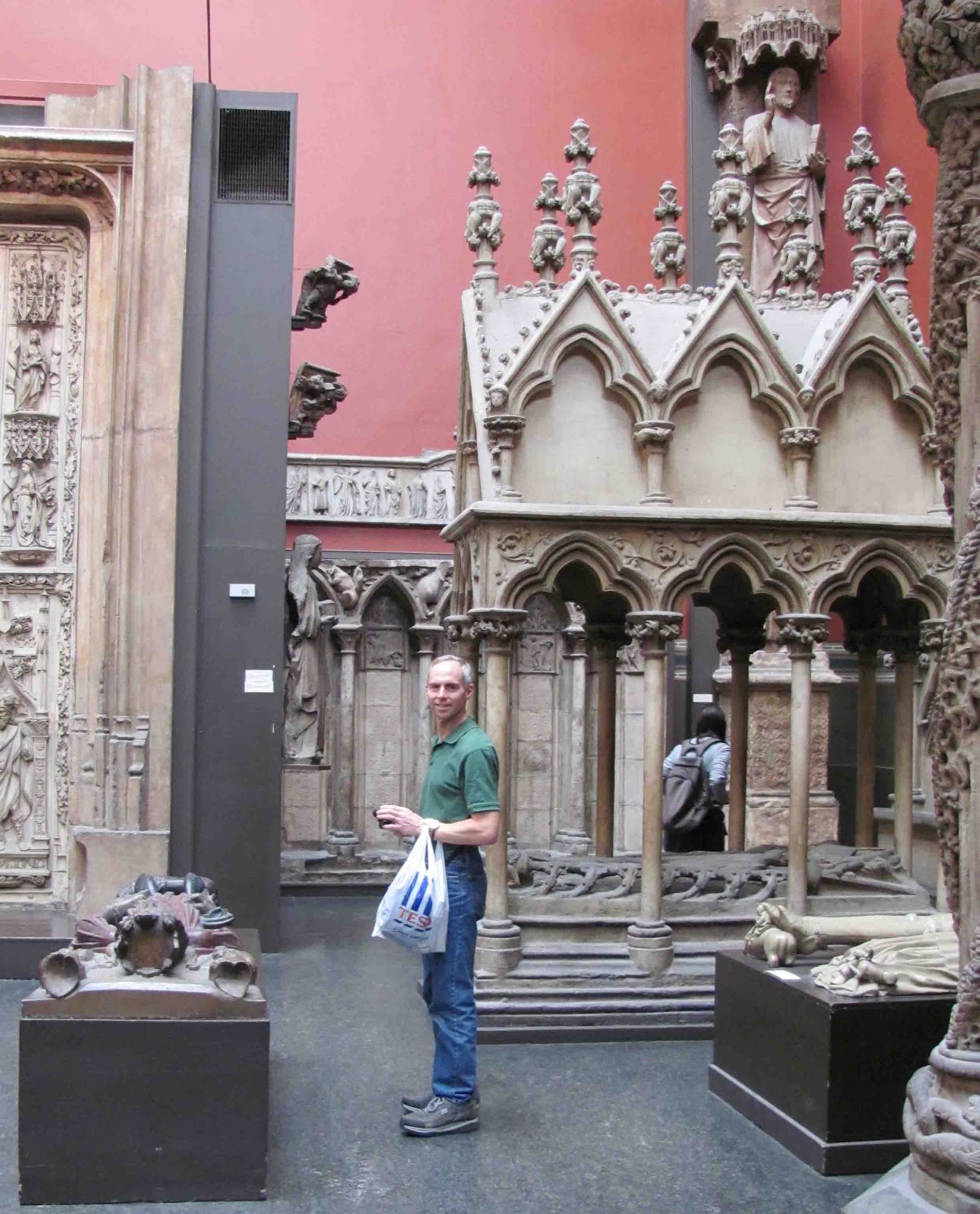
Dwarfed by other's achievements
in London's V&A Museum

This is often the way I feel: my accomplishments, what few I can call my own, feel as nothing compared with those of my heroes.  Yet perhaps part of the reason for my current lack-of-success is due to how highly I regard authors like Edgar Rice Burroughs, Gregory Benford, Robert Silverberg, and Kevin J. Anderson.  I look at what they’ve achieved, and I say, “I could never do all that.  If I could only accomplish half of what they’ve done, or even a quarter, I’d be satisfied.”  What’s becoming clear to me is that, like Julius Caesar and Mark Antony, my literary heroes have never been satisfied.  They work until they drop, always reach for the next rung of the ladder, and always strive to top their previous achievements.  

Perhaps, in order to achieve the success I desire, I must adopt such an attitude.  Part of me argues that if I do so, I’ll have to give up any sense of satisfaction with what I eventually achieve.  I don’t know how to respond to that argument.  All I know is that I’m not satisfied with where I’m at now.  For too long I’ve aimed to be lesser.  Perhaps it’s time to strive to become something infinitely greater.

Related Dragon Cache entries

Related Internet links