Showing posts with label Brian Michael Bendis. Show all posts

Monday, August 24, 2015

Understanding The Fantastic Four: Part 3

"Better run, T-Rex. It's clobbering time!"

The Ultimate Fantastic Four comic book series championed the brilliance and idealism of youth. It proved popular with fans, lasting for 60 issues, far longer than most Marvel comic book series endure these days. And ultimately, it served as a basis for this year's new Fantastic Four movie. The only question is: will anyone bother to see it?

Hollywood can be a strange place for a writer to navigate. Stories, or properties, are bought and sold, and most often not made into films or TV series. But whether these stories get made or don't get made, whether contracts are fulfilled or expire, buying rights to stories back, once they've been sold, can be a tricky business, argued out over years or decades via lawyers and the courts. Currently, Disney, a vast multimedia conglomerate that owns Marvel, Lucasfilm, and the ABC TV network (among, no doubts, hundreds or thousands of other media companies), are embroiled in a battle to win back the rights to make their own Fantastic Four movies. So they obviously don't want this new movie, made by a rival studio, to succeed. Marvel has also done some interesting things lately, including canceling the Fantastic Four comic book, and killing off the actors portraying the Fantastic Four in the movie in an issue of The Punisher. 

Sometimes, you really don't need that extra caffeine.

This situation no doubt puts Mark Millar and Brian Michael Bendis is a difficult situation. Here's a movie, which seems a fairly faithful adaptation of their story, and they're not allowed to promote it or celebrate its release. It pits two writers who have lived their lives regaling us with wondrous stories against other writers and artists who are attempting to translate their story into another medium. And in the process, it puts all of us, as readers and viewers, into a dilemma: Should we support Marvel and boycott this movie? Or should we embrace it and celebrate it for what it is, recognizing how true to Millar and Bendis' reimagined characters and story the filmmakers have remained? 

Prevent pest infestations before they start with
the Ultimate Fantastic Exterminators.

Still, I suppose we can't feel too bad for these two creators. Two years ago, the Queen awarded British citizen Mark Millar with an MBE for his services to film and literature. American Brian Michael Bendis has garnered plenty of awards over the years, and last week even celebrated his birthday. It seems an odd time and way to celebrate one's birthday, let alone the translation of one's story onto the silver screen, amid controversy and battles over ownership of classic characters and stories. But then, Bendis loves to tell stories about superheroes. And if there's one thing we know about superheroes, when they're not rescuing the innocent or defeating villains, they're fighting each other. This fact was illustrated most profoundly, perhaps, by Mark Millar's Civil War series, which serves as the basic for next year's Captain America movie. So perhaps it's fitting that, while the superheroes fight each other, Disney and Fox should be battling it out over who gets to make movies about the Fantastic Four.

Dr. Doom: the reason every smart homeowner buys Fire Insurance.

As for me, all I can suggest is that you see this movie and decide its merits for yourself. Ultimately, that's what superheroes are supposed to be fighting for anyway, isn't it? The ability for each of us to decide how to think and act, instead of allowing far more powerful entities to dominate our outlook and actions. That's certainly what young Reed Richards was trying to do, in the Ultimate Fantastic Four comics, when he struggled against parents and school teachers who didn't understand him, and persisted with his experiments to develop the world's first working teleportation system.

Dragon Dave

Related Internet Links
Marvel Influences in the new Fantastic Four movie
Cast of FF movie killed in Punisher comic
Is Marvel sabotaging FF and X-Men movies?

Friday, August 21, 2015

Understanding The Fantastic Four: Part 2

In the Ultimate Fantastic Four origin story, written by Mark Millar and Brian Michael Bendis, Reed Richards leaves school to join the government-funded think tank run by Dr. Storm. There he meets Dr. Storm's children, Sue and Johnny, as well as Victor Van Damme. He spends four years there, working with other scientific prodigies to help iron out the problems in the experimental teleportation machine the group has constructed. Victor, meanwhile, works on his own projects, and never deigns to speak to anyone. Then, one day, Reed returns to his room, to find Victor there, going through his notes.


Reed: What are you doing, Victor?


Get out of here! This is my room!
Victor: You're doing them wrong.


Reed: Hey, what? You can't touch that!
Victor: You're attempting to calculate the densities as if they still held a gravity.
Reed: You can't touch my--these are my formulas!
Victor: You don't know the gravity equation in the--

Reed may force Victor out of his room that night, but later realizes that Victor is intelligent, and his participation may help speed the realization of his dream. So he approaches Victor, and asks him if he will join his team. 

Victor may be as intelligent as Reed, but he doesn't understand what Reed is doing. His overwhelming self-belief keeps him doubting Reed's conclusions. So he continually fiddles with Reed's calculations, and when the final test comes, of teleporting something organic through the machine (an apple), he corrects Reed's numbers again. Instead of teleporting the apple, the machine expands the field outward, drawing himself, Reed, Sue and Johnny Storm, and Ben Grimm into another dimension. When they emerge, this descrambling of their atoms, similar to the transporter systems on the USS Enterprise in the TV series Star Trek, has changed their physical forms. Instead of reassembling their bodies correctly, they are now, and will forever more, be known as Mr. Fantastic, The Invisible Woman, The Thing, The Human Torch, and Doctor Doom.


Victor may be intelligent, but his belief in his own infallibility gives him a god complex. Like so many intellectuals, he knows exactly how to order the world so that it functions at maximum efficiency. Unlike Reed, he cannot truly work with others. He believes he should be in charge, and anyone whose beliefs or actions are at variance with his becomes his enemy. And, as any enemy threatens the proper structure he wishes to impose on the world, they and all their allies are dangerous and must be destroyed.

This, naturally, makes all human governments his enemies.

The new Fantastic Four movie draws their conception of Victor from this template laid down by Mark Millar and Brian Michael Bendis. When the military continually frustrate his efforts, he leaves Dr. Storm's think tank to continue his work elsewhere, and destroys the group's computers (and presumably, much of their progress) on the way out. After Reed joins the group, Dr. Storm reaches out to Victor, who has not achieved his goals on his own, and convinces him to return to the Baxter Building. Unlike Reed, Victor has not learned humility. He will continue to believe that he should be in charge, that he should be running not just the think tank, but the world. And after he and the others are physically changed, and the military take complete charge of the think tank, Victor realizes that, regardless of how powerful he becomes, he will never be able to control everyone on Earth. 

People who truly wish to help and empower others would channel this realization into working with the present system to achieve their desired goals. Victor choses a different path, a more destructive one. But I'll let you discover how he responds to the world's rejection as he sees it, and how he earns the name Dr. Doom, should you venture out to the cinema to see The Fantastic Four.

Dragon Dave

Wednesday, August 19, 2015

Understanding The Fantastic Four: Part 1

While I enjoyed the new Fantastic Four movie, a lot of people didn't. Some fans hated it, and shared their outrage on social media. Casual superhero fans heard this outrage, took to heart the critics' poor reports (When do critics rate comic book movies highly?), and decided to spend their money on other movies. Some fans have even ranted about how terrible the movie is online, without having first made an effort to see it. But I'm convinced that most people simply didn't understand where the director and script writers were coming from in telling their story. So I thought I'd take a break from these posts on England to explain the movie to anyone who might be interested. 

The first thing you need to know is the source material for this movie is based on the Ultimate Fantastic Four series, which rebooted the classic series for Marvel's Ultimate Universe line. This series was the brainchild of Mark Millar and Brian Michael Bendis, two powerhouse writers beloved by comics readers. Both have written stories that have been adapted into movies. For Mark Millar, some stories of his that have been made into movies include Kick-Ass, Wanted, and this year's Kingsman: The Secret Service. Brian Michael Bendis has served as a consultant on Marvel-related animated TV shows, including Ultimate Spider-Man, and his series Powers has been adapted into a TV series. So it's safe to assume that Hollywood takes many of its cues from Millar and Bendis when making superhero movies and TV shows.

Ultimate Fantastic Four reimagines all the characters younger, and starts off with Reed Richard, a young boy struggling through school, brilliant but misunderstood. When he falls prey to bullies, Ben Grimm stands up for him and defends him. As a result, Reed welcomes him into his world. Even at a young age, he knows what he wants to do. Teleportation--the ability to instantly transport oneself from one location to another--has long been the stuff of science fiction. He wants to make it a reality. He looks to the real of real science, in which other dimensions are postulated. His idea is to use one or more of these other dimensions as a transit path or gateway. Or, as he explains to Ben Grimm about these other realms:


Reed: No, no, it's it's everywhere. It's all around us. There's, well, there's any number of dimensions of--of time and space right on top of us and next to us and under us and around the world that we live in.


We live in this one and we're genetically custom-made to fit here--on the planet. And well, right next to us, right here, right now...is any number of other places and times. Any number of them. I mean, this is common knowledge. This is--yeah.


We just can't see or feel them. But they're there... They've always been there.

Ben: Dude, you are freaking me out.

Ben Grimm may not be able to visualize what Reed is trying to explain, but his ideas are drawn from current scientific speculation. Unfortunately, Reed's father is far less accepting of Reed's brilliance, especially when he takes apart household appliances and uses the components to build his teleportation devices. But Reed carries on, despite his father's displeasure and disbelief in him, and later presents his invention at the school science fair.


Reed: Whether it can be done (transported) for larger systems, such as atoms, remains a mystery. But my hypothesis here today is that instead of disembodiment, the real key to teleportation may be shifting objects through a parallel dimension. Shifting the objects through dimensions similar to our own, that are using the same space as our own. Once equations are properly calculated to breach this space, one would imagine that this kind of teleportation could, in fact, change every part of our society.


Starving people could have food distributed to them in an instant. Our transportation systems would totally change. The possibilities are endless. But this is only phase seven of my project. I can only transport a small object one way. Hopefully, by next year, I will personally be able to go and get my---uh... 


Well, uh... Maybe I'll just show you what I am talking about. Um, okay... You, uh, you might want to step back.

At this point, the fireworks start, and when they finish, Reed's model car has vanished, and the man wearing the red beret gets out his cell phone, dials a number, and says, "Yeah, it's me, Lumpkin. Found one."

A key difference between the film and the movie at this point is that, in the comic, Reed has only transported subatomic particles there and back again. Large items, such as the model car, have disappeared and proved unretrievable. But when the people on the other end of Lumpkin's cell phone invite Reed to join the prestigious, government-funded think tank operated by Professor Storm, he discovers that the team have built a much larger teleportation device. Within its confines, he can visibly see these other dimensions, or at least the gateway leading to them. And within them, floating like items cast into the ocean, are the model toys Reed has sent away with his small invention, but been unable to retrieve. 

Doesn't it stir your soul, to see an idealistic, hard-working person's years of creativity and persistence validated?

Dragon Dave

Monday, June 22, 2015

The Black Vortex Road Trip

My wife and I have been reading a series called "Legendary Star-Lord," but we were a few issues behind. We were really enjoying it until Issue 9, when suddenly we found ourselves in the midst of a story we hadn't been reading called "The Black Vortex." This is a thirteen issue series that runs through several Marvel titles, and we wondered if we really wanted to read it. But then we perused the checklist, and found that we had picked up a couple damaged issues from other Marvel series in the discount box that also belonged to The Black Vortex sequence. So we headed off to our normal comics store to find the missing issues. We purchased the two issues we were missing, and a few of the middle chapters that linked the "Legendary Star-Lord" issues we had previously bought, and then got down to some serious reading.

"The Black Vortex" is a series about an artifact discovered on an alien planet that imbues the volunteer with a huge amount of power. The long-term effects of wielding huge amounts of power bring to mind the old adage "Absolute power corrupts absolutely," but our heroes, including Star-Lord and the Guardians of the Galaxy, are faced by super villains who have already been powered-up by the Black Vortex. So it's a real test for them. Do they risk taking on the power, knowing what it can do to them? Can they trust themselves to only use such power for good?

On a subsequent visit, we found our local shop didn't have two of the remaining issues we needed. As we would shortly be heading off to England, we decided to call around and see if any other shops had them, and if so collect them now, rather than wait until after our return, when we might only find the back issue boxes marked up at a much higher cost. So it was time to get on the phone, and then head off on our Black Vortex Road Trip.


Our first stop, at a store about ten miles away, netted us one comic, "Captain Marvel " Issue 14. It's a story written by Kelly Sue DeConnick, who cowrote the second Richard Castle/Derek Storm graphic novel with Brian Michael Bendis. I've never read any Captain Marvel comics before, but she's involved in the series, so maybe I'll emerge with a greater knowledge of her. 


A few blocks later, we wondered if we had taken a wrong turn and ended up in England. For there was a British telephone box on the corner. Or at least it looked like a telephone box, only it was a little small. Hm. You don't suppose someone was having a little fun with a utility box, do you?


About twenty miles from home, we found the other issue we needed: "Cyclops" Issue 12. For the longest time, I wondered what the title might refer to. Images from science and Greek mythology sprang to mind, but nothing else. Then my wife reminded me that Cyclops was a member of the X-Men, and he was also part of the group being tested by the Black Vortex.

Oh well, I guess I'm not into Mutants.


As we were in the neighborhood, we stopped into my favorite place for fish and chips. It's not exactly British fish and chips, but it's a special treat, and whetted my appetite until we get to the United Kingdom.


The second comics store also offered us another surprise: a Jo Grant action figure. Plucky, pretty, and loyal, she accompanied the third Doctor across time and space for three years. I wasn't expecting to find her in the second comics shop, but then, you never know what'll happen when you pick up a comic book, and where it may take you. Especially when you're dealing with a source of immense power such as the Black Vortex. 

I'm guessing she found our car a little different from the TARDIS, but hopefully she enjoyed the twenty mile drive home. We'll have to find her a comfortable place to live. Perhaps next to a Dalek? I wonder if she'd like that?

All stories have the power to transport us to faraway realms, don't they? Our love for English stories certainly keeps us returning to England, where we hope to make many fascinating discoveries this year. What will we do with the power we gain from the discoveries we make this year? Time will tell if we can handle the power we glean from them in a responsible manner.

Now, if you'll excuse me, it's time for me to pick up the next issue, and utter these important words. "I submit to the Black Vortex..."

Dragon Dave

Wednesday, November 19, 2014

Rocket Raccoon & Iraq

Have you met Rocket Raccoon?

After finishing my first drawing of the Doctor snorkeling, I turned my skills, such as they are, to the back of my admission ticket, a piece of 8.5x11" copy paper. I've been thinking a lot about Rocket Raccoon lately, probably because I've seen him three times now in Marvel Comics' new movie "Guardians of the Galaxy." I enjoyed how he was portrayed in the movie, even if it was different from how authors like Bill Mantlo, Dan Abnett, and Andy Lanning have approached the character. I've seen artists draw him in various ways, and my friend Justin Ponsor, who works as the colorist for the current Guardians series written by Brian Michael Bendis, has even drawn a picture of him (and his friend Groot) that was accepted by Teefury.com. So I wondered what I could do with him. 

Instead of outlining his head, I started by drawing his fur, then his eyes, then defining his ears. Then it was more hair, and along the way, I started in on his snout. I've never been good at faces, let alone noses, and I was working from memory, with no images or models in front of me. I only spent a few minutes on my drawing, and most of that on his fur, but I'm happy with this first attempt. It's something to build on for later.

Dave & Busters may not have live raccoons for artists to draw, but they do employ waiters to serve their human customers. Twice while I was sketching a young woman came by and asked me if she could get me anything. Both times I assured her that I was doing fine, but I wondered if it bothered her that I was taking up space without buying anything at one of the booths in her area. So afterward, while I was waiting for the youth leadership conference to finish, I got up and spoke to her as she printed out checks at the cash register.

She thanked me for my concern, and told me that she had no problem with me sitting in her area. I asked her if she enjoyed working at Dave & Busters, a place that seemed synonymous with fun. Sadly, she said no, as people brought money for their food and games, but seemed to regard tipping as unnecessary. She was working her way through college, and upon graduation, it was her dream to go to Iraq, or some less-well-off country, and teach young children to read, write, and be more tolerant of others customs and beliefs. In the meantime, she was scraping to get by, pay for her education and living, and relying on Medical if she got sick. 

She seemed a rather erudite young woman, who claimed she rarely watched TV, and never saw a movie in the cinema before she read the book. In addition to her studies, she typically reads three books at a time, two nonfiction on subjects that interested her, and one novel or book of short stories. I've no doubt she could do well for herself should she decide to stay in the United States after she graduates, and her mother has argued repeatedly with her that she should do so, that going to countries like Iraq is unnecessarily dangerous. But she's more interested in changing the world, and making it a place where people regard others with respect, and live harmoniously with others. Her example lifted my spirits, and proved a welcome contrast to the words and actions of the minister in the banquet room. 

Please adequately tip your waiter or waitress, folks. You never know the potential ministry you may be funding.

Dragon Dave

Related Internet Links
Justin's drawing of Rocket & Groot

Friday, May 23, 2014

Captain America on Bravery


Captain Skaro: Is my namesake cool or what?


Iron Dalek: Yeah, he's nearly as great as my own.


Fury: You boys need to stop reading Secret Warriors Volume 1 now. 
Captain Skaro: But I want to catch up on my namesake before I see "Captain America: The Winter Soldier."
Iron Dalek: Give him a break, Fury. He loves following Cap's exploits.
Fury: Secrets serve a purpose, kid.


Captain Skaro: Look, there's a statue of Cap, with his name, and dates, and…oh.
Iron Dalek: What happened to Steve Rogers?
Fury: We all die sometime. What's important is how we live.


Iron Dalek: I'm proud of you for going to the movie, after what we read.
Captain Skaro: It's all for Bucky Barnes. If he's destined to take over the mantle of Captain America, I need to support him any way I can.


Captain Skaro: Steve Rogers, thanks for reminding me how I need to live.

Fury, Iron Dalek & Captain Skaro 

Marvel Comics' Secret Warriors Volume 1: Nick Fury, Agent of Nothing was written by Brian Michael Bendis and Jonathan Hickman. It features the artwork of Stefano Caselli, was colored by Danielle Rudoni, and lettered by Dave Lanphear.

Need more Dalek action? Then click the link to Pocket Dalek's blog, located at the top right of this page. He and his friends usually have something to share with you.

Related Dragon Cache entries
Captain America's Philosophy

Thursday, April 3, 2014

Focusing on What You Do Best

In "Growing Pains," Issue 2 of "Ultimate Spider-Man," once Peter Parker gains his superpowers, he tries out his new abilities. One place he does so is the school Basketball court. Using his enhanced strength and reflexes, he surprises the coach by making shots that would have previously been beyond him.  

Then he notices Flash Thompson chatting up the girl he loves, Mary Jane Watson. He hurls a basketball across the gym. The ball slams into his rival's head.

Needless to say, Flash is not amused.


Flash refuses to calm down, and catches up with Peter after school.  


While the basketball throw might have been instinctive, Peter doesn't really want to fight Flash. Peter tries to evade the blows, and raises his hands to ward them off. Then Flash punches Peter's outstretched palm, and crumples to the ground. Suddenly, it's Peter Parker who grew up on a high-gravity world; along with his increased strength and agility, his hand is as hard and unmovable as stone.


This incident is one of several that helps Peter realize responsibilities accompany abilities.  Even if a career in professional Basketball lay within his grasp, he has more to offer the world than he can ever contribute on the court. So, while he can do much more than he could before his transformation, he decides to focus on what he can do best. For him, this means rededicating himself to his studies, running density tests on the molecular adhesive his father was developing before he died, and keeping the streets of New York clean of nefarious villains. Hmm…an incredibly strong molecular adhesive? I wonder what he could do with that?

What do you do best?

Dragon Dave

Related Dragon Cache entries
Stan Lee's First Spider-Man Story


"Growing Pains" was written by Brian Michael Bendis and Bill Jemas, penciled by Mark Bagley, inked by Art Thibert, colored by Steve Buccellato, and lettered by Richard Starkings and Troy Peteri. You can read about more of Peter Parker's transformation into Spider-Man, and his first battle with the Green Goblin, in the seven-issue compilation Ultimate Spider-Man Vol. 1: Power And Responsibility. 

Wednesday, April 2, 2014

Playing Basketball Like Peter Parker

The summer before my Freshman year, I signed up for High School Basketball. I was never particularly good at guarding, or getting the ball in the basket, but I enjoyed playing, and it was a sport I could play by myself, or with a few friends, when I got tired of reading and wanted a little exercise. Suddenly, I was facing off against players from a higher-gravity planet: they could move faster, leap higher, and make far more baskets than me. 

The coach was equally alien. Instead of instructing us to guard man-to-man, or guard in fixed areas of the court, he diagramed plays and strategies as intricate as those of a professional dance troupe.  

In "Powerless," Issue #1 of "Ultimate Spider-Man," Peter Parker finds himself in a similar situation. He's not trying out for the team, but merely enduring his afternoon P.E. class.


After Flash Thompson and Kong make impressive baskets, it's Peter's turn to throw.


Unfortunately, his efforts fall short of impressing the coach.


No matter how hard I tried that summer, my abilities still resembled those of Peter Parker before he was transformed by that famous spider bite. Yet my coach remained kind and gracious. While he constantly encouraged me to step up my performance, he never called me out or belittled my efforts. Even though I was a drag on the team, he kept me involved during practice sessions. He even asked me to attend a preseason game. As it was a close game, he didn't send me in to play. Still, he wanted me there, and I appreciated the fact that he asked me suit up and sit with the team.  

Perhaps my coach was an exceptionally kind man.  Perhaps, in this instance, he decided that effort counted for more than ability.  Either way, he rewarded my efforts that summer with an A, and gave me an Excellent for "Citizenship."  In other words: even though it was to obvious to everyone that I was a drastically inferior Basketball player, he gave me the highest marks possible.  

For me, that makes him a real superhero.

Dragon Dave  

Related Dragon Cache entries
Celebrating Brian Michael Bendis

"Powerless" was written by Brian Michael Bendis and Bill Jemas, penciled by Mark Bagley, inked by Art Thibert, colored by Steve Buccellato, and lettered by Richard Starkings. Read about Peter Parker's transformation into Spider-Man, and his first battle with the Green Goblin, in the seven-issue compilation Ultimate Spider-Man Vol. 1: Power And Responsibility. 

Monday, February 17, 2014

Celebrating Brian Michael Bendis

Comic Book Heroes


Brian Michael Bendis has written so many great comics that he's become an architect of Marvel Comics.  This means that he helps chart the course a particular character will pursue in the long term, helps juggle all the characters in their various magazines, and plans big crossover events between titles.  His stories must stand on their own, work within a larger story arc (which frequently encompasses 4-8 issues), and also pave the way for shocking plot developments and character revelations years in the future.  In addition to his work for Marvel, he also writes (and occasionally draws) his own creations.  He's exceptionally hardworking, creative, and responsible, which is why the fans love him, and why all the big (and small) comics publishers want him to work for them.  

Discovering him, and reading his stories, has proven a real treat. While I enjoy much of what he's done, my particular favorites are his Ultimate Spider-Man stories, which blend fun superhero action, charming characters, involving drama, and of course, Peter Parker's trademark wit.  I must ask you to take care as you peruse the following Bendis posts: it's entirely possible that you'll not only find them pleasing, but be tempted to buy some of the books he's written.  Steel yourself, or you could end up filling your bookcases in no time flat! 

Dragon Dave

Related Dragon Cache entries
Brian Michael Bendis & Spider-Man
Captain America's Philosophy 
Identifying with Spider-Man
Richard Castle's First Graphic Novel

Thursday, October 24, 2013

The Life & Times of the Great Stan Lee

As a young man, Stan Lee etched his name into the annals of comic book history.  For it was then that he created characters who will live forever in our hearts, such as Spider-Man and the Fantastic Four.  He proved such a dynamic, creative force that Marvel kicked him upstairs, so to speak.  "So what has he done with the rest of his life," you ask?


Well, after he moved into editorial roles, he oversaw all the different magazines Marvel produced.  For example, along with Roy Thomas, he was instrumental in bringing "Conan The Barbarian" to Marvel.  He also served as Marvel's spokesperson.  As he had created so many great heroes, his was a name we could trust.  If Stan Lee said we needed to buy something, or that we would enjoy reading a particular story, well, it was time to raid the piggy bank, and head out to the store.

Today, Brian Michael Bendis is a major writer for Marvel Comics.  When he was just starting out, he made up signs for a Superman Parade and Comics Convention, and welcomed the celebrities as they arrived.  He describes how he met Stan Lee in his book Total Sell Out.


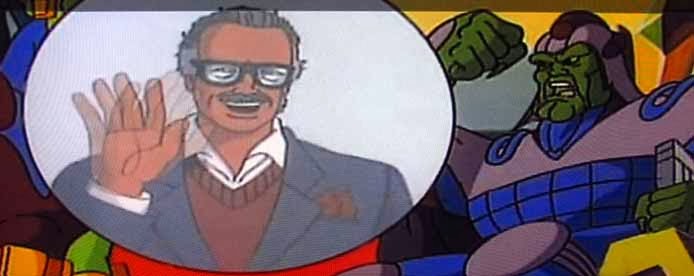
Stan Lee may not have superpowers, but he possessed the keen wit to look at Bendis' name tag, which is how he welcomed the aspiring writer and artist so warmly.  Then again, perhaps he does have superpowers. In "Super-Skrull," an episode of the 1990s animated TV series, The Fantastic Four, he pauses the action to welcome viewers, and then activates his English/Skrull translator device.  


When the action resumes, everyone can understand what the Skrull are saying.  This allows our heroes to discover the nefarious plot, and us to enjoy the story.  

Most ninety-year-olds would spend their days relaxing at home.  But not Stan Lee: he's got too much enthusiasm for life.  While he still advises Marvel, spearheads projects, headlines comic book conventions, and appears in Marvel movies, he insists on keeping active and serving others.  He maintains his youthful fitness, nurtures young adults, and protects New York City by working as a janitor at Midtown High School.  


In "Stan The Man," a recent episode of Ultimate Spider-Man, Stan risks his life to help Spider-Man and Mary Jane rescue Harry Osborn and Principle Coulson from the evil Lizard.  In doing so, he shows off his incredible fitness, and demonstrates how the tools and skills of a custodian can be used to protect and defend others.


No wonder Spider-Man loves and admires his creator!  Just don't expect Stan Lee to expound on all the amazing ways he's benefitted our lives. For as he says in the episode, "My greatness is only overshadowed by my modesty."  

We can all learn something by studying the incredible life and times of the great Stan Lee.

Dragon Dave

Monday, September 16, 2013

Richard Castle's First Graphic Novel?


When it comes to author Richard Castle, public opinion remains divided. People view him as either lazy or hard-working, childish or mature, naive or jaded.  Perhaps the largest argument concerns whether he is actually a real person.  We all know an actor, Nathan Fillion, plays him on TV. But Fillion's portrayal seems so real that some maintain that it was informed by the author himself, and the TV show is just an adaptation of his life story.  Let's face it: if you were a bestselling author, and you tagged along with a good looking homicide detective like Kate Beckett, you wouldn't want all your fans following you around all day, would you?

After all, every author loves to be complemented on his work.  But everyone is also entitled to a certain amount of privacy, and no one enjoys being stalked.

In the case of Richard Castle's Deadly Storm, readers are in no doubt as to the existence of its authors.  In addition to penning every issue of "Ultimate Spider-Man," and numerous other comic books, Brian Michael Bendis is an architect of the Marvel universe.  He heads up a division of Marvel, where he helps decide which storylines each title should pursue, and how the events depicted in each will interact with the others.  His co-writer is Kelly Sue Deconnick.  She's best known for writing Marvel's "Avengers Assemble" and "Captain Marvel" comics, but she also writes other titles and edits English language translations of Japanese Manga books.  Both writers are very real, and someday you might have the pleasure of meeting them at a comic book convention.  

Just as the TV show "Castle" is an adaptation of author Richard Castle's life, so Richard Castle's Deadly Storm is an adaptation of his first Derek Storm novel.  (Sadly, like many of his older titles, it's out of print, but perhaps publishers will take note of this post, and make it available again).  We meet Derek Storm in a trailer park, where he has tracked down Jefferson Grout, and is using his video camera to record the man having a fling with another woman.  


Despite his cavalier charm, and the way he rarely seems to take anything seriously, Storm is a sensitive man, and isn't looking forward to giving his client, Mrs. Grout, proof of her husband's infidelity.  Thus preoccupied, he inadvertently steps on a piece of litter.  Within seconds, lights switch on all over the trailer park, and Derek finds himself on the run from three men with guns, blasting away at him.  When he makes it back to his office, he finds people waiting for him.  They wear nicer clothes than him, ooze confidence, and exhibit capabilities far beyond him.  In other words: CIA operatives.  

As Derek Storm will later clarify, CIA stands for the Central Intelligence Agency, not the Culinary Institute of America.  (Just in case you were wondering).  They're not supposed to carry out missions on American soil.  But it seems that Jefferson Grout, the man Storm was following, is a former CIA agent who has gone missing (or rogue), and he's not the first one the agency has lost recently.  While Grout evaded the CIA operatives sent after him, Storm managed to find him (until he lost him during the trailer park shootout).  Well, the CIA want him to track down Grout again.  Storm is intrigued by the case, as well as the beautiful Clara Strike, who will be his handler for this mission.  

Heck, he'll even be paid for serving his country.  


So he ignores the warnings of his father--a former CIA agent--and continues pursuing Grout, this time for his government.  Doing so will land him in jail, under suspicion for murder.  Tracking down leads will take him to a certain Latin American country with a history of CIA involvement.  He'll get beaten, risk jail and imprisonment, even death. Yet he'll follow the clues where they lead, because he wants to know why Grout disappeared, because he likes Clara Strike, and because he believes that, even if solving this case means taking a few hard knocks, it will make him an infinitely better detective.


Plus, he might just get to play with some cool, CIA espionage devices.  

Richard Castle's Deadly Storm is a slim volume, but a fun one.  It's a novel that could easily be filmed as an hour-long TV show, and can be read in one sitting.  After reading it the first time, you can peruse it again later, and discover aspects of the story you might have missed the first time around.  And then there are the Special Features.  For three pages of the novel, readers get the authors' script, complete with their notes and suggestions.  Another page reveals artist Lan Medina's initial breakdown of the page in pencil, and further pages show how those pages were inked and colored.  These features might seem basic to the experienced comic book reader, but for those less well versed in such matters, they offer welcome insight into the process of creating a graphic novel.  

Sadly, this book may not dispel the controversy surrounding Richard Castle's existence.  Even Brian Michael Bendis has suggested that he was tasked with adapting a nonexistent novel written by a fictional character.  Perhaps this is taking Richard Castle's anonymity too far. For just like Bendis and Deconnick, Richard Castle has his own website. There you can learn about his life, read summaries of his books, and even ask him questions.  After perusing his site, why not visit the websites of Brian Michael Bendis and Kelly Deconnick, as well as the art page featuring Lan Medina's work?  For regardless of who exactly contributed what to this adaptation, Richard Castle's Deadly Storm is a fun read, and those who craft entertaining stories are well worth learning about.

Just don't stalk them, okay?  No one likes that.

Dragon Dave

Related Internet Links
Brian Michael Bendis
Kelly Sue Deconnick
Lan Medina

Thursday, August 1, 2013

Identifying with Ultimate Spider-Man


After watching "Ultimate Spider-Man" on TV, I thought I'd check out his comic book counterpart.  Not being conversant with Marvel's latest offerings, what I thought was "Ultimate Spider-Man: Volume 1" turned out to be "Ultimate Comics Spider-Man: Volume 1."  (This volume begins a sequel series that also takes place in Marvel's Ultimate Universe).  Oh well, at least the comic opens with an ample introduction.  


As you can see (providing Blogger allows you to click on the images and enlarge them), Peter Parker is an ordinary teenager.  He's done incredible things, and he's saved the world from villains numerous times.  Yet what is his reward?  He has to work at a fast food restaurant to earn his spending money.  He has to be polite to customers who take out their frustrations on him.  And he has to obey all the rules, even those that seem silly and uncool to him.  


By portraying his protagonist's life in readily identifiable ways, author Brian Michael Bendis helps us identify with Peter Parker.  We may not have worked at Burger Frog, but we've all had jobs that we were less than proud of.  We've cowered before bosses, subsumed our identities, and only managed to carry on by promising ourselves, "Someday..."  At least Peter gets to don his Spider-Man outfit at night, and try to make his world a better place.  This little bit of freedom, and his contribution to others, soothes his ego, and reminds him that his current lowly status is not forever, but merely a passing phase.  Thus we cheer him on as he flies above the streets of Manhattan.  For to us, he is not merely Spider-Man, but he is also Peter Parker.  And, in a very real way, he is also us.

The Ultimate version of us.

Dragon Dave

Related Dragon Cache entries
Captain America's Philosophy