Showing posts with label Fantastic Four. Show all posts

Monday, August 24, 2015

Understanding The Fantastic Four: Part 3

"Better run, T-Rex. It's clobbering time!"

The Ultimate Fantastic Four comic book series championed the brilliance and idealism of youth. It proved popular with fans, lasting for 60 issues, far longer than most Marvel comic book series endure these days. And ultimately, it served as a basis for this year's new Fantastic Four movie. The only question is: will anyone bother to see it?

Hollywood can be a strange place for a writer to navigate. Stories, or properties, are bought and sold, and most often not made into films or TV series. But whether these stories get made or don't get made, whether contracts are fulfilled or expire, buying rights to stories back, once they've been sold, can be a tricky business, argued out over years or decades via lawyers and the courts. Currently, Disney, a vast multimedia conglomerate that owns Marvel, Lucasfilm, and the ABC TV network (among, no doubts, hundreds or thousands of other media companies), are embroiled in a battle to win back the rights to make their own Fantastic Four movies. So they obviously don't want this new movie, made by a rival studio, to succeed. Marvel has also done some interesting things lately, including canceling the Fantastic Four comic book, and killing off the actors portraying the Fantastic Four in the movie in an issue of The Punisher

Sometimes, you really don't need that extra caffeine.

This situation no doubt puts Mark Millar and Brian Michael Bendis is a difficult situation. Here's a movie, which seems a fairly faithful adaptation of their story, and they're not allowed to promote it or celebrate its release. It pits two writers who have lived their lives regaling us with wondrous stories against other writers and artists who are attempting to translate their story into another medium. And in the process, it puts all of us, as readers and viewers, into a dilemma: Should we support Marvel and boycott this movie? Or should we embrace it and celebrate it for what it is, recognizing how true to Millar and Bendis' reimagined characters and story the filmmakers have remained? 

Prevent pest infestations before they start with
the Ultimate Fantastic Exterminators.

Still, I suppose we can't feel too bad for these two creators. Two years ago, the Queen awarded British citizen Mark Millar with an MBE for his services to film and literature. American Brian Michael Bendis has garnered plenty of awards over the years, and last week even celebrated his birthday. It seems an odd time and way to celebrate one's birthday, let alone the translation of one's story onto the silver screen, amid controversy and battles over ownership of classic characters and stories. But then, Bendis loves to tell stories about superheroes. And if there's one thing we know about superheroes, when they're not rescuing the innocent or defeating villains, they're fighting each other. This fact was illustrated most profoundly, perhaps, by Mark Millar's Civil War series, which serves as the basic for next year's Captain America movie. So perhaps it's fitting that, while the superheroes fight each other, Disney and Fox should be battling it out over who gets to make movies about the Fantastic Four.

Dr. Doom: the reason every smart homeowner buys Fire Insurance.

As for me, all I can suggest is that you see this movie and decide its merits for yourself. Ultimately, that's what superheroes are supposed to be fighting for anyway, isn't it? The ability for each of us to decide how to think and act, instead of allowing far more powerful entities to dominate our outlook and actions. That's certainly what young Reed Richards was trying to do, in the Ultimate Fantastic Four comics, when he struggled against parents and school teachers who didn't understand him, and persisted with his experiments to develop the world's first working teleportation system.

Dragon Dave

Related Internet Links
Marvel Influences in the new Fantastic Four movie
Cast of FF movie killed in Punisher comic
Is Marvel sabotaging FF and X-Men movies?

Friday, August 21, 2015

Understanding The Fantastic Four: Part 2

In the Ultimate Fantastic Four origin story, written by Mark Millar and Brian Michael Bendis, Reed Richards leaves school to join the government-funded think tank run by Dr. Storm. There he meets Dr. Storm's children, Sue and Johnny, as well as Victor Van Damme. He spends four years there, working with other scientific prodigies to help iron out the problems in the experimental teleportation machine the group has constructed. Victor, meanwhile, works on his own projects, and never deigns to speak to anyone. Then, one day, Reed returns to his room, to find Victor there, going through his notes.


Reed: What are you doing, Victor?


Get out of here! This is my room!
Victor: You're doing them wrong.


Reed: Hey, what? You can't touch that!
Victor: You're attempting to calculate the densities as if they still held a gravity.
Reed: You can't touch my--these are my formulas!
Victor: You don't know the gravity equation in the--

Reed may force Victor out of his room that night, but later realizes that Victor is intelligent, and his participation may help speed the realization of his dream. So he approaches Victor, and asks him if he will join his team. 

Victor may be as intelligent as Reed, but he doesn't understand what Reed is doing. His overwhelming self-belief keeps him doubting Reed's conclusions. So he continually fiddles with Reed's calculations, and when the final test comes, of teleporting something organic through the machine (an apple), he corrects Reed's numbers again. Instead of teleporting the apple, the machine expands the field outward, drawing himself, Reed, Sue and Johnny Storm, and Ben Grimm into another dimension. When they emerge, this descrambling of their atoms, similar to the transporter systems on the USS Enterprise in the TV series Star Trek, has changed their physical forms. Instead of reassembling their bodies correctly, they are now, and will forever more, be known as Mr. Fantastic, The Invisible Woman, The Thing, The Human Torch, and Doctor Doom.


Victor may be intelligent, but his belief in his own infallibility gives him a god complex. Like so many intellectuals, he knows exactly how to order the world so that it functions at maximum efficiency. Unlike Reed, he cannot truly work with others. He believes he should be in charge, and anyone whose beliefs or actions are at variance with his becomes his enemy. And, as any enemy threatens the proper structure he wishes to impose on the world, they and all their allies are dangerous and must be destroyed.

This, naturally, makes all human governments his enemies.

The new Fantastic Four movie draws their conception of Victor from this template laid down by Mark Millar and Brian Michael Bendis. When the military continually frustrate his efforts, he leaves Dr. Storm's think tank to continue his work elsewhere, and destroys the group's computers (and presumably, much of their progress) on the way out. After Reed joins the group, Dr. Storm reaches out to Victor, who has not achieved his goals on his own, and convinces him to return to the Baxter Building. Unlike Reed, Victor has not learned humility. He will continue to believe that he should be in charge, that he should be running not just the think tank, but the world. And after he and the others are physically changed, and the military take complete charge of the think tank, Victor realizes that, regardless of how powerful he becomes, he will never be able to control everyone on Earth. 

People who truly wish to help and empower others would channel this realization into working with the present system to achieve their desired goals. Victor choses a different path, a more destructive one. But I'll let you discover how he responds to the world's rejection as he sees it, and how he earns the name Dr. Doom, should you venture out to the cinema to see The Fantastic Four.

Dragon Dave

Wednesday, August 19, 2015

Understanding The Fantastic Four: Part 1

While I enjoyed the new Fantastic Four movie, a lot of people didn't. Some fans hated it, and shared their outrage on social media. Casual superhero fans heard this outrage, took to heart the critics' poor reports (When do critics rate comic book movies highly?), and decided to spend their money on other movies. Some fans have even ranted about how terrible the movie is online, without having first made an effort to see it. But I'm convinced that most people simply didn't understand where the director and script writers were coming from in telling their story. So I thought I'd take a break from these posts on England to explain the movie to anyone who might be interested. 

The first thing you need to know is the source material for this movie is based on the Ultimate Fantastic Four series, which rebooted the classic series for Marvel's Ultimate Universe line. This series was the brainchild of Mark Millar and Brian Michael Bendis, two powerhouse writers beloved by comics readers. Both have written stories that have been adapted into movies. For Mark Millar, some stories of his that have been made into movies include Kick-Ass, Wanted, and this year's Kingsman: The Secret Service. Brian Michael Bendis has served as a consultant on Marvel-related animated TV shows, including Ultimate Spider-Man, and his series Powers has been adapted into a TV series. So it's safe to assume that Hollywood takes many of its cues from Millar and Bendis when making superhero movies and TV shows.

Ultimate Fantastic Four reimagines all the characters younger, and starts off with Reed Richard, a young boy struggling through school, brilliant but misunderstood. When he falls prey to bullies, Ben Grimm stands up for him and defends him. As a result, Reed welcomes him into his world. Even at a young age, he knows what he wants to do. Teleportation--the ability to instantly transport oneself from one location to another--has long been the stuff of science fiction. He wants to make it a reality. He looks to the real of real science, in which other dimensions are postulated. His idea is to use one or more of these other dimensions as a transit path or gateway. Or, as he explains to Ben Grimm about these other realms:


Reed: No, no, it's it's everywhere. It's all around us. There's, well, there's any number of dimensions of--of time and space right on top of us and next to us and under us and around the world that we live in.


We live in this one and we're genetically custom-made to fit here--on the planet. And well, right next to us, right here, right now...is any number of other places and times. Any number of them. I mean, this is common knowledge. This is--yeah.


We just can't see or feel them. But they're there... They've always been there.

Ben: Dude, you are freaking me out.

Ben Grimm may not be able to visualize what Reed is trying to explain, but his ideas are drawn from current scientific speculation. Unfortunately, Reed's father is far less accepting of Reed's brilliance, especially when he takes apart household appliances and uses the components to build his teleportation devices. But Reed carries on, despite his father's displeasure and disbelief in him, and later presents his invention at the school science fair.


Reed: Whether it can be done (transported) for larger systems, such as atoms, remains a mystery. But my hypothesis here today is that instead of disembodiment, the real key to teleportation may be shifting objects through a parallel dimension. Shifting the objects through dimensions similar to our own, that are using the same space as our own. Once equations are properly calculated to breach this space, one would imagine that this kind of teleportation could, in fact, change every part of our society.


Starving people could have food distributed to them in an instant. Our transportation systems would totally change. The possibilities are endless. But this is only phase seven of my project. I can only transport a small object one way. Hopefully, by next year, I will personally be able to go and get my---uh... 


Well, uh... Maybe I'll just show you what I am talking about. Um, okay... You, uh, you might want to step back.

At this point, the fireworks start, and when they finish, Reed's model car has vanished, and the man wearing the red beret gets out his cell phone, dials a number, and says, "Yeah, it's me, Lumpkin. Found one."

A key difference between the film and the movie at this point is that, in the comic, Reed has only transported subatomic particles there and back again. Large items, such as the model car, have disappeared and proved unretrievable. But when the people on the other end of Lumpkin's cell phone invite Reed to join the prestigious, government-funded think tank operated by Professor Storm, he discovers that the team have built a much larger teleportation device. Within its confines, he can visibly see these other dimensions, or at least the gateway leading to them. And within them, floating like items cast into the ocean, are the model toys Reed has sent away with his small invention, but been unable to retrieve. 

Doesn't it stir your soul, to see an idealistic, hard-working person's years of creativity and persistence validated?

Dragon Dave

Thursday, October 24, 2013

The Life & Times of the Great Stan Lee

As a young man, Stan Lee etched his name into the annals of comic book history.  For it was then that he created characters who will live forever in our hearts, such as Spider-Man and the Fantastic Four.  He proved such a dynamic, creative force that Marvel kicked him upstairs, so to speak.  "So what has he done with the rest of his life," you ask?


Well, after he moved into editorial roles, he oversaw all the different magazines Marvel produced.  For example, along with Roy Thomas, he was instrumental in bringing "Conan The Barbarian" to Marvel.  He also served as Marvel's spokesperson.  As he had created so many great heroes, his was a name we could trust.  If Stan Lee said we needed to buy something, or that we would enjoy reading a particular story, well, it was time to raid the piggy bank, and head out to the store.

Today, Brian Michael Bendis is a major writer for Marvel Comics.  When he was just starting out, he made up signs for a Superman Parade and Comics Convention, and welcomed the celebrities as they arrived.  He describes how he met Stan Lee in his book Total Sell Out.


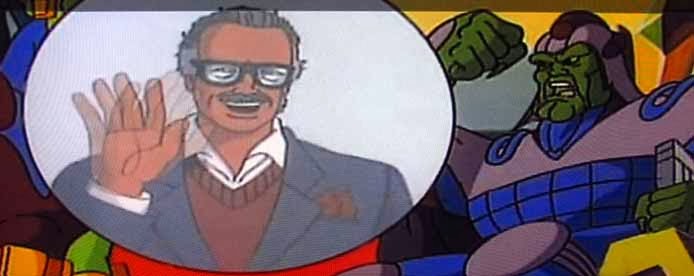
Stan Lee may not have superpowers, but he possessed the keen wit to look at Bendis' name tag, which is how he welcomed the aspiring writer and artist so warmly.  Then again, perhaps he does have superpowers. In "Super-Skrull," an episode of the 1990s animated TV series, The Fantastic Four, he pauses the action to welcome viewers, and then activates his English/Skrull translator device.  


When the action resumes, everyone can understand what the Skrull are saying.  This allows our heroes to discover the nefarious plot, and us to enjoy the story.  

Most ninety-year-olds would spend their days relaxing at home.  But not Stan Lee: he's got too much enthusiasm for life.  While he still advises Marvel, spearheads projects, headlines comic book conventions, and appears in Marvel movies, he insists on keeping active and serving others.  He maintains his youthful fitness, nurtures young adults, and protects New York City by working as a janitor at Midtown High School.  


In "Stan The Man," a recent episode of Ultimate Spider-Man, Stan risks his life to help Spider-Man and Mary Jane rescue Harry Osborn and Principle Coulson from the evil Lizard.  In doing so, he shows off his incredible fitness, and demonstrates how the tools and skills of a custodian can be used to protect and defend others.


No wonder Spider-Man loves and admires his creator!  Just don't expect Stan Lee to expound on all the amazing ways he's benefitted our lives. For as he says in the episode, "My greatness is only overshadowed by my modesty."  

We can all learn something by studying the incredible life and times of the great Stan Lee.

Dragon Dave

Tuesday, June 25, 2013

DTM Racing & The Fantastic Four

This weekend, I watched a DTM race for the first time.  That's not to say that I've never seen a DTM race, as I've followed the series (known as the German Touring Car Masters) on and off since the early 1990s. The format of these highlight shows remained fairly consistent over the past two decades.  The opening minutes would summarize qualifying, a discussion of the season thus far, and interviews.  The middle third of the hour-long broadcast would show edited portions of the race.  Each show would end with wrapping-up interviews, and a little of the podium celebrations.  Thus, after commercials, what I actually saw of the race was probably little more than twenty minutes of the cars speeding around the track.  Even if I had to endure this brief glimpse of the series, I longed to watch the highlight shows during the year, rather than several months after the entire series had ended.

A few months ago, discussions with a friend led me to investigate the history of Marvel Comics' Fantastic Four.  I discovered that Roger Corman helped produce a low-budget movie in 1994 based on their origin story, and their first meeting with the villainous Doctor Doom.  Although the movie was never officially released, either direct-to-video or in cinemas, it demonstrated that the people who had purchased the movie rights from Marvel understood the characters, and desperately wanted to do them justice with a big budget motion picture.  I discovered that the movie was available on Youtube, and watched it one afternoon.  While it was hard to evaluate the film's merits, watching it as I did on a small rectangle on my laptop, I found it highly enjoyable.

I've realized for some time now that the DTM races were available on Youtube, so the desire to watch complete races, and follow the series throughout the season, beckoned.  That, plus my interest in watching Roger Corman's "The Fantastic Four" on my TV, led my wife to investigate the possibilities of doing so.  She discovered that we could access the Internet through our Playstation 3 game console, and found an app that made it possible to see content with the entire TV screen.  I worried about excessive pixelation during the movie, but it played so nicely that my wife forgot at times that she wasn't watching a DVD.  I worried about the feed halting at times, but everything played smoothly, and the video and sound quality were both excellent (in the case of the races, sometimes even better than the usual broadcasts).  

While we're happy with our cable Internet access, we've been wondering lately if we really need Cable TV.  Has the time arrived when I stop thinking of television in terms of channels and times, and start thinking of it as a database I can access at my leisure?  I'm not sure that we've answered that question yet, but I know this.  I loved watching "The Fantastic Four," and wish they would release the film on DVD, along with bonus material about the production.  We also enjoyed watching the DTM races from Spielberg (Germany) and Brands Hatch, complete and uncut, and each with a length of approximately one hour-and-forty minutes.  I'm wonder what else we'll discover--and grow to love--as we investigate how technology is revolutionizing our (apparently) outdated concept of home entertainment.

Dragon Dave

Related Internet Links
The DTM Racing Series
The 1994 Fantastic Four movie