Showing posts with label City of London Museum. Show all posts

Wednesday, February 29, 2012

Hercule Poirot meets the Romans

London's treasures await

On the morning of our third day in London, as we left Hercule Poirot's home in Whitehaven Mansions, my strength began to ebb.  I work out regularly at the gym, do my best to stay lean, fit, and healthy, and take walks around my neighborhood when the mood strikes and my schedule allows.  It had been a long time since I had felt exhausted by merely walking around.  But clearly my long walk yesterday around London, on top of our first evening’s stroll to such sights as Westminster Abbey, the Houses of Parliament, and Whitehall, were taking their toll.  I slowed down, not out of breath but lagging in energy, and, with muscles burning and joints crying foul, walked the few blocks to my next destination.

The Museum of London is just that: a history of the city from prehistoric times until today.  London has existed far longer than any American city: it was founded as Londinium a few years after Christ’s death in the first century, following the invasion by the Roman emperor Claudius.  Yet tribes such as the Iceni and Celts inhabited the land long before that.  And London as we know it today did not spring into being overnight.  London was destroyed and rebuilt several times, before being abandoned and forgotten.  Eventually people found a reason to return, re-founded the city, and from there it grew, enveloping nearby towns and villages such as Westminster and Whitehall, until London became the sprawling metropolis we know today.

What interested me most was the city's Roman period.  After watching the vivid portrayal of life of the Empire in films such as “Gladiator,” in TV series such as “Rome,” “I, Claudius,” and the Doctor Who story “The Romans, in novels like “Roma Eterna” by Robert Silverberg and “Imperium” by Robert Harris, and from reading historic works by Suetonius, Cicero, and Pliny the Younger, I was curious to see how the Empire had influenced the development of civilization in England.  But as I dragged myself inside, my breathing fast, my mouth dry, and my concentration nonexistent, I knew I was in no shape to take in all that this museum had to offer.

Pay unto Caesar for your refreshments!
In the museum’s cafĂ©, we refreshed ourselves with water, soda, and examples of some of the baked goods that England is famous for.  Even though it was earlier, we called this our “elevenses,” as the English call their midmorning break.  Then we braved the exhibits.

Award-winning and best-selling author Connie Willis once remarked that she loved it when something in one story led her to read another.  I’ll go farther than this: under fiction’s powerful influence you may find yourself hungering to read or watch stories in genres you might not otherwise seek out.  You may even find yourself braving difficult nonfiction that you ordinarily wouldn’t touch with the proverbial ten-foot pole.  I imagine that is the case for Connie Willis, as her time travel novels exhibit such attention to detail that she must enjoy studying history.  

I contemplate a new suit
Some might question the wisdom of spending my limited time in London inside a museum, but the time I spent there left an impression upon me.  For so much of what drew me to visit England was its fiction.  In addition to the great stories about contemporary life, some personalities are burned indelibly into my consciousness.  King Arthur and Merlin.  The Emporers Julius Caesar, Claudius, and Nero.  Elizabeth Bennett and Fitzwilliam Darcy.  Queen Victoria.  Doctor Who.  Winston Churchill.  Hercule Poirot.  Some might cut such a list in two, dividing it between Fiction and Fact.  But what we think we know about those who lived in the past is often enlivened by Fiction, and those who lived only in Fiction survive in our hearts because they bring the past so vividly to life.  Time and necessity bring these disparate partners together; love entwines them in our hearts.  To paraphrase Mr. Spock, I find the interrelationship between the two fascinating.

I left the Museum of London sated, invigorated, and hungering for more.

Related Dragon Cache entries

Friday, January 13, 2012

Doctor Who, Ling, and the No-Win Situation

At the end of “The Dalek Invasion of Earth,” the Doctor’s granddaughter Susan decides to remain behind in London to marry David Cameron (No, not the present day Prime Minister) and rebuild the city.  In the next story, “The Rescue,” the Doctor, Barbara, and Ian meet Vicki, one of two survivors of an Earth ship that crashed on the planet Dido.  The Doctor invites Vicki to join them, and in the following adventure, the Tardis lands on Roman-era Earth.  

The travelers settle down for a welcome respite in a country villa currently unoccupied by its owners.  But trouble soon disturbs their rest.  While shopping at the local market, Vicki refers to London.  Barbara corrects her: in this time, the city is called Londinium.  The woman working the stall informs a slave trader that the women are not locals, and therefore unlikely to be missed.  The trader’s men attack the villa at night, and capture Ian and Barbara.  Ian is pressed into service working the oars aboard a ship, while Barbara ends up in the slave markets of Rome, where a servant of Nero’s purchases her to work in the palace.  

The Rulers of Londinium
While I have never been stripped of my rights, others have sometimes placed me in a no-win situation: either I must act as they desire, or I will be perceived as irresponsible, rude, and “not a team player.”  If I express my frustration over the situation to them, I will be seen as “unreasonable.”  Thus, in private, I rant about the injustice of the situation, the actions I will be compelled to perform, and the insensitivity of the person(s) who placed me in this no-win situation.  

In Dr. Gregory Benford’s novel The Stars in Shroud, the protagonist Ling tells the story from his perspective.  As a deeply religious man, as one who spends time meditating and seeking insights, the manner in which he relates his adventures often rings in the ear like the teachings of a wise old monk, such as this: 

“The difference between a conviction and a prejudice is that you can explain a conviction without getting angry.  This is a dead give-away in negotiations; if your opponent flares his nostrils unconsciously before speaking, he probably isn’t going to abide by any compromise settlement.”

When I rant and rave over the injustice perpetuated upon me, am I reacting based upon my convictions or my prejudices?  The two words are similar; their differences not easily discerned.  It seems to me that prejudice is irretrievably linked with undesirable aspects of the human condition such as preconceived notions, hostility, and causing damage or injury.  I certainly want to be known for my convictions, not my prejudices.  

Knowing how I feel when I am forced to perform a service I find undesirable makes me wonder how often I place others in a similar situation.  Often this is difficult to know, as others feel a similar reluctance to appear unreasonable or “not a team player.”  Today’s reliance on cell phones, texting, emails, and instant messaging only make it more difficult to discern others’ reactions.  Only through observing others directly can I observe the nonverbal communication the other person voluntarily (or involuntarily) transmits.  And then only if I am looking for it, instead of waiting for the other to finish what he is saying before I can then respond with what I wish to say.
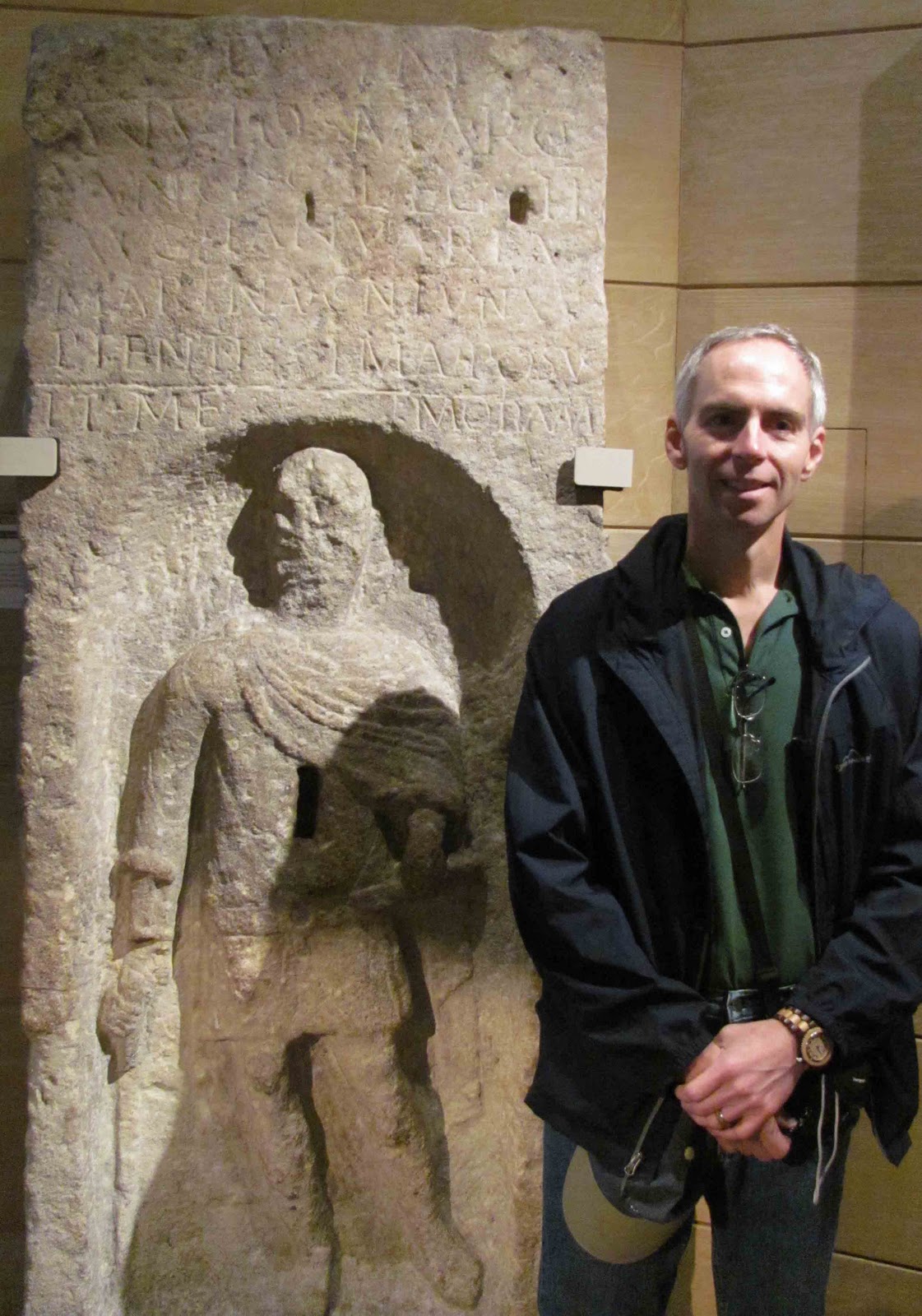
A memorial to a Roman Centurion

While no-win situations are unavoidable, I can seek to control my reactions to them.  Giving way to anger and rage doesn’t help me become the person I wish to be.  Instead, it only builds on any preconceived notions I have about the person who imprisoned me in the situation, and these, of course, can eventually result in hostility, or even inflicting injury upon someone who would never knowingly hurt me.  

Similarly, I must not neglect Ling’s second sentence.  If I find myself in a position where I am asking others to do something on my (or a group’s) behalf, I must make every effort to ensure that I am not placing them in the same no-win situations that I so despise.

Life is difficult enough without enslaving others to our wishes, and compelling them to perform tasks they find undesirable.

The Doctor Who story “The Romans” is available on DVD from the BBC.  Dr. Gregory Benford’s novel, The Stars in Shroud, is available in public libraries, and wherever fine, used science fiction books are sold.  
Related Dragon Cache entries: