Showing posts with label Arnold Schwarzenegger. Show all posts

Saturday, February 13, 2016

Weekend Round-up: On Honor & Fear

This week, I made two visits to the dentist. I'd been worried about them, and hence put them off. But they turned out to not be as bad as I'd anticipated, which was a nice discovery.

I read three books, which I wrote about on Jane Lindskold's blog. This is what I wrote:

The First Book of Swords by Fred Saberhagen. Didn’t made much of an impact 20+ years ago. Found it a far richer read this time. The ending made me wonder if Saberhagen originally planned a larger novel, but the publishers opted to split it into two or three.
The Labours of Hercules by Agatha Christie. Proof that SF/Fantasy authors like Saberhagen don’t have a monopoly on mythological contexts.
Problem at Polensa Bay by Agatha Christie. Stories featuring Poirot, Pyne, and Quin. Most of these Christie originally wrote (and published) for one character. Then later she rewrote the stories in a different form, and republished them. Only this time, instead of characters swapping swords of power, she swapped detectives. Interesting way to recycle, and keep the pounds rolling in.
Additionally, I read an Ultimate Spider-Man graphic novel, and lots of comics. I really enjoy the comics, most of which are different titles, authors, and artists. I think, because they're so visual, and because the stories cover such a wide spectrum of genres, that it helps my creativity. In any case, it's been a good week for the writing, and I think the two are related.
My wife and I finished off the week watching "The Last Stand." It's one of the first movies Arnold Schwarzenegger made after he stepped down as California's governor. It's one of my favorites. He plays a small town sheriff, who decides to block a Mexican drug lord fleeing FBI custody from escaping over the US/Mexico border. At the end, when the sheriff catches him, the drug lord tries to buy him off. The sheriff tells him "My honor is not for sale." It's a good way to leave the week, I think, musing on what one's honor means, and what we do to protect what we stand for.
Oh, and also remembering that sometimes, the things you put off, and worry about, aren't really half as bad as you had feared.
Dragon Dave
Two Earlier Entries on "The Last Stand"

Wednesday, November 18, 2015

Arnold Schwarzenegger's Nazi Stamp Album: Part 2

Arnold might have accepted the situation better, had he understood what had happened. But how can a child understand what has happened to family, his community, and his country, if his father refuses to talk about it? How can he make sense of such an upside-down situation, when all the men in his town who fought on (he thought) the side of right refuse to speak about, or even remember, their involvement in the war? How can he feel any sense of identity, and hope for his future in his home or his homeland, when forces from other countries walk his streets, and dictate how his government should function? Even his cherished stamp album was taken away from him. This album had fired his imagination with the grand new, modern world Hitler had promised to build. Instead, just as Allied forces had destroyed Hitler's dreams, the foreigners occupying Austria stole Arnold's cherished album, along with everything else associated with the Nazi party, and consigned it to the flames.

How could any child deal with that?

Is it any wonder that, as a child, he fixated upon the idea of America, the world's conquering hero-nation of World War II, and the home of all the movies that helped him escape the poverty and emptiness of his childhood, as being the land of opportunity and freedom? Is it so incomprehensible that he looked for a way to escape Austria, and when he found a means that seemed to work for him in bodybuilding, threw himself so fully into it that he became the most successful bodybuilder in history? 


Extraordinary times breed extraordinary people, and, as Total Recall demonstrates, one such person is Arnold Schwarzenegger. He worked hard at Bodybuilding, and when his successes gave him the opportunity to emigrate to the United States, he leapt at the chance. After working one's muscles to failure for four, five, or six hours each day, most bodybuilders lack the energy and focus to do much else. Not so Arnold. In addition to his rigorous gym sessions, he took business classes in community colleges, helped run Joe Weider's Muscle And Fitness empire, promoted bodybuilding contests he didn't compete in, ran his own mail order bodybuilding business, and operated several home repair businesses with fellow bodybuilder Franco Columbu.  

Note: Arnold Schwarzenegger thought most of his fellow bodybuilders were "lazy."

Arnold's hard work paid handsome dividends. He made his first million dollars in the real estate market. When he tired of all his conquests in the Bodybuilding world, he turned his focus and passion toward Hollywood, and helped make the kind of movies that he adored as a child. When he tired of being a movie star, and desired to give back to the country that had given him everything he ever dreamed of achieving, he threw his energies into serving as the governor of California. In addition to serving Californians everyday needs, he helped design and fund infrastructure projects that would improve cities, update highways to relieve congestion, and build high speed rail systems. 

Arnold Schwarzenegger's life might have been far different had his father really reached out to him, talked to him, and helped him understand the Austrian government's reaction to the post-Hitler years. His life might have been more conventional had he been allowed to carry some relic of the past, such as his cherished stamp collection, into the future. Instead, he worked hard, never lost sight of his goals, and eventually transformed all his desires and dreams into reality. And unlike Hitler, he didn't need to start a war, or oppress an entire culture and race, to build a better world for all of us to live in.

Dragon Dave

Monday, November 16, 2015

Arnold Schwarzenegger's Nazi Stamp Album: Part 1


Arnold Schwarzenegger's father was not a hate-filled person who dedicated his life to the extermination of the Jewish people. At least, that's not the way Arnold remembers him in his autobiography Total Recall. He was an Austrian gendarme, or policeman, who served in the German army during WWII. Thus, in his small way, he worked to transform Hitler's dreams into reality.

All conquerors and empire-builders dream of doing good works that will benefit the majority of their subjects. Like my grandfather with his stamps, and me with my Wacky packages, Arnold remembers collecting Nazi stamps, and putting them into an album. Its pages awed young Arnold with the glorious new world Hitler promised to create. 


The book was actually a do-it-yourself album for promoting the mighty accomplishments of the Third Reich. There were sections for different categories, such as public works, tunnels and dams under construction, Hitler’s rallies and speeches, great new ships, new monuments, great battles being fought in Poland. Each category had blank pages that were numbered, and whenever you went to the store and bought something or invested in a war bond, you would get a photo to match up with a number and paste into your book. When the collection was complete, you’d win a prize.

But WWII turned against the Germans, and Hitler's dreams turned to ashes.

Those who worked hardest to bring Hitler's dreams to life--those who survived--were imprisoned, tried in courts of law, and executed. The rest--those who merely served, and carried out the orders of their commanders--were sent home, to rebuild their communities, and resume their ordinary lives. Yet what can be ordinary about returning home to a devastated land, one in which all the glorious visions that the media has inundated its citizens with have failed? What can be ordinary about returning home as a soldier, after having lost the war, and being told by the world community that you must atone for your crimes? Imagine doing your civic duty for years, then returning home, and as the years go on, you work hard in relative poverty, and keep learning more revelations of the cruelties and horrors the regime you served had perpetrated. Definitely not a situation you'd want to relive with your friends every Saturday night, or regale your family with your war stories.

Arnold would have loved to have talked with his father, and understood why his nation, Austria, now had to atone for its participation in WWII. But Arnold's father refused to discuss the war. And then, one day, Arnold's cherished stamp album disappeared. Like all such reminders of the Nazi movement, it too was spirited away by the forces now occupying Austria, never to be seen again. 

This is the societal and familial situation in which Arnold Schwarzenegger grew up. It wasn't a situation of his own making. Yet, it was one he had to live with. Amid poverty, feelings of isolation, and an authoritarian upbringing, Arnold forged his own path to independence. He would become the greatest world championship bodybuilder of his era, a world-famous star on the silver screen, and a two-term governor of one of the largest and most famous states in the United States of America. But he started off poor, lonely, and without any real resources to call his own. Aside from ambition, of course. But then, what else do you really need in life?

Dragon Dave

Monday, February 9, 2015

Happy Birthday Jules Verne


Eleven years ago, I watched the movie "Around the World in 80 Days" in the cinema. This comedic version featured Steve Coogan and Jackie Chan as Phileas Fogg and his valet Passepartout. In addition, it featured Arnold Schwarzenegger, Jim Broadbent, Owen and Luke Wilson, and former Python John Cleese in smaller roles. Although it performed poorly at the box office, I enjoyed it, and have watched it several times since on DVD. So when I found the novel included in this treasury of Jules Verne novels at Barnes and Noble, I wanted to see how the modern film deviated from the original story.


Surprisingly (or perhaps unsurprisingly), the modern film bares little resemblance to the novel. As I enjoyed the movie, I welcomed a chance to experience a completely different story. Gone were all the steampunk elements, as well as the slapstick comedy. All new to me were Phileas Fogg as a man of the most exacting habits, who fired his last butler for delivering his shaving water two degrees too cool. As a rich gentleman, Fogg leads an insular, scholarly life. His only contact with the outside world is his daily walk between his house and his club in London. Yet he exhibits an extraordinary knowledge of all aspects of human existence. So strong is his faith in his own deductions that, when challenged, he bets his friends that he can circumnavigate the globe in a seemingly inadequate length of time. Oh, and the amount of his wager? Only the entirety of his earthly fortune.


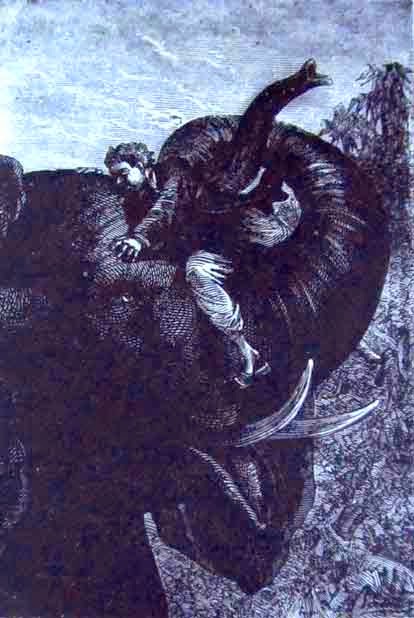
This volume contains a plethora of black-and-white illustrations that evoke the imagery of the late Nineteenth century. In addition to Verne's exciting prose, the artwork keeps me turning the pages. Yet I can't read the novel fast enough. Weighing in at nearly three pounds, this hardback quickly grows too heavy to hold up while laying in bed at night. So reading it is reluctantly relegated to the daytime hours, when I can carve out a little time to sit down and read a chapter or two. Still, for the price, and with the sumptuous artwork, this collection from Barnes and Noble was a real bargain. 

Only one-third of my way into the novel, it's easy to see why readers flocked to Verne's stories. Around the World in Eighty Days is just one of fifty-four novels Verne wrote in his Voyages Extraordinaires series. I'd love to think that I might be able to read them all, but life is too short to allow me to read more than a fraction of all the books that catch my interest. So for now, I'll reluctantly content myself with finishing this novel during the daytime hours, and count the minutes between each reading session.

Really, Verne's adventure story is just too much fun!!!

Yesterday was Jules Verne's 187th birthday, so Happy Birthday Jules Verne! When I join you up above the clouds, I look forward to an eternity in which I can sing majestic operas, master the harp, and read all the great books ever written. Including yours.

Dragon Dave

Saturday, January 26, 2013

Three Last Thoughts on “The Last Stand”


I had a few last thoughts about the movie “The Last Stand” that I didn’t fit into “The Ultimate Test of Character,” and I wanted to share them with you.

Thought #1: The movie reminded me of some of those great road movies from the 1970s and ‘80s.  Or perhaps I should say Not So Great, but they were a part of my youth.  Of course, there were the comedies, like “Smokey and the Bandit,” and “Cannonball Run.”  One movie in particular that came to mind was the early 1980s movie  “The Last Chase.”  A great plague, and the death of the fossil fuel industry, has led to the collapse of the United States.  Franklyn Hart, a retired racing driver (played by the original "Six Million Dollar Man," Lee Majors), defies his totalitarian government, reassembles his old Porche roadster, and drives across America, heading for California, where there are fewer restrictions on travel.  There are more movies like this, but I only remember fragments of them.  They’re just images in my mind now, and I can’t remember most of their titles.  But they were part of an era of Hollywood moviemaking, and an expression of the universal need to explore.  Feel the need to escape, to get out there, to see the world?  Then just get in your car, or hop on your motorcycle, and do so!

Thought #2: There were lots of moments in “The Last Stand” that made me smile or laugh, such as when Deputy Figuerola is going through Lewis Dinkum’s weapons collection and pulls out a sword from “Conan The Barbarian.”  Of course he wants to take it, but Sheriff Owens (Schwarzenegger) essentially tells him No, we’re not fighting in the Crusades.  As Dinkum briefs the Sheriff and deputies on what he has to offer them, Owens turns to him and asks “Do you name all your things?”  Dinkum (Johnny Knoxville) replies: “Only the things I love.”  I may not exactly get Dinkum, but...yeah, I get that.

Thought #3: For the most part, the film doesn’t glorify violence.  Sure, it’s an action movie, and therefore there’s violence aplenty.  If you choose to see it, keep in mind that it’s rated R for that reason.  But director Kim Ji-woon doesn’t glorify the violence, nor does he dumb it down.  He doesn’t portray violence to look cool or awesome for the PG crowd.  It’s not a ballet of unreal violence, with characters leaping off roofs, performing summersaults, and landing atop speeding vehicles, all while shooting submachine guns and blowing away the enemy.  The blood is there, the deaths seem painful and real, and this demonstrates that violence is neither fun nor beautiful.  It’s horrible and tragic, and that’s something that Sheriff Ray Owens cannot forget.

Before Mexican druglord Gabriel Cortez, and his associates, bring violence to Sommerton Junction, deputy Jerry Bailey asks Sheriff Ray Owens for a transfer to the big city, where he can experience a career filled with excitement and adventure.  Owens’ words to him are poignant, and worth remembering. 

“Adventure,” he says with a cough.  “Excitement,” he mutters, and coughs again.  “A Deputy craves not these things.”

Okay, maybe that’s not exactly what he said, but that’s what his response to Bailey reminds me of.

At any rate, there you have them: my last three thoughts on “The Last Stand.”  Now I’m thoughtless. 

Dragon Dave 

Related Internet Links

Friday, January 25, 2013

The Ultimate Test of Character


In the movie "The Last Stand," currently in theaters, Arnold Schwarzenegger plays Sheriff Ray Owens.  As there seems to be little crime in the small town of Sommerton Junction, Arizona, most view him as little more than a figurehead.  No one, not even the mayor, shows him any respect.  When Owens points out that the mayor has parked his brand new Camero ZL1 in the fire lane, the man tosses him the keys, before accompanying the school sports team to a local game.  He simply cannot imagine anything—even a fire—disturbing the peace in their quiet little town.

Likewise, Owens’ deputies don’t regard their role in Sommerton Junction as important.  He catches Jerry Bailey and Mike Figuerola hanging out with Lewis Dinkum, the local wild man who has somehow gotten a permit to collect all manner of weapons.  As Owen arrives, young Bailey demonstrates that he can’t handle one of Dinkum’s larger pistols.  When Owens asks him to run the license plates on a semi-truck passing through town, Figuerola must again show Bailey how to work the computer.  Yet when Bailey approaches Owens later that night, he asks the Sheriff to help him get transferred to the big city, where he believes he can do something worthwhile with his life.

When Gabriel Cortez, a Mexican drug lord escapes FBI custody, he races toward Sommerton Junction in a modified Corvette stolen from an auto show.  Thanks to skills honed on a race track built by his father, and the help of armed associates, he evades everyone sent his way.  His plan: to cross over the Mexican border near Sommerton. 

I wasn’t expecting much from Schwarzenegger’s first starring vehicle in ten years.  "The Last Stand" reminded me of “Raw Deal,” and some of the other small movies he starred in after his success in “Conan The Barbarian.”  Nor did Johnny Knoxville’s name, featured so prominently on billboards, inspire confidence.  But I found the story well thought out and constructed.  As the rest of the cast played their roles seriously, Knoxville’s brief moments onscreen provided welcome comic relief, and prevented the little action movie from taking itself too seriously.  Above all else, I really enjoyed Schwarzenegger’s performance as Sheriff Owens, who has seen enough of violence and death, and knows the terrible price that drugs cost individuals and society.  The FBI and his deputies may want him to stand down, to look the other way, but Owens knows he cannot simply let Cortez pass through his town without trying to arrest him.

The movie portrays so many great truths about our lives, but if I had to pick just one, it would be this.  It’s easy to do the job or task you feel called to when others applaud your efforts.  It’s immensely harder when no one believes that what you are doing is important.  Often, people shout that they are “Taking a stand,” or doing great things, but most of them abandon their efforts if they receive no discernible recognition or benefits after awhile.  It is only those who truly believe in what they do, whose self worth derives not from others but from within, who carry on when no one notices.  That is the ultimate test of character: to continue doing what you believe is important, even when everyone else has written you off.

Oh, and one other thing.  Whatever you do, don’t park your car in a Fire Zone.  Especially not when Sheriff Ray Owens is around.

Dragon Dave

Wednesday, January 16, 2013

Arnold Schwarzenegger's Greatest Challenge


Although it was his sixth acting job, 1982's “Conan The Barbarian” really launched Arnold Schwarzenegger’s success in Hollywood.  After watching the movie again, I also enjoyed the extra “From the Vaults,” a collection of interviews conducted on the set nearly thirty years ago.  Something Schwarzenegger said stuck with me. After thirteen years of bodybuilding competition, and winning every title worth winning, he felt no more challenge in the sport.  So he looked around for “something different that would create a lot of challenge for me and be very difficult.”  He noticed that acting was a particularly difficult profession to get into. While a bodybuilder might land the occasional movie role, none had yet climbed to the pinnacle of that profession.  Thus acting provided a challenge that his former sport no longer offered him.  He liked that it was hard to get into, that it afforded him a lot of obstacles, and that it gave him “something new to fight for.”

I don’t know about you, but I’ve never chosen to do something because it was difficult.  I’ve done things because I wanted to do them, including pursuing my present course, but I’ve never purposely sought out something that would provide me with the most challenge and lots of obstacles.  I guess that’s what separates me from people like Schwarzenegger, who not only rewrote the record books in bodybuilding, but also went on to become one of Hollywood's top movie stars. That process would not be easy.  He had to prove himself in a lot of smaller productions before more high profile movies came his way.  Also, as he mentioned in the interview, he had to do additional stunt work, as few stuntmen could double for his unique physique.  In time, he won audiences over with his unique personality and style, and people flocked to theaters more because he was in the movie than for what it was about.

Like most Schwarzenegger fans, I’m saddened by the dissolution of his marriage.  In this, he reminds me of the Biblical character of Samson, who, while capable of great feats of strength and courage, possessed a similar personality flaw that led to his downfall.  (The character of King David also comes to mind).  Such timeless heroes demonstrate that those who seem the strongest may nonetheless be weak in other areas of their lives.  Nor am I certain that history will look kindly upon his years as governor of California.  More than any of his previous challenges, politics is an arena in which people say one thing and do another.  Success there certainly cannot be achieved by one person’s efforts alone, no matter how tirelessly they work, or the popularity of the causes they fight for.  But it’s worth pointing out that he never accepted a salary during his years of service, and that he gave up tens of millions of dollars (if not hundreds of millions) that he could have earned had he remained in the acting profession, and continued to endorse nutritional supplements.

Unlike some other Hollywood stars that have crashed and burned, Arnold Schwarzenegger may be guilty of inappropriate conduct and poor judgment, but I’ve not heard of him doing anything vicious or hateful.  And he does seem to be acting responsibly toward those in his life.  I don’t know if he will find overcoming all the obstacles he faces too hard, but I hope he can fight his way back to the top of the acting profession.  It’s important that highly regarded people rebuild their careers, for in doing so they inspire us to overcome the obstacles that lie in our own paths.  I’ve admired him in the past for many of the things he has done, and hope he does well in some of his upcoming movies, such as this month's "The Last Stand," and next year's "The Legend of Conan."  I want to see him overcome perhaps the greatest challenge of his life, and win me over, all over again. 

Dragon Dave