Showing posts with label Monty Python. Show all posts

Wednesday, August 3, 2016

The Destruction of Fawlty Towers

Last year, I visited Torquay for two reasons. One was that it was the English city where Agatha Christie lived and wrote her stories. Another was its association with Monty Python and Fawlty Towers.


While planning out our trip, I studied the Hotel Gleneagles' website. It stated that not only could I stay there, but I could see a live dinner show based on the Fawlty Towers TV series. As the six writers and actors responsible for the Monty Python TV show had stayed in Gleneagles, and their visit inspired member John Cleese to create the Fawlty Towers TV series, this seemed like an irresistible opportunity. 

Sadly, although the website was still operating, Gleneagles had already closed by this time.


Still time for a swim?

During our visit to Torquay, my wife and I visited the property. It had not yet reopened, and no cars were in the parking lot. But little signs, here and there, advertised its connection with Basil Fawlty, the fictional owner, and his bumbling assistant Manuel, the hotel bellhop and waiter. I peered in through the windows, and looked through the side gate. I saw a cover over the pool, and an empty hotel lobby. But no one inside, enjoying this place of living history. 

While I was there, another car pulled up, and a local man got out. He took some photographs of the hotel with his phone, and we chatted for awhile. He enthused about the Hotel's association with Fawlty Towers, a show he loved and regarded as a classic British sitcom. He kindly took this photograph of me standing before the entrance.


When I discovered the article on the purchase and renovation of Moorlands House in Hay Tor, where Agatha Christie wrote her first novel, The Mysterious Affair at Styles, I decided to search for any developments of Hotel Gleneagles. Instead of learning that it had been also refurnished, redeveloped, and that I would be able to stay there, I learned that the building had been torn down earlier this year. So, Agatha Christie's historic hotel gets saved, and John Cleese's gets razed? One is cosseted, the other destroyed? Sometimes, life just doesn't seem fair.

Still, I got to go there, and see the historic Gleneagles Hotel, before it was lost to history forever. Or, as the Daleks would say, before Fawlty Towers was exterminated, Exterminated, EXTERMINATED!!!

Dragon Dave

Monday, February 9, 2015

Happy Birthday Jules Verne


Eleven years ago, I watched the movie "Around the World in 80 Days" in the cinema. This comedic version featured Steve Coogan and Jackie Chan as Phileas Fogg and his valet Passepartout. In addition, it featured Arnold Schwarzenegger, Jim Broadbent, Owen and Luke Wilson, and former Python John Cleese in smaller roles. Although it performed poorly at the box office, I enjoyed it, and have watched it several times since on DVD. So when I found the novel included in this treasury of Jules Verne novels at Barnes and Noble, I wanted to see how the modern film deviated from the original story.


Surprisingly (or perhaps unsurprisingly), the modern film bares little resemblance to the novel. As I enjoyed the movie, I welcomed a chance to experience a completely different story. Gone were all the steampunk elements, as well as the slapstick comedy. All new to me were Phileas Fogg as a man of the most exacting habits, who fired his last butler for delivering his shaving water two degrees too cool. As a rich gentleman, Fogg leads an insular, scholarly life. His only contact with the outside world is his daily walk between his house and his club in London. Yet he exhibits an extraordinary knowledge of all aspects of human existence. So strong is his faith in his own deductions that, when challenged, he bets his friends that he can circumnavigate the globe in a seemingly inadequate length of time. Oh, and the amount of his wager? Only the entirety of his earthly fortune.


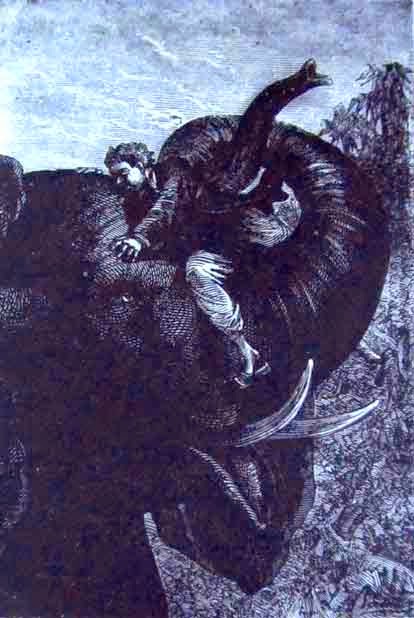
This volume contains a plethora of black-and-white illustrations that evoke the imagery of the late Nineteenth century. In addition to Verne's exciting prose, the artwork keeps me turning the pages. Yet I can't read the novel fast enough. Weighing in at nearly three pounds, this hardback quickly grows too heavy to hold up while laying in bed at night. So reading it is reluctantly relegated to the daytime hours, when I can carve out a little time to sit down and read a chapter or two. Still, for the price, and with the sumptuous artwork, this collection from Barnes and Noble was a real bargain. 

Only one-third of my way into the novel, it's easy to see why readers flocked to Verne's stories. Around the World in Eighty Days is just one of fifty-four novels Verne wrote in his Voyages Extraordinaires series. I'd love to think that I might be able to read them all, but life is too short to allow me to read more than a fraction of all the books that catch my interest. So for now, I'll reluctantly content myself with finishing this novel during the daytime hours, and count the minutes between each reading session.

Really, Verne's adventure story is just too much fun!!!

Yesterday was Jules Verne's 187th birthday, so Happy Birthday Jules Verne! When I join you up above the clouds, I look forward to an eternity in which I can sing majestic operas, master the harp, and read all the great books ever written. Including yours.

Dragon Dave

Friday, May 16, 2014

Daleks vs the Killer Rabbit of Caerbannog


Pocket: Help me carve this up for Master and Mistress.
Denim: Um…if you insist.


Pocket: What's wrong?
Denim: It's that movie we saw last night. What if a Killer Rabbit seeks revenge on us?
Pocket: The Killer Rabbit of Caerbannog is only Arthurian legend. 
Denim: Are you sure? The way it decimated his troops...
Pocket: Even if it was based on reality, the events in the film occurred in 932 A.D. There's no such thing as Killer Rabbits these days.


Pocket: See, doesn't that look nice? Mistress will enjoy that. 
Denim: Yes, I suppose so.


Pocket: Would you forget about the Killer Rabbit of Caerbannog and carve off a piece for Master's dessert? By Davros, you're worried about something you saw in Monty Python and the Holy Grail! There are no such things as Killer Rabbits!


Pocket, Denim, & ...

Wednesday, January 29, 2014

David Jason & Monty Python: Part Two

What I'm Reading Wednesday


David Jason's first big TV comedy came in 1967 with "Do Not Adjust Your Set."  In addition to costar Denise Coffey, he played alongside Eric Idle, Michael Palin, and Terry Jones.  Whereas the latter three attended prestigious Cambridge and Oxford, Jason hadn't possessed the right background or grades to attend any sort of university. The three Pre-Pythons were younger than him, and boasted far less acting experience. Nevertheless, they exuded a confidence in their abilities that Jason greatly envied.  

Another factor which separated him was their friendship. The three already knew each other well, having shared so many experiences, and previously collaborated together.  As a result, Jason found them "posh" and "a bit cliquey."  I've enjoyed Michael Palin's diaries from the 1970s and '80s, so I was glad to learn that he "seemed the nicest," and that Jason "felt that there was less of a boundary with him."  Nonetheless, the show was divided into halves, with Jason and Coffey filming their silent comedy routines, and occasionally performing on studio-bound skits written by the other three.  

While Jason and Coffey contributed a few skits, and improvised their "Captain Fantastic" routines, Eric Idle, Michael Palin, and Terry Jones wrote the bulk of each episode.  During the first season, David Jason recalls that everyone contributed enthusiastically.  But as would reoccur on "Monty Python" at the BBC, Idle, Palin, and Jones grew increasingly frustrated during the second season.  They saw their imaginations being stifled by the limitations of a children's show.  Eventually, the three petitioned the Head of Comedy at Rediffusion to schedule the show later in the evening.  He refused, on the grounds that "Do Not Adjust Your Set" was the most successful show the company had ever produced. Feeling that they needed to explore their creativity in different ways, the three left Rediffusion, which effectively ended the show.

Although he didn't know it at the time, David Jason was one of the budding young stars of English comedy.  "Do Not Adjust Your Set" would serve as a stepping stone for his career, and he would go on to perform (and star in) a great number of TV shows, including one of my personal favorites, "Open All Hours."  He may never have been a writer, but through hard work and persistence, he later became someone whom TV producers sought out and asked, "What type of program would you like us to build around you?"  He became so highly regarded in Britain that in 2005 he was knighted by the Queen. 

Still, when he was climbing the ladder of British TV, and he saw Eric Idle, Michael Palin, and Terry Jones shoot to worldwide fame with "Monty Python," he felt tremendously jealous.  Well, be honest: wouldn't you?  But then, none of us know all that the future holds in store for us.

"All hail Sir David Jason, knight of the British TV realm!"

Dragon Dave  

Related Internet Links

Wednesday, January 22, 2014

David Jason & Monty Python: Part 1

What I'm Reading Wednesday

I purchased the DVD for the TV series "Do Not Adjust Your Set" because it featured several of the actors who would go on to star in "Monty Python."  An added bonus was realizing that David Jason was in the show.  I've been a fan of his ever since watching "Open All Hours," the four seasons of which I saw on PBS over ten years ago.  I had subsequently seen him in the detective series "A Touch of Frost," but that was a dark and serious show, nothing like his character of Granville in "Open All Hours."  So it was fun to watch him hamming it up with Michael Palin, Terry Jones, and Eric Idle, in their late 1960s pre-Python sketch comedy series.  He seemed to interact so naturally with the others, that I just figured he must have been one of the young, rising stars of comedy on English TV.  But in life, things are often more complicated than they appear.


At a mall in Brighton, England, I found My Life, David Jason's autobiography.  In it, he reveals that he was born during World War II, and was too young to be evacuated from the suburbs of London.  Or perhaps I should say the poor housing districts, as his mother worked as a domestic servant, and his father as a fishmonger.  Neither parent seems to have worked hard to inspire David, and perhaps his teachers thought he showed little promise as well.  In either case, he left school at fifteen, and took a series of jobs, eventually learning the electrician's trade.

But before he left school, one person made an impact on his life.  He was the principle, who evidently needed someone to fill the lead role in a school play, and commandeered him for the job.  To his surprise, David Jason found he enjoyed acting, and others, including the leader of an amateur dramatics society, agreed that he had talent.  David wasn't sure about continuing to act beyond that first play, but when he realized that the number of girls in the amateur dramatics group far outnumbered the boys, he decided to give it a go.

The acting bug stuck with him, but his parents refused to subsidize him to attend an acting school, even when he was accepted, and others believed he showed promise.  This wasn't because they didn't love him, as David Jason points out.  It was just that their eldest son, who had served in World War II, had joined the acting profession after his army service, and they thought that one son who was perennially seeking a new job was enough.  Given his less-than-stirling academic career, they wanted something safe and secure for their younger son.  Let him learn a trade, they thought.  Something with security and a future.

So David Jason relied on his training as an electrician to get by while getting bit parts as an actor.  Usually these were roles that demanded a great deal of physical comedy.  As he developed a reputation for this, he was able to wean himself away from doing electrical work, until he acted full time.  One year he was able to buy his first car, a tiny English Mini, for personal use.  He got a job that summer at the Pier Theatre in Bournemouth.  And one night, a TV producer traveled down to see him perform.  He had heard of David Jason's panache for physical comedy, and after watching him that night, offered him a role in his new show "Do Not Adjust Your Set."  That series would take the nation by storm, and become the top-rated children's show in England.  

Unlike his pre-Python costars, David Jason didn't attend Oxford or Cambridge.  He didn't have any connections among the movers-and-shakers in the English TV industry of that time.  Instead, he earned his way onto "Do Not Adjust Your Set" through years of hard work and practice, practice, practice.  Still, he made it there, because he loved acting, and he persevered with what he loved doing.  

That's what matters.

Dragon Dave

Monday, January 20, 2014

Beware Frank Bellamy's Winged Avenger

Marvelous Monday Comics

In The Avengers episode "Winged Avenger," someone is killing ruthless industrialists.  Government agents Emma Peel and John Steed find their clawed corpses in locked, upper-story offices.


At first, Emma Peel doesn't notice this comic lying among the papers knocked off the desk of one victim.


But when another ends up dead, on the grounds of his estate, she remembers one panel from the comic, and Steed agrees on the striking similarity.


This leads Emma Peel and John Steed to the offices of Winged Avengers Enterprises, where they find a man dressed up in the Winged Avenger costume, poised to savage beautiful women with his deadly claws.  But even if the killer wore the costume, how did he climb up the sheer walls of office buildings?  And who might have used the costume to murder the heartless businessmen?  The artist who is gradually taking over every aspect of the comic book's production?  The writer who is growing more and more frustrated with his partner?  Or the model, who sometimes leaves the office at the end of the day, so comfortable in the costume that he's forgotten he's wearing it?


"Winged Avenger" features lots of comic book imagery, drawn by Frank Bellamy, a British artist who died too young.  He may be most remembered by fans of the comics version of Gerry Anderson's Sci-Fi puppet TV show "Thunderbirds."  Die-hard Monty Python's Flying Circus fans can also find his artwork in Terry Jones and Michael Palin's children's book Bert Fegg's Nasty Book For Boys & Girls, which satirized British annuals of the period, and recycled Monty Python scripts.  That is, if you can find a copy.

Dragon Dave

Related Dragon Cache entries
Emma Peel & Daleks

Related Internet Links
Watch "Winged Avenger"
Frank Bellamy at Wikipedia

Tuesday, October 1, 2013

Monty Python Discover The Meaning of Life


In the 1970s, when John Cleese, Graham Chapman, Eric Idol, Terry Gilliam, Terry Jones, and Michael Palin started working together, they were full of enthusiasm.  The ideas flowed, and each was excited by the others' efforts.  But as the years went by, tensions mounted as each yearned to pursue his own projects, and all were frustrated by the low pay they reaped from their TV shows and movies.  In 1981, after innumerable discussions, writing attempts, and delays, the men felt as if they were getting nowhere with a follow-up to their previous film, "The Life of Brian."  In his diary from November 25th, Michael Palin records that he'll be "mightily relieved when this next Python film is done and out of the way and we don't have to write together for another four years."

Hoping that a change of venue might inspire them, the six men flew to Jamaica in January 1982, where they rented a house.  At first, they floundered to write material they all liked, or devise a structure that could encompass all the skits they had come up with.  One morning, while Michael Palin and Graham Chapman were working together, their cook told them she needed a ride to the market.  So they threw out ideas as they chauffeured Beryl around the island to buy the ingredients for the evening meal.  They dreamed up a musical number involving fish and a mystery play.  After lunch, none of the others liked their idea. John Cleese and Eric Idol wanted to revisit an old idea for an over-arching narrative, but no one liked that either.  When the two Terrys then suggested the old TV idea of "a rag-bag of non-sequiturs and complex connections" to link the various skits, the mere idea of repeating themselves sapped everyone's creativity.  "It's as if...this is the moment that this material--the best of three years' writing--finally defeated us."

But their efforts would not end in defeat.  The next day, Terry Jones estimated that they had roughly 100 minutes of good material.  "This seems to spur people into another effort," Palin wrote.  Within minutes, they had a title they liked, "Monty Python's Meaning of Life," and began hammering out the various phases of the movie's structure.  They are on a roll again, they are all excited, and most importantly, they had found the direction they needed to finish the script.  

Although they didn't know it at the time, "The Meaning of Life" would be the last movie the six men made together.  It may not be the best film ever made, but it holds an enviable 89% critics rating and an 82% audience rating on Rotten Tomatoes.  More importantly, it was a film that the six men cared about, and dearly wished to make.  Yes, a moment of inspiration allowed them to assemble the film into a form that they could all agree on, but it only occurred after three years of hard work, and because they didn't give up on a project that was important to them.

Dragon Dave  

Related Internet Links
Monty Python's The Meaning of Life on Rotten Tomatoes

Thursday, September 12, 2013

Michael Palin’s Discipline


Hawaii’s remote location is both a blessing and a curse.  Traveling there makes for a delightful change of place, where aided by the warm temperature, the cool tradewinds, the stunningly beautiful landscape, and the laid-back, carefree nature of islanders, one can cast off the cares of the world.  And yet, because so much must be transported there, everything becomes more expensive.  Staying in a remote location such as Punalu’u becomes even more expensive, with such necessities as a half-gallon container of ice cream (which in recent years has been bastardized down to 1.75 or even 1.5 quarts) costing ten or twelve dollars in a local grocery store.

So it was that my wife and I embarked on the hour-plus drive back to Hilo, where for a mere seven or eight dollars, our modern, sleeker cartons of ice cream could be found.  Other comforts of civilization cost too much, and had to be left on the shelves for budgetary reasons.


While there, in this pinnacle of Hawaiian civilization, we took the time to visit Hilo Bay Books.  There I secured a few precious items of literature that I had wondered if I might ever find.  Noticing the man behind the counter was watching a clip from "Monty Python’s Flying Circus" on his computer, I mentioned that I was currently reading Michael Palin’s Diaries.  To my surprise, he asked which of the two volumes I was referring to.  "The second one, concentrating on the 1980s," I told him. Like me, he loved the classic TV series, and was amazed by the creativity of its founders.

Michael Palin has been blessed with enviable talent, but that didn’t mean he could simply sit down and whip up a masterpiece whenever the mood struck him.  As a successful actor, writer, and TV presenter, his time and talents were in constant demands, to say nothing of all his personal commitments to his family and friends.  In the spring of 1981, Palin had finished his scenes for “Time Bandits.”  Yet he was constantly involved with the film, due to his friendship with Terry Gilliam, the disagreements between the Pythons and their management, the brewing trouble between Gilliam and George Harrison over the film’s music, and the constant rejections from American distributors.  Add to all that his regular meetings with the Pythons as they transacted business and tried to cobble together various ideas for what would become their final theatrical movie, “The Meaning of Life.” 

Finding time to pursue personal projects proved nearly impossible.  He constantly fended off offers from TV, movies, and fellow Pythons to participate in other movie and TV productions.  Yet he carved out several hours each day for writing.  Initially, he wasn’t sure what type of story he wanted to tell.  With so many competing distractions, this uncertainty over the shape and scope of the finished project didn’t help.


On March 9th, he records, “Nothing springs instantly to my pen—no characters so all-consumingly important that I have to write about them.  It’s a shame really—all those people out there with burning convictions and desperate messages to the world which they can never make anyone listen to and here am I, pen poised to create entertainment for the world and not knowing what I want to say.”

Three days later, he faces another long day at his desk.  He estimates when he should finish.  He wonders when he can have his next cup of coffee.  He records, “Yawn.  Stretch.  Yawn.  Look blankly through all I’ve written this week, trying desperately to summon up any belief in the purpose of these arbitrary scribblings and character snippings.” 

“The hour passes without hardly a line written.  It’s like insomnia, in reverse.  My mind refuses to wake up.”

Later that day, he opts to go for a run during an unseasonable dry spell.  As he pounds around Parliament Hill and nearby surroundings, inspiration strikes.  By the time he returns home, he sits down with renewed enthusiasm, and with clarity of focus starts to write what would eventually become the film “The Missionary.”

Okay, his breakthrough didn’t occur while he was actually sitting down at his desk, trying to write.  The idea only struck him when he went out for a run.  But would it have occurred to him if he hadn’t chained himself to the desk each day for hours at a time?  I don’t think it would have.  How about you?

Dragon Dave

Related Dragon Cache entries

Related Internet Links

Thursday, July 4, 2013

Palin’s Perspective


Before I read Michael Palin’s Diaries, I only knew him as a performer, and in that regard, chiefly for his work in Monty Python.  But just as there was more to the comedy ensemble than their TV show and movies, Michael Palin is much more than a performer.  There’s Michael Palin the family man, Michael Palin the entrepreneur, and Michael Palin the creator.  As a writer, I enjoyed reading about how he constantly turned his mind to new and interesting challenges.  Using his fame and prestige from Python, he tries his hand at all kinds of creative endeavors, from writing and directing his own TV shows, to acting in nonPython feature films, and writing stories of all kinds, including children’s stories and novels for adults. 

In addition to his creativity, Halfway To Hollywood reveals his perspective on life in the 1980s.  We see London through his eyes, and glimpse other places he visits, from other areas of England, to other cities in Europe, and even to the United States.  These insights function as a mirror, reveal how we often disregard what is immediately in front of us, praise what seems new and noteworthy, and reject what seems too different to be desirable.

Recently, I chatted with a friend about his business trips to England.  His initial perspective on English cuisine was that he didn’t like it.  But then, as we talked further, it became apparent that he had enjoyed many pleasant meals there.  This jibes with my own trips to England, where I tried many of the delicacies I had seen or read about in English fiction.  While I ultimately decided that Black Pudding and Kippers weren’t my favorites, I loved Cornish Pasties, Steak and Kidney Pies, and many of the cakes and tarts I tried.

In his entry for October 27, 1980, Michael Palin writes of a trip to Ireland, in which he ate “eggs and bacon like it used to taste before it was sealed and suffocated in cellophane packets, and home-made bread and toast too thick and generously cut to fit in any toaster.”  Cuisine in England must have changed since the early 1980s, for his appreciation of Irish breakfasts sound akin to my appreciation of English breakfasts.  I certainly never had eggs and bacon that tasted mass-produced.  In fact, the bacon there was far better, in my opinion, than what we get in America.  Also, the rich flavor of their breads made me appreciate our varieties all the more upon my return to the United States.  I never enjoyed dining at Panera Bread, for example, until we visited England.  It has since become one of my favorite lunch spots.

There’s only one problem with appreciating cultural differences.  For, while travel can broaden the mind, it can also broaden the hips.

Dragon Dave  

Thursday, October 20, 2011

A Ramble, a Triumph, and a Risky Sacrifice

"Ooh, bookshops!"

After we left St. Martins in the Fields, the next stop on our list was the British Museum.  The one o’clock service had left us feeling rather mellow, so as we walked London’s streets, we wandered inside any stores that interested us, particularly several bookshops, where I searched the shelves for the work of several English authors.  I eventually found a novel I didn’t have by E. F. Benson.  This prolific English novelist wrote in the late nineteenth and early twentieth centuries, but his work is little remembered in the States.  I had hunted down all six books in his Mapp and Lucia series. Now I had a new novel to enjoy.  In Mrs. Ames, the title character dominates everyone in her small town, but when latest social triumph backfires, her previously obedient husband falls under another woman’s thrall.  In order to reclaim him, she is forced to endure a painful journey of self-discovery.  While it was yet another novel of social manners (I had been hoping for one of his biographies, memoirs, or tales of the supernatural), it was a still a new book to read by an author who has brought me much joy.  I left the store in a triumphant mood.

After awhile, we realized that we had become lost, and consulted the doorman standing outside a boutique hotel.  He directed our footsteps onward, and a few blocks later, we found ourselves outside the British Museum.


We joined the throng, and made our way inside.  The lives of the ancient Egyptians, Assyrians, and Greeks hold great interest for me, and here I was, where I could explore so many relics of these ancient civilizations.  Yet, I suddenly realized that with the afternoon passing so quickly, we could spend the rest of the day here (just an hour or two was left until closing), or we could hurry to see the other places on our list before they closed for the day.  After a quick huddle, we decided that we really needed more time to explore this building’s many treasures.  So reluctantly, we consigned the British Museum to another vacation, and left in search of Covent Garden.

A beautiful woman poses for my camera
It may seem odd for someone to choose a popular shopping area such as Covent Garden over studying such important historical artifacts as the Rosetta Stone, a limestone fragment from the Sphinx, or statues from the Parthenon.  But my primary purpose in traveling to England was to understand how people here lived their daily lives, as well as gain deeper insight into their culture and traditions.  And there was one shop in particular that we wanted to visit, one that epitomized the difference between our two great countries: Neal’s Yard Dairy.  The moment we had seen it in a Rick Steves’ travelogue on PBS, we had decided that we needed to go there. 

Neal’s Yard is a small area located near Covent Garden.  In his book Diaries 1969-1979: The Python Years, Michael Palin relates that he and Terry Gilliam were once part owners of a film studio there.  I find this ironic, because if you poll any group of Monty Python fans, along with the “Ministry of Silly Walks” and the “Dead Parrot” sketch, another that is sure to be mentioned is “The Cheese Shop.”  Cheese plays an important role in English culture.  In shows as diverse as “Fawlty Towers” and “Yes, Prime Minister,” people are seen concluding their meals with several types of cheese.  And these are not varieties that most Americans would recognize, but those that, if they are offered in our supermarkets, are almost always imported from other countries.  As Stephen Fry (actor, writer, comedian, and poet) states in his book, Stephen Fry in America:

“America doesn’t get cheese.  They put up with the most hideous orange melted gunk, weird vestigial descendants of Munster and Cheddar…Cheese, in the real sense of the word, along with proper bread, can only be found in special places in America, usually cities with a student and artist population.”

We wanted to discover what exactly it was that the English “got” and Americans didn’t.  For this, we had sacrificed seeing the priceless treasures of the British Museum.  We could only hope that we would not later regret our decision.

Related Dragon Cache stories

Related Internet Links