Showing posts with label J. K. Rowling. Show all posts
Monday, March 9, 2015
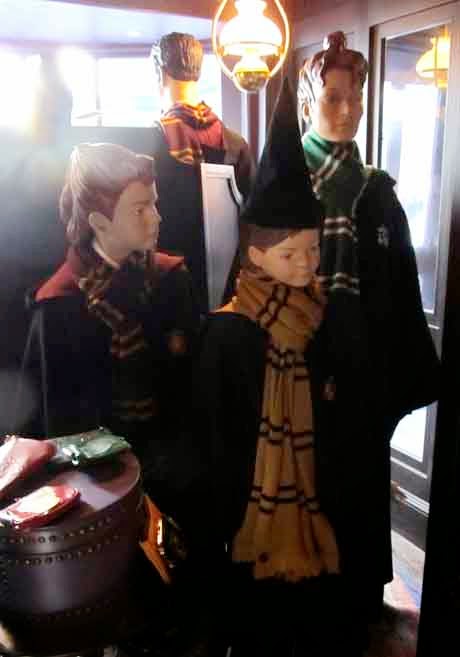
School Supplies in Hogsmead
If you ever need to buy school supplies for your young witch or wizard, the best place to visit is Hogsmeade, a quaint English village located in the heart of Orlando, Florida.
There you can buy the black robes that pass for a uniform at Hogwarts, that foremost school of Magic and Witchcraft. Regardless of what House the sorting hat has assigned them to, you can find other necessary attire, such as sweaters, hats, and scarves, to match the colors of Slytherin, Ravenclaw, Hufflepuff, or Gryffindor.
First-year students, and careless students who need a replacement, can find the wand that suits them best at Ollivander's Wand Shop.
If your young witch or wizard is into sports, they likely play Quidditch. The older brooms Hogwarts assigns their students tend to pull to the side, and can prove truculent at times. For a more responsive model, I suggest the Nimbus 2000. What it costs you in money, it'll make up on the field. The increased performance might be enough to get him or her on one of the House teams.
Or perhaps your children look to the heavens for their inspiration. You'll find a wide variety of telescopes to help your children interpret the meaning of celestial movements.
Of course, every young woman needs her own mirror, if only to remind herself--every day--who's the fairest of them all. It's her, naturally.
Dragon Dave
Friday, February 20, 2015
In Defense of Mr Dursley
Mr. and Mrs. Dursley, of number four, Privet Drive, were proud to say that they were perfectly normal, thank you very much. They were the last people you'd expect to be involved in anything strange or mysterious, because they just didn't hold with such nonsense.
--the introductory paragraph in J. K. Rowling's novel Harry Potter and the Sorcerer's Stone
I don't know what delights you might discover when reading a book by Gilderoy Lockhart, but delving into J. K. Rowling's first novel, Harry Potter and the Sorcerer's Stone, offers delights for anyone who has only seen the movie adaptation. One of those is an enhanced understanding of Harry's uncle, Mr. Dursley.
The Dursleys have everything in life they want, and this is largely because of Mr. Dursley's hard work. He not only works for a company that makes drills, but has made his way to the top office as the company director. He's made his reputation, and doesn't want anything to damage how others perceive him. The one thing that could do that is if his coworkers and neighbors learned that his wife's sister is a witch. And that's just what he and his wife come to fear, when a baby is left on their doorstep.
The baby's name? That of their infant nephew, Harry Potter.
Now we tend to think of witches as being fun and cool in Harry Potter's world, but society has a long history of demonizing things it doesn't understand. The history of witch trials and witch-burnings is hardly a tribute to ordinary people's ability to accept others who live a life different from theirs. Mr. Dursley and his wife thus shine a light on our own limitations to accept change. Whether you label yourself a conservative, a moderate, or a liberal, in any aspect of your life (your political outlook, your religious beliefs, your views on society at large), there are areas in which you are liable to be adaptable, and places where you simply cannot bend.
Mr. Dursley is one of us. He's just like us. The problem is that he's too much like us. So he comes off as one dimensional. We laugh at him, we make fun of him, we deride him. The problem is that we are the hypocrites, not Mr. Dursley. We want to believe that we're better than him. And maybe we are in some ways. But when the owls start to appear, delivering invitations for Harry to join Hogwarts, he can no longer hide from the truth: Harry is destined to become a wizard.
And everyone in the world will know that he raised the boy!
In time, this fear will give way to cruelty, and it's true: there's simply no excuse for the way Mr. Dursley treats Harry. He houses the growing boy in a cupboard under the stairs, he makes Harry into the family servant, he never celebrates Harry's birthday but lavishes untold gifts upon his biological son. But inside Mr. Dursley, there's a good person yearning to get out. He wants to treat Harry well. I believe he wants to lavish gifts upon Harry, and proudly show him off to everyone as his own son. The problem is that Harry keeps on exhibiting signs of a magical nature. I think Mr. Dursley honestly believes that if he keeps on repressing the boy's magical instincts, and plowing on with his own version of Tough Love, that Harry will choose to become a good, stable, conventional member of society. Just like he hopes his biological son Dudley will become.
But then the owls start appearing, delivering invitations for Harry to join Hogwarts, and Mr. Dursley goes frantic. If only he could protect his nephew from the evil, insidious attraction of magic! Why can't the boy choose to be like everyone else? Why can't Harry embrace his ideals, and be the boy Mr. Dursley wants to love and admire?
Ultimately, Mr. Dursley reminds us of our own brittleness, of our inability to accept diversity. He reminds us how we fight against religious, political, societal, and familial change, even though we know it's inevitable. He reminds us why we argue vociferously and tirelessly how others ought to stop being different, and be more like us, the way we want them to be. And finally, he shows us how one-dimensional we appear when we refuse to accept that others are different from us, and refuse to accept their choices as just as rational (and righteous) as our own.
But that's just me, one thing I got out of reading J. K. Rowling's novel. How do you see Mr. Dursley? Am I onto something, something real and true? Or am I merely a muddled muggle?
Dragon Dave
Wednesday, September 10, 2014
J K Rowling on Children's Illustrations
![]() |
| Three Witches and a Knight explore an enchanted garden in "The Fountain of Fair Fortune." |
While watching "Harry Potter and the Deathly Hallows: Part 2" recently, I was struck by "The Tale of the Three Brothers," a fairy tale which the characters in the movie tell Harry at one point. Like Harry, my Muggle upbringing prevented me from reading the stories most magical parents read to their children. Unlike Harry, I lack a wand, as well as the magical capability to wield it. Nevertheless, the way the filmmakers brought "The Tale of Three Brothers" to life through dialogue and images, made me want to read it. Then I realized I had purchased The Tales of Beedle the Bard some time ago, and until now it had been languishing on my bookshelf.
Thankfully, it's not one of those books that behave like monsters, and attempt to bite your hand when you pick it up. Nor did it seem irritated with me, and scold me for ignoring it for so long. So I was charmed as I read "The Tale of the Three Brothers," as well as the other four stories in this slim volume. I found it interesting to read fifteenth century stories whose popularity had ensured not just their survival, but their relevance for contemporary readers. Beedle's writing harkened me back to the Medieval era, when Muggles had reasons to fear magic, as there was no Ministry of Magic to police witches and wizards properly, and warn them of the dangers of indulging in the darker arts. For as J. K. Rowling points out in her Introduction, Magic (regardless of its power or effectiveness) doesn't solve problems. Magic is just another tool that (some) Humans use to solve problems. Unfortunately, time proves most of our decisions wrong, and we often find ourselves working hard to manage or correct problems our choices and actions have created.
In addition to Beedle's prose, Professor Albus Dumbledore also gives us his thoughts on each story. He tells us which ones he enjoyed most, and suggests how each fairy tale may have differed from reality. He explains the reasons why some of these stories may have changed throughout the centuries to address new situations. His commentary provides insight into a world Muggles like me can only dream of inhabiting.
While I enjoyed reading this slim volume, I was shocked to discover that J. K. Rowling actually drew the illustrations. I do a little drawing now and then, and when I'm working on a story, drawing the characters and the setting help me better visualize a scene. Hopefully, this helps me to better convey it through words. Unlike my drawings, J. K. Rowlings illustrations are actually good. It's no wonder her Harry Potter novels have proven so popular, given her ability to visualize scenes through her sketching. Her work inspires me to devote more time to my own drawing, which was the last thing I expected when I picked up this slim volume.
There are lots of reason why you should buy this book. If you love Grimm's Fairy Tales, you'll appreciate the differences in the stories collected within this magical volume. If you've always wanted to read the Harry Potter novels, but worried about committing yourself to seven books, you can start here. If, like me, you'd simply like another glimpse into J.K. Rowling's magical world, this slim volume can provide that for you. But there's a better reason than all of those to pick up The Tales of Beedle the Bard, and that's because proceeds from the book go to fund Lumos, a charity that provides educational, medical, and social benefits to disadvantaged children across Europe. Buying this book will help institutionalized children find loving families, and better prepare them for adulthood. Plus, as I said, it's a safe magical book: it won't bite the hand that buys it, or shriek at you for not reading it sooner. For me, that makes buying The Tales of Beedle the Bard a Win/Win situation for everyone. But then, maybe I'm not seeing the whole picture. After all, I'm only a Muggle.
Dragon Dave
Wednesday, October 17, 2012
Quidditch: J. K. Rowling’s Sport
![]() |
| "Just envision throwing the Quaffle through the goals." |
In the Harry Potter novels, author J. K. Rowling invents a
sport for the students to play at Hogwarts.
The game is Quidditch, and the players fly over the game field on their
broomsticks. Each player has a
specialized job, and Harry’s is the most special of all. For he plays the Seeker, and more often than
not, the team whose Seeker captures the tiny flying ball called the Snitch will
win the game.
![]() |
| "Let's keep those broomsticks high, everyone!" |
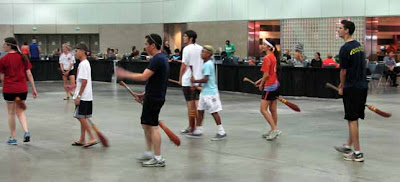
At Stan Lee’s Comikaze, a section of the exhibit floor had
been given over to participants to play a land-based version of Quidditch. I’m not sure if the players fully understood
the rules, or the teams needed time to work out their strategies. It seemed to me that the players spent more
time standing around and talking than they did playing. Still, they seemed to be enjoying themselves,
and I thought it a nice touch that the organizers had translated a game from J.
K. Rowling’s novels into something practical that attendees could play between
panels, presentations, and the other activities.
![]() |
| "I'm tired of being a Chaser. Let me be the Keeper, please?" |
But in that I was mistaken. Quidditch is more than just an imaginary game
played by fictional characters. Students
in universities and high schools have formed teams. Quidditch, also known as Muggle Quidditch, is
a real sport. In addition to regional
and European championships, World Cups have been held. (The last occurred in 2011 in New York). The International Quidditch Association
proclaims that there are 798 teams in the United States, and that Quidditch is America’s
fastest growing sport. Interested in
playing Quidditch? Check out the IQA
website to find a team, download rules, watch videos, and read the latest
Quidditch news.
![]() |
| "Watch out for the Bludger!" |
I’m sure J. K. Rowling never envisioned all this when she
invented a sport for Harry Potter to play at Hogwarts. But because her readers love her characters,
and her novels, they made Quidditch a reality. I may understand Quidditch no better than I understand Soccer (sorry, Football), Rugby, and Cricket, but I can't help but feel that its rising popularity serves as a wonderful testament to the important role that Fiction plays in our lives.
![]() |
| "I bet I could make this goal if I had a Nimbus 2000." |
Some people claim there’s no magic in this world of
ours. I disagree.
Dragon Dave
Related Internet Links
Monday, July 23, 2012
Terrance Dicks: Don’t Let the Screen Go Dark
![]() |
| One journey ends. Another begins. |
Saturday proved an unusual day for me. It had been a hard week, and my wife and I
were feeling, well, “narky.” Like the
collar of a favorite shirt, we were afraid if we did much more, our emotions
would start to fray. So, after
breakfast, we abandoned plans to “make Saturday count” and did something we’ve
done with decreasing regularity in recent years: we spent most of the day
relaxing, and a good portion of it reading.
This proved a happy and healing process for us. I finished Foreigner by C. J. Cherryh,
a novel I’ve been chipping away at for some time. My wife finished The Stainless Steel Rat
Returns by Harry Harrison. I also
started Time of the Great Freeze by Robert Silverberg, a 1964 novel
written for young readers. (Believe it
or not, J. K. Rowling didn’t invent the Young Adult market). But more on those books later.
In his story “The Great Slow Kings,” Roger Zelazny introduces
us to two aliens, Drax and Dran, who plan to build a society around two examples
of a lesser species whom their robot Zindrome brings to their planet Glan. While Drax and Dran reenact their version of
the conversation between Socrates and others in Plato’s Republic, these
newcomers live life at a frantic pace, and populate Glan. Lacking direction from the Slow Kings, they build
their own societies. Thus, by their
inaction, Drax and Dran become irrelevant.
In “Roger Zelazny is in My Head,” I discussed the battle I
wage every day in my writing. My Slow Kings
are named Procrastination and Perfectionism.
Like Zindrome, I’m often caught in the crossfire between these two. Sometimes I’ve listened to Procrastination,
and opted not to write because I “wasn’t in the mood.” Or I’ve listened to Perfectionism and
abandoned promising stories because they “weren’t good enough.” I may never dethrone my Slow Kings, but each
time I complete a new post, I’m publishing a message that may prove meaningful
to someone. Writing this blog comes with
a price tag, however. During the week, I
can’t write this blog until I’ve first met my daily target for my novel. On the weekend, other priorities make
themselves known.
After yesterday’s rest, I found myself with no blog post
prepared. So my thoughts returned to
Drax and Dran, but they also returned to Terrance Dicks, who worked as the
Script Editor for the TV series “Doctor Who” from 1970 to ’75. In 1977, producer Graham Williams needed a
script yesterday. So, working at a frantic pace, Terrance Dicks
created a four-part story called “Horror of Fang Rock.” On his DVD commentary, Dicks shared this
insight: his goal wasn’t to write a great (or perfect) story, it was about not
having the TV screens in Britain go dark those four nights.
![]() |
| Terrance Dicks' legacy is well-guarded. |
I know most who stumble across The Dragon’s Cache won’t
return. But if I am to make this blog a
dependable source of encouragement and inspiration, I must provide something
new on a regular basis. Otherwise, those
who look to me for some thoughts to power their day will grow disenchanted, and
search out more dependable sources.
In Roger Zelazny’s story, Drax and Dran contribute nothing
to their world. Certainly
Procrastination has never contributed a single thing to mine. Ironically, the blog posts I thought most
perfect often attract little interest, while those that have proven most popular
almost always took me by surprise. This
suggests that Perfectionism isn’t a perfect guide either. (This realization also suggests that when I
finish my dragon novel, I should revisit my older manuscripts. Perhaps Perfectionism judged some of those
stories too harshly).
Yes, I need time to work on my novels. Yes, I need time to relax and recharge. But now I recognize the truth: Procrastination
and Perfectionism’s arguments cannot be trusted. With my apologizes to the great Roger Zelazny, I
must model myself on Terrance Dicks, and do my best to never, ever, let your
screen go dark.
Related Dragon Cache entries
Related Internet Links
Monday, April 23, 2012
Lucius Malfoy vs. Neil Gaiman
I never cease to be surprised by the ironies of fate. Why one artist, despite similar talent and ability, rises to stardom, while another toils in obscurity. Recently, I realized that the actor Jason Isaacs, who came to my attention through the PBS miniseries “Case Histories,” and currently stars in “Awake,” also played Lucius Malfoy in the Harry Potter movies. Given his strong portray of the villain, one would think the actor would have felt some assurance that his services would be requested for all the movies. Yet, after “Harry Potter and the Order of the Phoenix,” Jason Isaac’s reportedly had to get down on his knees and beg J. K. Rowling to include him in the final three films. Talk about the glamorous life of an actor!
"Please, Ms. Rowling, please write me in! Please please!"
I find it ironic that despite his incredible range, and noteworthy performances in a long list of movies, TV shows, and stage productions, Jason Isaacs remains solidly under the radar of the paparazzi. Unlike the similarly-featured Daniel Craig, he can take the London Underground to a movie premier. People may go gaga over him when he’s on the red carpet, but they don’t notice him on the train ride home. And that’s the way he likes it. While he imagines he’d like to earn “obscene” amounts of money, he prefers his “calm, sedate and suburban” life to what he sees as the “hideously compromised” lives of those who have skyrocketed to stardom. Such as, for example, his body double Daniel Craig.
Like J. K. Rowling, another author who has learned that becoming a superstar writer will cost you your anonymity is Neil Gaiman. I had the pleasure to seeing him at last year’s World Fantasy Convention. I admire his work in the Science Fiction and Fantasy genre, as well as for connecting so readily with his fans through his website, blog, Tumblr, and Twitter. But I think he first drew my attention for his simple approach to writing. He repeatedly tells authors aspiring to be published that there are three things one must do to become a successful writer: 1) Write, 2) Finish, and 3) Submit. Anyone who can boil down all the intricacies of the marketplace, and the essential makeup of a successful author, into such a basic formula obviously exhibits a certain clarity that can only aid them in communicating to readers through their fiction.
At the recent World Fantasy Convention, I laughed until my sides ached during his panel discussion with Connie Willis. I took careful notes as he charted his progression as an author during his Guest of Honor interview. But then the breath caught in my throat as he announced that he was considering dramatically cutting back on his internet activities to concentrate more fully on his writing. And when he admitted that he was seriously considering not attending conventions any more, my jaw dropped.
He went on to share that he no longer enjoyed attending conventions because he could not walk the halls unnoticed. He couldn’t peruse the books and other items for sale in the dealers’ room, or contemplate the works displayed in the art show. He couldn’t simply hang out in the hotel bar and hope to meet a few new friends. Why? Because he had grown too popular. His fans were always hunting him down to ask him a few questions, or asking him to sign their books, and that would be all right, except for the sheer number of them. To paraphrase a popular Carpenters song: “Crowds appear whenever Neil Gaiman is here.”
![]() |
| Neil Gaiman: A Literary Giant |
Despite my perfectionist tendencies, I sometimes wonder if part of my reluctance to follow Gaiman’s formula through to completion stems from my fear of the disruptions and change success might bring. To quote Charles Stross, “Writers are often boring people. They stay home and they, like, write for hours and hours every day. Watching them write is really boring, because believe it or not, it takes much longer to write a book than to read it.” Charles is being somewhat tongue-in-cheek here, as anyone who has ever seen or met him at a convention knows that he is anything but boring. Still, he has a point. While Alf Wight (who wrote as James Herriot) may have written his books in the living room, watching TV with his family, for most of us the writing life means willfully condemning ourselves to solitary confinement, and then having little to talk about when meeting others socially.
Typical Nonwriter/Writer Interaction at Party
Nonwriter: "So, what've you been up to lately?"
Writer: "Um, er, well...let's see...I've been writing?"
Nonwriter raises eyebrows. "Really? Please excuse me while I refill my glass. Then I want to hear all about it!"
While I’ve come to grips with this aspect of my chosen endeavor, and even to enjoy the solitude and quiet, I need to validate my efforts by finishing and submitting. Do I want to walk in the shoes of someone like Steven Brust (or Jason Isaacs), with a number of well-loved books to my name? Absolutely. Do I want to be like Neil Gaiman or J. K. Rowling or Daniel Craig, making “obscene” amounts of money and living a “hideously compromised” life? Not so much.
Still.
I guess, when you think about it, worrying about becoming a superstar player is incredibly stupid. Especially when you’ve yet to make the team.
Related Dragon Cache entries
Related Internet Links
Friday, April 20, 2012
Lucius Malfoy and Vlad Taltos: Kindred Spirits
My wife and I have this argument (sorry, discussion): she contends that watching movie credits is a waste of time; I find them interesting. Case in point. Last weekend, we had just finished “Harry Potter and the Order of the Phoenix” when a name popped out at me: Jason Isaacs. To her chagrin, I watched longer, until the cast list appeared. What? Jason Isaacs plays Lucius Malfoy? No!
(Note: When I’m screaming “No!” like this, picture me as Captain Kirk in “Star Trek II: The Wrath of Khan,” after Khan has seemingly left Kirk for dead inside the asteroid. But instead of “Khan!” I’m shouting “Noooooo!”)
As an aspiring writer (sorry, a writer aspiring to be published), I don’t usually track actors. Instead, I follow people like screenwriters, directors, and producers. You know, those “creative” types. It appears, from scanning Mr. Isaacs’ resume, that he’s been in a lot of productions I should have seen, along with a few I have. But the first time he really stood out for me was in the recent PBS miniseries “Case Histories,” about private investigator Jackson Brodie. Part of the reason the show impressed me was that it was set in and around Edinburgh, a city I’d love to visit someday, and have always associated with SF/Fantasy authors Charles Stross and J. K. Rowling. (In the Kate Atkinson novels upon which the PBS miniseries was based, Jackson Brodie apparently lives in Cambridge. Like I said, these “creative” types).
![]() |
| The Edinburgh Duo "In this corner..." |
But another, and perhaps the main reason the miniseries sucked me in was Jason Isaacs’ performance. The cases he sought to solve didn’t matter all that much: what really brought the show to life was Isaacs’ performance. I really felt for him when he tried to convince his divorced wife not to move away, and to allow him to continue seeing his daughter, despite his violent career-choice. I believed the love he felt for his daughter. I understood why others remained his friends, even when circumstances dictated they should shift their loyalties. His portrayal of Jackson Brodie reminds me of why so many love the Vlad Taltos novels of Steven Brust. Like Vlad, Jackson seems the perennial outsider, and there are constantly forces at work to prevent those friends and family members from helping him. Yet they risk their reputations and their lives repeatedly for him, because of who he is, and what he has become to them.
While I find the storyline of “Awake” compelling, the main reason I started watching the Science Fiction drama was because of Isaacs’ performance in “Case Histories.” While I miss the moody setting of Edinburgh, I find his portrayal of Detective Michael Britten just as compelling. In many ways, his looks and on-screen presence remind me of Daniel Craig, another British actor who has shot to worldwide fame since he started playing James Bond in the Before-He-Was-Bond productions of “Casino Royale” and “Quantum of Solace.” But Jason Isaacs as Lucius Malfoy? I’ve seen all the Harry Potter movies at least once, the earlier ones several times, but never would have connected him with the somber, brooding Jackson Brodie, or for that matter Michael Britten, in a million years. Recognizing this, I’m less surprised that his portrayal in the miniseries connected with me so strongly. If he can transform his features and mannerisms so completely from one role to the next, he seems capable of tremendous range for an actor.
This ability, combined with the respectable body of work he has accumulated, begs the question of Isaacs’ relative obscurity, in comparison with Daniel Craig, an actor who, from my perspective, exhibits similar looks and capabilities. (Given all the high profile roles he’s been offered since he took on Before-He-Was-Bond, I’ve never seen Daniel Craig subsume himself so utterly in a role as Jason Isaacs did with Lucius Malfoy). But then again, I might as well ask why Steven Brust, despite his impressive body of work, his creation of an unforgettable character, and having built a strong following, has yet to achieve a superstar status in the literary community similar to that of J. K. Rowling or Neil Gaiman.
Ah, the quirks of fate!
This entry will conclude with Lucius Malfoy vs. Neil Gaiman.
Related Dragon Cache entries
Related Internet Links
Subscribe to:
Posts (Atom)