Showing posts with label magic. Show all posts

Tuesday, August 20, 2013

Gnomes and the Magical Swiss Lime Tree


"In the deep snow the countryside looks like fairyland.  Hans and [his dog] Barry plod through the snow, between the snow-laden trees, which look like great big hooded gnomes.  Everything is glistening and shining in the moonlight, and the branches of the old limetree cast magic shadows."
--Ferdinand Steenaerts, The Boy From A Village Called Trub

Lime trees in Switzerland (also known as the Linden Tree, or Tilia europaea), are magical trees. They can live for thousands of years, and feature in some of mankind's oldest religions, myths, and legends. Historically, villages held court under them.  Today people use them to track the seasons of the year, as a symbol of the changing face of Europe, and as an aid to understanding the cosmos.   


The Lime tree's leaves and bark can be used to make tea, medicines, even shoes.  Some communities have trained the tree limbs to grow horizontally, and hold dances in the trees.  Learning about the Lime trees' significance gives me another reason to visit Switzerland.  If I visit during the winter though, I'll have to watch out for those "great big, hooded gnomes."  While J. K. Rowling suggested in the Harry Potter novels that gnomes are mischievous but harmless, Terry Brooks has revealed their warlike nature in his Shannara series, and the ease with which they can be subverted to evil causes.  But then there's the Travelocity Gnome.  He's become a patron saint to travelers.  And many gardeners, the world over, enlist Gnomes to watch over their gardens.  

When I was growing up, my church frowned on drinking and dancing. We were taught that such harmful activities would lead to our downfall.  Yet the Swiss not only drink and dance, but they do so in their magical lime trees.  As the Swiss are smart people, it's safe to assume that they wouldn't drink and dance in trees if they regularly fell out of them.  So what beneficial force uplifts the Swiss, and keeps them safe during their tree-parties?  

From the way Ferdinand Steenaerts links them with the magical Lime trees and the beauty of the Emmental region in winter, it's got to be the Gnomes. 

Dragon Dave

Related Dragon Cache entries
The Familiar Flavor of Terry Brooks

Related Internet Links
Lime Tree Society
Lime Tree Symbolism
Russian Grannies dance in Lime tree slippers

Monday, March 18, 2013

Jack, Lovejoy, and Magical Beans

How might a few beans transform your life?

Two weekends ago, we realized it had been awhile since we made black bean nachos.  So my wife rinsed off a pound of black beans, put them in a pot of water, and let them soak.  The following day, she rinsed them off again, then poured them into a crockpot with more water, and left them to cook while we went off to see “Jack the Giant Slayer.”

We arrived late (for us), with the previews only a few minutes away.  Strangely, we had the cinema mostly to ourselves.  When the previews started, only a handful of the seats were filled.  By the time the movie began, perhaps a dozen or more people had joined us.  But no more than that. 

Initially, we had not planned on seeing the movie.  But something about the images in the preview called to me, and suggested it would be fun.  Perhaps it was the fact that Ewan McGregor was in it.  We’ve enjoyed his roles in dramas such as “Mrs. Potter,” in which he played Beatrix Potter’s publisher, as a fishing expert in “Salmon Fishing in the Yemen,” and of course, his portrayal of Obi-Wan Kenobi in the “Star Wars” prequels.  In “Jack the Giant Slayer,” he again plays a knight, only this time he swaps his white clothing for black leather armor.  We don’t usually attend movies just because of an actor, but having enjoyed so many movies with him playing a lead role, his presence tipped the balance for us.

What came as an unexpected surprise was to see Ian McShane playing King Brahmwell, in whose land the action takes place.  Many people know him for the HBO series “Deadwood,” or his role of Blackbeard in “Pirates of the Caribbean: On Stranger Tides,” but I’ll always think of him as the bohemian art dealer who played the title role in the British TV series “Lovejoy.”  Here he plays a king who views himself as largely a figurehead, but who desperately wants to protect his kingdom and retain the relevance of his position.  The inadequacy he feels is continually hinted at, most poignantly perhaps by the armor he wears.  At once, he seems glorious, strong, and yet, more like a court jester than a king.  The role suited McShane well, and in many ways, his was the performance that anchored the movie.

Bill Nighy, who constantly exhibits a wider range of abilities on the big screen, in movies from “Love Actually,” the second and third “Pirates of the Caribbean” movies, “Hitchhiker’s Guide to the Galaxy,” and “The Best Exotic Marigold Hotel,” again subsumed himself in his role as Fallon, the two headed leader of the giants (he played the larger head), utterly unrecognizable with his CGI makeover, and yet always the center of attention.

His depiction of Fallon reminded me of Zaphquod Beeblebrox, the two-headed man from Betelgeuse in The Hitchhiker’s Guide to the Galaxy, written by Douglas Adams, and based upon the popular radio series.  This would have been even more interesting had Bill Nighy played Beeblebrox in the movie adaptation of Adam’s novel.  (I would again be reminded of Douglas Adams the following day, when Google celebrated what would have been his sixty-first birthday with an animated Doodle on their main search page).


After the movie, we came home, warmed up some leftovers, and ate lunch (some rather fine chimichangas from a nearby Mexican restaurant) while the tantalizing aroma of baking beans filled the house.   Then, shortly before dinner, my wife took the beans out of the crockpot, drained them, and mashed them in a saucepan.  As she cooked them over the stove, she added back in some of the water from the crockpot until she got the right consistency.  Then she served them up with tortilla chips, cheese, shredded lettuce, salsa, and sour cream, for her famous black bean nachos.


In “Jack the Giant Slayer,” few of the major characters--not even his uncle--would have believed in magical beans, or Jack's ability to utterly transform himself.  Yet, because he dared to believe a young priest's assertion that the beans were magical, he later climbed a beanstalk, rescued Elmont (McEwan), the leader of King’s Brahmwell’s elite guard, defeated the giants, won the princess he loves, and captured an important crown.  My wife’s black bean nachos may not help me secure my destiny, but they tasted delicious, and I enjoyed them almost as much as the movie.  It's a shame more people didn't watch it with us.  But then, the magical properties of beans are sadly underrated.

Pocket Dalek:
You will respect the beans!
You will respect the beans!
Dragon Dave


Related Dragon Cache entries
An Evening at Ritz Cinema: Part 4, in which we watch "Salmon Fishing in the Yemen," in James Herriot's Cinema in England.

Dining Outside is for the Bird (and the People), in which I eat outside in London, just like Lovejoy would.  (I know, exciting stuff, right?)

Wednesday, October 17, 2012

Quidditch: J. K. Rowling’s Sport

"Just envision throwing the Quaffle through the goals."


In the Harry Potter novels, author J. K. Rowling invents a sport for the students to play at Hogwarts.  The game is Quidditch, and the players fly over the game field on their broomsticks.  Each player has a specialized job, and Harry’s is the most special of all.  For he plays the Seeker, and more often than not, the team whose Seeker captures the tiny flying ball called the Snitch will win the game.

"Let's keep those broomsticks high, everyone!"

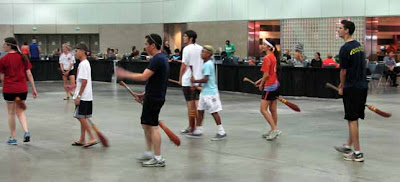
At Stan Lee’s Comikaze, a section of the exhibit floor had been given over to participants to play a land-based version of Quidditch.  I’m not sure if the players fully understood the rules, or the teams needed time to work out their strategies.  It seemed to me that the players spent more time standing around and talking than they did playing.  Still, they seemed to be enjoying themselves, and I thought it a nice touch that the organizers had translated a game from J. K. Rowling’s novels into something practical that attendees could play between panels, presentations, and the other activities.

"I'm tired of being a Chaser.  Let me be the Keeper, please?"

But in that I was mistaken.  Quidditch is more than just an imaginary game played by fictional characters.  Students in universities and high schools have formed teams.  Quidditch, also known as Muggle Quidditch, is a real sport.  In addition to regional and European championships, World Cups have been held.  (The last occurred in 2011 in New York).  The International Quidditch Association proclaims that there are 798 teams in the United States, and that Quidditch is America’s fastest growing sport.  Interested in playing Quidditch?  Check out the IQA website to find a team, download rules, watch videos, and read the latest Quidditch news.

"Watch out for the Bludger!"

I’m sure J. K. Rowling never envisioned all this when she invented a sport for Harry Potter to play at Hogwarts.  But because her readers love her characters, and her novels, they made Quidditch a reality.  I may understand Quidditch no better than I understand Soccer (sorry, Football), Rugby, and Cricket, but I can't help but feel that its rising popularity serves as a wonderful testament to the important role that Fiction plays in our lives.

"I bet I could make this goal if I had a Nimbus 2000."

Some people claim there’s no magic in this world of ours.  I disagree.

Dragon Dave

Related Internet Links