Showing posts with label Douglas Adams. Show all posts

Monday, March 29, 2021

Douglas Adams: Mostly British

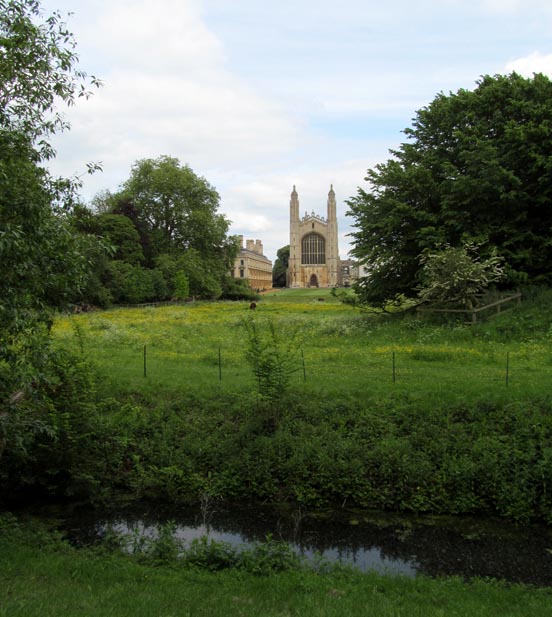
The wild beasts of Grantchester Common, England


In Douglas Adams' novel Mostly Harmless, his last novel in the Hitchhiker's Guide series, seasonal migrations takes place near the village where Arthur lives. Great beasts sweep majestically across the vast plains on their way somewhere else. When Ford Prefect arrives, he is struck by these herds of wild beasts that annually appear, and the local villager hunt to fill their storerooms with meat. This aspect of the story, along with a meeting late in the novel with a certain iconic rock musician, gives this British novel a decidedly American vibe. 

Seven years after he published Mostly Harmless, Douglas Adams emigrated to the United States, and lived there for the rest of his life. Or perhaps, as an American author, I should say that he lived here.

The way Douglas Adams ended his novel, as well as the entire Hitchhiker's Guide series, left me more than a little sad. Still, I'm glad I reread this classic series. It was one I fell in love with in my teens. After decades of loving the stories Adams wrote for Doctor Who, as well as those he oversaw and shaped in his role as the TV series' Script Editor, I can appreciate his Hitchhiker's Guide novels more. The way his characters navigate the complex possibilities of space and time travel still evokes a sense of awe, which is the signature of great Science Fiction.

Trinity College, Cambridge, England


When I visited Cambridge three years ago, I could see the town that E. F. Benson had described so lovingly in his novels Limitations and The Babe, B.A. I sensed a little of the university life that Adams' Doctor Who story "Shada" alluded to. Although I did not get to meet many students, the few I met showed an interest and respect for science. This helps me appreciate the fertile ground in which Adams' ideas were germinated. 

And yet, somewhere in Cambridge, peopled by today's aspiring comedians and dramatists, is the Cambridge University Footlights Dramatic Club. Perhaps, if I ever return to the university town, I can catch a performance of the storied group known as the Footlights. It'd be interesting to see what this troupe of performers, whose membership once included members of Monty Python and Douglas Adams, is currently doing. 


St John, Douglas Adams' college, Cambridge, England


The fact that Douglas Adams gave his final Hitchhiker's Guide novel Mostly Harmless an  American flavor, and eventually emigrated to the United States, reminds me of how much I have enjoyed traveling to England, and even considered living there. It makes me wonder if, through writing the series about exploring the universe, Douglas Adams discovered his own love of travel, and this caused him to consider living elsewhere. It makes me feel a little closer to the author I never really knew, apart from the stories he created. 

So long Douglas, and thanks for all the stories.

Dragon Dave


Monday, March 22, 2021

Douglas Adams: Mostly About Family

Grantchester, a village outside Cambridge, England

In Douglas Adams' novel Mostly Harmless, the fifth installment in his Hitchhiker's Guide series, the spaceship Arthur Dent is traveling aboard crash-lands on an alien world. Inhabitants of a nearby village accept Arthur, and he discovers that they've never heard of sandwiches. So Arthur assumes the role of Sandwich Maker for his village. This gives him an important role in the community, and he hires an apprentice to keep up with customer demand. 

After Trillian and Zaphod dropped out of the series in book three, we never learned what happened to them in book four. In Mostly Harmless we learn that Trillian has traded in her vagabond status for a career as an interstellar reporter. On her way to covering the next big news story, Trillian stops off on Arthur's adoptive homeworld, and introduces him to their daughter Random. 

As Arthur never had a close relationship with Trillian, you can imagine his surprise at Trillian's bombshell.

King's College, Cambridge, England


It seems that sometime after both Zaphod and Thor left her, Trillian decided she wanted a daughter. She reached out to the interstellar gene banks for a compatible match. As Arthur had sold his genetic material to travel aboard spaceships in First Class, she was able to get the requisite genetic material from a fellow Earthling. Now she has a daughter she's never has time for, as her interstellar reporting duties prevent her from having a stable homelife. 

During his travels, Arthur had thought he was getting something for nothing. Now, he realizes that, well, there's no such thing as a free lunch. Whether it includes sandwiches or not. 

She may have just arrived, but Trillian doesn't have time to stop and catch up with Arthur. Nor can she be bothered to bring Arthur with her, so they can function as a family while she's covering stories across time and space. Instead, she announces that she's leaving Random with Arthur because, well, she's his daughter too, and he should share in the responsibility of raising Random. One moment Arthur is content, if not completely happy, in his new life as chief sandwich maker for his village. The next, he's a father who must work to connect with a daughter who is a complete stranger to him.

Grantchester Common, Grantchester, England


Random has never had much of a relationship with her mother, as Trillian was always on the go for her job. So she's never really known where she fits in, and doesn't get along with others. How can she be expected to feel love for this man, and honor him as her father? After all, from her perspective, she's never even had much of a mother. 

There's no such thing as a perfect family, and even in the best of times, maintaining healthy family relationships can be difficult. Douglas Adams' parents divorced when he was young, so he knew how difficult it can be to build a happy and nurturing family. He had a complicated relationship with English barrister Jane Belson, whom he married in 1991 after several breakups and a broken engagement. As Mostly Harmless was published the following year, I imagine Adams drew upon his own childhood, as well as his on-again/off-again relationship with Jane Belson, in crafting the complicated dynamics between Arthur, Trillian, and Random in Mostly Harmless.

Dragon Dave 

P.S. Two years after Douglas Adams published Mostly Harmless, his wife Jane gave birth to a daughter.


Monday, March 15, 2021

Douglas Adams: Mostly Trisha


London, England

While Douglas Adams' first four novels in the Hitchhiker's Guide series appeared roughly a year apart, eight years elapsed before the fifth appeared. I'm not sure when I purchased Mostly Harmless, but I'm guessing it was several years following publication. Sadly, the first time I read it, I never really got into the novel. One thing I remembered as I reread it was my initial reaction that the novel was overwritten, featuring scenes that just seem to go on and on...and on.

Mostly Harmless is longer than any of the previous installments in the Hitchhiker's Guide series, and seems concerned that the changes and paradoxes created by people traveling through time. As an interstellar reporter, Trillian zips back and forth through time. If the events she covers get altered by herself or other travelers, and cause history to be rewritten so that the events she covers never actually happened...well, you can see how all of spacetime could become muddled.

Arthur and his girlfriend Fenchurch leave Earth and travel through space together. One day she just...disappears. Arthur never learns why she simply ceased to exist. Apparently, it's a remote--but very real--danger of hyperspace travel. Forlorn, Arthur continues traveling--not as a hitchhiker, but a paid passenger--and sells his genetic material to upgrade to First Class. 


London, England


Meanwhile, Ford Prefect notices that his original expansive entry on Earth is now included in his copy of the electronic travel book at the heart of this series: the Hitchhiker's Guide. After traveling to the guidebook's headquarters, he discovers that the Vogons, who destroyed Earth in the first novel to create a hyperspace bypass, are now in charge. 

In some ways, the change in management has proven beneficial. Under the previous management, secretaries often edited travel correspondents' reports. Thus, his entry covering Earth history, culture, and cuisine was reduced to "Mostly Harmless."*

Sadly, not all change is beneficial. Ford learns this firsthand, when the Vogon management attempts to kill him. Still, at least they merely shoot their weapons at him, rather than subjecting him to their poetry.


Buckingham Palace, London, England


We also met a woman called Trisha, a TV news reporter on Earth (which, remember, isn't supposed to be around, after the Vogons destroyed it in the first book). Trisha once met Zaphod at a party, but turned down his invitation to explore the universe. She has always regretted not going off with him in his spaceship. So when another spaceship lands in London, she makes sure that she is the one to interview the aliens. 

I enjoyed Trisha's journey in Mostly Harmless. We can all relate to regret over paths not taken. Her experiences in the novel are the kind that First Contact chasers dream about. She may have missed out on her first opportunity to travel and experience new things. Still, when that next opportunity came her way, she was ready!

Dragon Dave

*Even after all these decades, I'm still interested in reading the intergalactic guidebook. Perhaps now that the Vogons are in charge, it will soon become available for Earthlings to purchase. Just please, Vogon managers: no poetry!


Monday, March 8, 2021

So Long Douglas Adams, and Thanks for all the Fish

A Road near Holmfirth, England


Douglas Adams' fourth novel in the Hitchhikers Guide to the Galaxy series is the shortest of all, and proved a surprising favorite. I thought it featured some of the best characterizations of any installment in the series, and told a beautiful love story. Like all the best bedtime stories, it begins with a dark and stormy night in England.

In So Long, and Thanks for all the Fish, Arthur Dent returns to England after hitchhiking throughout the galaxy. Unlike the first three novels, in which he was always dragged into an adventure by a character like Ford Prefect or Slartibartfast, he's charting his own course this time. Somehow the Earth exists, even after it was destroyed by the Vogons in book one. As Arthur walks along a highway in the rain, a car stops to pick him up. So now he's hitchhiking on a planet familiar to him, even if it shouldn't exist.

Back in his familiar British surroundings, Arthur falls in love with a troubled soul. Her name is Fenchurch, and she is troubled because she sees things she shouldn't, and exhibits talents her fellow humans do not possess. Arthur is drawn to her, and learns that she has seen visions of Earth's destruction by the Vogons, which somehow, on Earth, or at least this Earth, has not taken place.


In the previous book, Arthur developed a new ability. Or rather, he fell into it. It's a superpower many comic book characters exhibit, and if you haven't read the series recently, I won't spoil it for you. Let's just say that, in pursuing Fenchurch, he discovers that she also has this superpower. Finally, after all his travels, Arthur has found a kindred soul.

In the first three novels Arthur often came off as rather muddle-headed, and unable to grasp the importance of the situation he was thrown into. Zaphod constantly belittled him, Trillian looked down on him, and Ford lost patience with him more than once. Yet here, on this still spinning Earth, he becomes, if not a hero, at least the strong protagonist who always belonged at the heart of this series. 

Holmfirth, England


Events usually loom larger than the characters in Douglas Adams' Hitchhikers Guide series. So after all his travels, In So Long, and Thanks for all the Fish, the way Arthur finally finds the place he can finally call home, and the person with whom he can share it, is what I most remember.

Dragon Dave

P.S. My late friend, Marvel colorist Justin Ponsor, held a deep and abiding love for Douglas Adams. Although he wasn't much of a reader, he surpassed me by reading every book Adams ever wrote. He told me how sad he became, when he reached the last sentence of The Salmon of Doubt, Adams' final unfinished novel, and the words just...stopped. 

At Justin's funeral, his sister referenced his love for Adams' stories, and concluded her talk with "So long Justin, and thanks for all the fish." Apparently, some readers have found in the title of this Douglas Adams novel a humorous way to say good-bye. For the most part, saying good-bye is, I think, a skill I lack. While the Hitchhiker's Guide series seems to end here, apparently Adams couldn't say good-bye to the series either. Thus many years later, he published his final installment, Mostly Harmless.


Monday, March 1, 2021

Douglas Adams, the Universe, Abandonment and Thor

St. John, Douglas Adams' college, Cambridge, England


Life, the Universe, and Everything, the third novel in Douglas Adams Hitchhiker's Guide to the Galaxy series, sees the unraveling of the not-so-friendly foursome of Arthur, Ford, Trillian and Zaphod. Zaphod, the two-headed ex-president of the universe, decides there's some crucial facts that he's hidden from his conscious (collective) mind. So he wanders off after awhile, and is never heard from again. Likewise, when Arthur meets up with Trillian at a party, she seems cold and distant. Again, she leaves with someone else. This time it's Thor, the Norse god of Thunder. 

The way these two characters just drop out of the novel, as well as The Hitchhiker's Guide series at this point, without any sort of resolution to their individual plot arcs, seems weird. Then again, before this novel was published, Adams had an affair with novelist Sally Emerson while she was separated from her husband. After the affair ended, and she returned to her husband in 1981, Adams dedicated Life, the Universe, and Everything to her. So perhaps, the way Zaphod and Trillian abandon Arthur and Ford ties in with events in Adams' life, and the theme of abandonment I noticed in the first two Hitchhiker novels. 


The Round Church (next to St. John), Cambridge, England


Thor has been on my mind for many years now, as he plays a large role in the Marvel Cinematic Universe movies. My wife and I collected the comic for several years, after Thor Odin-son lost his worthiness to wield the hammer, and an Earth-woman, much to Odin's displeasure, took on the mantle of Thor. 

Recently, Neil Gaiman published the book Norse Mythology, in which he updated some of the  Norse myths about Thor and Asgard for today's readers. Dark Horse is currently adapting these stories in a comic book series. Thor's hammer hangs on my wife's keychain, and she has read Rick Riordan's series about the Norse gods. A print of the Marvel character Thor, taken from an original painting by my late friend comics colorist Justin Ponsor, hangs in our living room. So it's interesting to me that in a series that extrapolates so heavily on scientific concepts, Douglas Adams chose to make Thor, a character from ancient mythology, a character in two of his novels. 

Grantchester Common outside Cambridge, England


I wonder what attracted Douglas Adams to the Norse god of Thunder, and what he would make of the character as portrayed in the Marvel movies. Did he grow up reading the Norse myths about Thor like Neil Gaiman? Or did he grew up reading Marvel's Thor comics, and that was why he placed the Norse god in two of his books?

Dragon Dave

Monday, February 22, 2021

Douglas Adams, the Universe, and Cricket

Cambridge, England
 

While the set pieces of the first two novels in Douglas Adams' Hitchhiker's Guide to the Galaxy series were familiar to me from their TV and movie adaptations, the rest of the series represented a fresh step forward. Nevertheless, as I read, aspects of the novels occasionally evoked a Deja Vu feeling. This suggests that even if my conscious mind didn't remember the stories, those decades-old reading experiences had found a foothold in the subconscious regions of my brain.

The third novel, Life, the Universe, and Everything, reunites Ford and Arthur with a friend called Slartibartfast. The trio leave prehistoric Earth, and travel forward in time to Earth shortly before the Vogons arrive to demolish the Earth to make way for a hyperspace bypass. There, at Lord's Cricket Ground in London, a group of robots from the planet Krikkit arrive in a spaceship during a test match and start attacking everyone. 

I immediately recognized the premise of this third novel, having heard how Douglas Adams originally pitched it to the Doctor Who TV series. When the producer vetoed his idea, Adams offered up the story of "Shada" instead, which was what they filmed. Or should I say, tried to film, until labor union strikes prevented the story from being completed. Nonetheless, I've watched "Shada" many times over the years, as various attempts have been made to complete the story, and craft all the filmed sequences into a coherent story. In fact, "Shada" was one of the primary reasons I wanted to visit Cambridge, as the location filming took place there.

Cambridge, England
 

Douglas Adams' novels are always big on ideas. At the heart of this third Hitchhiker novel is the premise of the planet Krikkit. It is a planet blockaded by time from the rest of the universe. While life passes at a normal pace for its inhabitants, it passes at a completely different rate for everyone else. This idea was later used by Robert Charles Wilson in his Hugo award-winning novel Spin. I don't know if Wilson got the idea from Adams' story, but he certainly wrote a beautifully compelling novel, different from the Hitchhiker books in every conceivable way. 

I met Robert Charles Wilson once, before he published Spin. Even though I arrived late to the convention, and missed his signing, he graciously stopped what he was doing to sit down with me, sign his books, and answer a few questions. Years later, when talking with a friend about Spin, she asked if she could borrow my copy. She loved it so much she asked if she could loan it to her friends. While I never got the novel back, I'm glad I was able to introduce others to such a special novel.

I wish I could have met Douglas Adams. Apart, that is, than through his stories.


Cambridge, England


I don't know if Douglas Adams, who worked as Script Editor for Doctor Who, was as mad about Cricket as Anthony Ainley, the actor who later played the Doctor's chief nemesis of the Master. It's a game I've seen played many times on British TV programs, and generally portrayed as one that some Brits have a real passion for. I wish I understood the rules of the game. I liked Adams' idea that every planet in the universe has some variation on the game, and that all of them derive from the planet Krikkit.

I wonder if, in whatever portion of the multiverse the souls of Doctor Who alum end up, if Douglas Adams and Anthony Ainley aren't playing a game of Cricket right now, either with or without robots.

Dragon Dave


Monday, February 15, 2021

Douglas Adams at the End of the Universe

Cambridge, UK


In Douglas Adams' second novel in the Hitchhiker's Guide to the Galaxy series, The Restaurant at the End of the Universe, the crew of the spaceship Heart Of Gold travel to the famous restaurant. Here Adams' scientific imaginings run riot, as diners at the restaurant watch the final, dying gasps of the universe. After each meal, the restaurant is maneuvered through time and space to allow the next group of diners to experience the end of everything all over again. Arthur Dent, Ford Prefect, Trillian and Zaphod also meet the Norse god Thor there. It seems even the gods frequent this restaurant.

Afterward, Arthur and Ford end up on another spaceship crewed by people who love bureaucracy so much that they never actually accomplish anything. Along with the crew of the ship, who are constantly organizing committee meetings, Arthur and Ford land on Earth amid the prehistory of Man. There, no one aside from Arthur and Ford possess survival skills. But there are Hominids, and Arthur learns to communicate with them.

Sadly for dinosaur fans, but fortunately for Arthur and Ford, all the dinosaurs have been wiped out. I know, bummer, right? Who wouldn't like seeing Arthur and Ford being chased by dinosaurs?


Kings College, Cambridge, UK


It's an intriguing way to end the novel, with Arthur returned to Earth, and being in no danger of living to see the Vogons demolish Earth to make way for an interstellar bypass. Considered together, the two books also suggest a fear of abandonment, or getting stuck somewhere you don't belong. In the first novel, The Hitchhiker's Guide to the Galaxy, Ford had gotten stuck on Earth for years until the Vogons arrived, and someone aboard ship kindly allowed him to hitch a ride. Now The Restaurant at the End of the Universe finishes with both trapped on prehistoric Earth, again with little hope of rescue. 

I guess that's one of the dangers of hitchhiking: getting stuck somewhere, and waiting a long time until you can get a ride somewhere else. You can certainly feel for Ford here. When he got stuck on 20th Century Earth, at least he had plenty to do to occupy his time. What's he going to do this time on prehistoric Earth?

To me, these two books feel like the halves of a complete story. Indeed, while the six-part BBC adaptation diverged greatly from these two books, this is where the miniseries ended.

Cambridge, UK


As I read these novels, I was reminded that Douglas Adams studied in Cambridge, and graduated from this prestigious university town. While Ford cannot call Earth his home planet, he continually reminisces throughout the series about arguing some topic with a group of British students or college professors. When I visited Cambridge a few years ago, I didn't attend any university parties, or join in a scientific discussion in a pub. Still, it was easy to imagine Adams doing that.

I wonder if there wasn't a lot of Ford Prefect in Douglas Adams.

Dragon Dave


Monday, February 8, 2021

Douglas Adams: The Hitchhiker's Guide to Cambridge


Life along the River Cam in Cambridge, England


I wonder if anyone on Earth hasn't heard of The Hitchhiker's Guide to the Galaxy? While I've never listened to the original radio series, I've read Douglas Adams' novel--and watched the TV and movie adaptations--several times. I discovered this novel in my teens, and thought it was the coolest thing ever. As a member of the Science Fiction Book Club, I ordered each successive novel as soon as it was offered. Adams' story about Arthur Dent being whisked off Earth just before it's destruction with the help of his friend Ford Prefect, an interstellar hitchhiker and guidebook contributor--is indelibly inscribed upon my brain. 

For years, I've yearned to read the entire series again. Inevitably, I'd start with the best of intentions. Yet each time I read the first novel, other books forced their way into my hands, and I read no farther. This seemed strange as I remembered loving the novels so much. 

I might even go so far as to label the situation a paradox.


A busy street in Cambridge, England


This year, I vowed things would be different. To accomplish this, I broke my rule of never following one novel with another by the same author, and read each installment without allowing any other books to push their way into my hands. As a result, my memories of each individual novel may be a bit muddled, but I finished the Hitchhiker journey, and can now look back on the entire series as a whole.

The first novel, The Hitchhiker's Guide to the Galaxy, introduces us to Arthur Dent and Ford Prefect, a Humanoid who can pass for an Earthling. It also introduces us to Trillian. Arthur once met at a party, and liked her, but she left Earth with Zaphod Beeblebrox in his spaceship. After the destruction of Earth, all four end up on a stolen spaceship named the Heart Of Gold, along with a morose robot named Marvin. The first novel ends rather abruptly, and leads directly into the second. 


The Blogger in Cambridge, England


After reading the novel, it was interesting to reflect on the scenes and characters the filmmaker's included in their big screen adaptation, and how much of Adams' novel they changed to make their more cinematic.

Aside from its more spectacular elements, I wonder if Adams was decrying the notion of destroying the old simply to build something new. Key events early in the novel, which prompt Arthur and Ford to begin their journey, include the destruction of Arthur's home to build a highway bypass, and the destruction of Earth to build a hyperspace bypass. 


St. John's, Adams' college in Cambridge, England


Before writing this novel, Adams backpacked across Europe. Did he see modernization trends that disturbed him, and prompted him to write a novel about the need for preservation? If so, his time in the university town of Cambridge would have taught him to appreciate historic places.

Dragon Dave 


Monday, November 20, 2017

Braving the Evils of Cambridge with Doctor Who: Part 2


Outside Emmanuel college, some students ambushed us with their soppy hard luck stories about how taking a ride in the River Cam could help them pay for their education. I couldn't help if but wonder at the veracity of their claims. I mean, tuition at one of England's top two university towns can't be all that expensive, right? 

There's a debate going on regarding education these days. Some authorities maintain that all students are evil. The rest maintain that most, while not villains, are nonetheless capable of blending facts and lies to their advantage. However one may categorize the students at Cambridge, they convinced us to take their tour with their "cheap" prices. Then they led us astray, or at least down to Garret Hostel Bridge. There we joined a group of other gullible tourists from exotic locales like Spain and India. 


While we waited to board our vessel, a gentleman from a nearby pub hawked his "authorized" (and more expensive) tours. He also informed us that, by consorting with "unregistered" students, we were technically breaking the law. Leave it to a pub owner to dispense the truth about the evil students'  activities with such kindness. Still, aside from assaulting us with his honesty, he left us to our wicked ways. Soon we boarded our simple wooden vessel, and the students launched us out onto the Cam.


Bridges spanning the River Cam range from functional to stunning. Many boast a fascinating history. One of our tour guide's anecdotes, regarding Clare Bridge, proved especially memorable.

The student, who supposedly finished his undergraduate degree at Brighton University, told us that builders had left one of the ornamental stone balls along the rails chipped. This subterfuge left the bridge unfinished in the eyes of the law, which helped the then bridge owners pay less than their fair share of taxes to the crown. That's the problem with consorting with students. Pretty soon, you're falling prey to their evil, cheating ways.


Doctor Who fans will find another anecdote about Clare Bridge equally interesting. As the Doctor and his companion Romana punted along the Cam in the story "Shada", they were unexpectedly whisked off to Gallifrey (and the story interrupted by another story, "The Five Doctors") by the evil Lord President. Once the Doctor (in all five incarnations) defeated the Lord President of Gallifrey, the Timelords returned him and Romana to their wooden boat on the Cam. They did this so expertly that we see no visual sign of their re-emergence in time in "Shada." Having said all that, we do see the Doctor, a centuries old Timelord who has amassed unimaginable knowledge on every conceivable subject, and mastered countless skills, suddenly lose his grip on his pole, and nearly fall into the water as he passes beneath Clare Bridge. So even the Doctor can get unsettled by unexpected trips through time, especially when directed by evil Timelords.

Of course, I've heard the rumor that actor Tom Baker refused to take punting lessons the day before filming his boating scenes for "Shada", figuring he could operate a punt without training. Personally, I have no time for rumors these days, especially ones that defame any actor who played in Doctor Who. Rumormongering is evil, and the virtuous man has nothing to do with them.

Dragon Dave


Monday, November 13, 2017

Braving the Evils of Cambridge with Doctor Who: Part 1


From Grantchester, the home town of investigative vicar Sidney Chambers, we wandered through Grantchester Meadows. There people swam and boated in the river, walked their dogs, or just relaxed in the fields. Amid such pastoral splendor, we wondered where the villain Skagra parked his spaceship in the Doctor Who story "Shada." We even wondered if the spaceship was still there, as it was invisible in the story.

It's been forty years since the events in "Shada" recorded by fearless British author Douglas Adams, took place. Still, had K-9 been with us, I'm sure he could have identified the landing site. After all, what good is a robot dog, if it can't even remember where the villain parked his invisible spaceship?


Near the Old Vicarage, the home of politician and bestselling English author Jeffrey Archer, we stopped to observe a pair of swans and their newly hatched children. There we chatted with a gentleman who had studied their nesting spot for the past few weeks. It would seem that, if Skagra was still lurking nearby, or hiding in his invisible spaceship, the villain didn't seem to be bothering the swans.  


A (not so) short walk took us to Emmanuel College. There the Doctor and his companion Romana visited Professor Chronotis in his office. The good professor was a retired Timelord who had summoned the Doctor to return a powerful book to Gallifrey, the Doctor's home planet. Unfortunately, the villain Skagra stole the book, and used it to try and take over the universe. But then, that's what villains do, isn't it? They recognize essential facts, like the fact that books hold a certain power, and wield that power to their evil ends. 

But then, all that is necessary for evil to triumph is for good people to play with their smartphones all day.

Dragon Dave

Thursday, July 11, 2013

The Wit of Douglas Adams


In his commentary for “The Armageddon Factor,” the sixth and final story of the sixteenth season of Doctor Who (as well as the final story in “The Key to Time” story arc), director Michael Hayes recalled his meeting with screenwriters Bob Baker and Dave Martin.  While he couldn’t recall what was said, he remembered that the meeting seemed to go on forever.  Eventually, he decided to end it by telling Baker and Martin, “Excuse me, chaps, but I think I’ll head off to the bar now.”  

Apparently Michael got quite a reputation for doing this sort of thing.  Douglas Adams, who wrote “The Pirate Planet,” the second story in “The Key to Time” arc, was certainly aware of it.  Hayes enjoyed reading Science Fiction occasionally, and his favorite all-time SF authors were Alfred Bester and Issac Asimov.  When The Hitchhiker’s Guide to the Galaxy was published, Hayes bought a copy, and asked Adams to autograph it for him. 

Afterward, Hayes looked in the novel, and realized that, in addition to signing his name, Douglas Adams had written a brief note.  “To Michael Hayes,” it read.  “The man who can always find his way to the bar.”

Wherever you are, Douglas, hurry back.  We miss you!

Dragon Dave

Related Internet Links
If you're interested in Douglas Adams’ work for Doctor Who, check out the interview at Doctor Who Archives, in which he discusses his time on the show, displays his characteristic wit, and mentions his own affection for bars. 

For more on Douglas Adams’ life, and how he created "The Hitchhiker’s Guide to the Galaxy," follow the link at the bottom of the Doctor Who Archives interview, or get there from the link below.  (In true Douglas Adams' style, it comes in four parts, not the promised three).

Saturday, February 23, 2013

Trade Union Influence On Doctor Who


The recent DVD release of “Shada” contains “Strike! Strike! Strike!”  This extra covers the history of trade union strikes that affected television production of Doctor Who during the 1960s, 70s, and 80s.  The documentary listed a number of acronyms for such unions, some of which I could find no description of when searching the Internet.

ABCS
ABS: Association of Broadcasting Staff
ACTT: Association of Cinematograph & Television Allied Technicians
BECTU: Broadcasting, Entertainment, Cinematograph, and Theatre Union
BETA
CUBE
EETU/PU: Electrical, Electronic, Telecommunications & Plumbing Union
ETA
ETU: Electrical Trades Union (merged in 1968 to form EETU/PU)
EQUITY: (formerly known as) British Actors Equity Union
FAA: Film Artistes Association? (Now section of BECTU)
FFU
NATTKE: National Association of Theatre & Television Employees
NUJ: National Union of Journalists
SOGAT: Society of Graphical & Allied Trades
VAF: Variety Artists’ Federation (Now part of EQUITY)
WRITER’S GUILD (of course, The Writer's Guild of Great Britain, also known as WGGB)

It seems incredible that so many unions could affect production of one television show.  Yet when Doctor Who began in the 1960s, television was a relatively new medium.  Unions regulated virtually every aspect of production, and if union leaders felt their members weren’t being treated fairly, they called a strike.  Strikes altered production schedules, and sometimes viewers in areas of England didn’t get to see episodes of a four or six-part serial because of a strike.  But the only story that really suffered was “Shada,” during which filming was halted, and the production never remounted.  Thus “Shada,” written by (“The Hitchhiker’s Guide to the Galaxy” creator) Douglas Adams, enjoys a certain cachet among Doctor Who fans as the “great unfinished story.”  Fans mourn its loss, and wish that somehow, the BBC had finished it.

During the era of the first two Doctors, the BBC produced nearly one episode each week.  From the third Doctor on, the BBC produced a more reasonable twenty-six episodes each year.  Production fell again in the late 80s.  Still, there are so many classic stories to enjoy.  Even the first and second Doctor stories that no longer exist have fan-produced telesnap versions.  “Shada” and “Strike! Strike! Strike!” remind us how many more stories might not have been completed, had trade unions exerted a more adverse effect on Doctor Who.

Dragon Dave