Showing posts with label Nevil Shute. Show all posts

Monday, March 30, 2020

Rick Steeves on Social Distancing

Sacramento Airport, St. Patrick's Day 2020

Recently, world traveler and TV presenter Rick Steeves has observed that travel has become extremely touristy. Instead of venturing into the unknown to make interesting discoveries, tourists swamp the most popular sites for Instagram moments. 

"Look where I am!" they say. "That's one off the bucket list!

Meanwhile, places off the beaten track, that could prove fun and inspiring destinations, and where tourism could really benefit the locals, go relatively unvisited. This sort of herd mentality, of having to go where everyone else goes, makes no sense to me. Don't people want to experience adventure and discovery anymore?

Besides, where's the fun of sitting in traffic, waiting in line, or being limited to a designated amount of time in a given location because it's such a popular destination? I suppose it's easier to impress your friends with photos and tales of the places you've been, if they are places they'll instantly recognize. But is that was travel is supposed to be about?


On my return flight, I was struck by how empty Sacramento Airport felt. Few restaurants had patrons. Most stood empty. I saw one person walking away from the counter at Starbucks, while Peet's Coffee & Tea was staffed, but seemingly closed. Hardly anyone waited for flights. Most of the chairs at the gates were empty. 

By now, admonitions to wash your hands, wipe down any surfaces you touch, and keep your distance from others were in the news. So we found an unoccupied area at the gate, disinfected the seats and sidetables w/ wetwipes, and pulled out our ebook readers. Within a few minutes, a woman plunked down next to us. Seemingly oblivious to us, she talked on her phone loudly and continuously enough to make reading impossible.


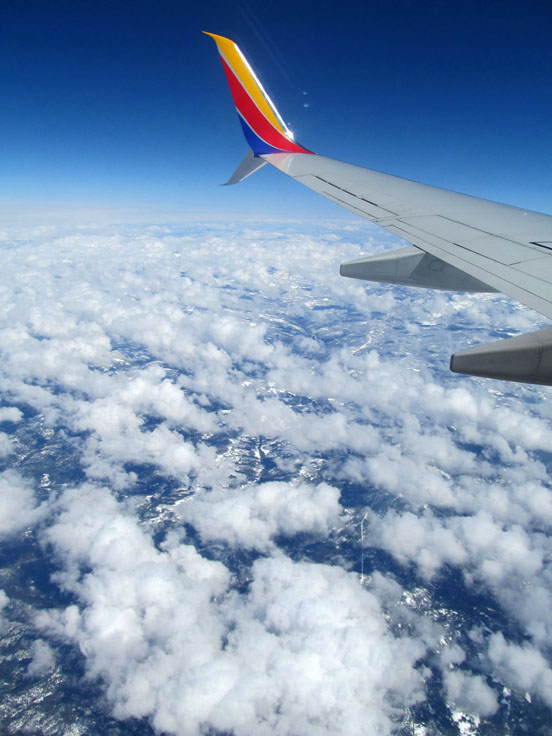
With people canceling or changing their travel plans, most airlines canceled flights. Despite only having thirty passengers, Southwest Airlines demonstrated their mission of customer service by not canceling our flight, or rescheduling all their flights to fly full. Instead, they kept to their schedule, operating at a loss to not inconvenience their passengers. 

The flight crew advised everyone to spread out, and leave plenty of space between themselves and others, in order to inhibit the potential spread of Coronavirus COVID-19. Being among the first to board, my wife and I took a row around a third of the way back. We disinfected out seats and tray tables, and strapped in. 

Despite warnings from government health authorities and the Southwest staff, passengers filled up seats and rows in front, beside, and behind us. Again: the herd mentality. When a family filled up the row directly in front of us, we abandoned our seats, and left our carry-ons where we had stowed them.


The view ahead on our Southwest flight

A little behind the wings, we found a row with no one else close around. We disinfected the seats and tray tables, and got comfortable. By the time boarding had finished, only six others had joined us from the wings back. This left 145 empty seats on the plane, with 22 people clustered up front.


The view behind

On our trips to England, we've visited many popular places, such as Westminster Abbey and Stonehenge. But most of the places we traveled to were places few international travelers go, such as the town of Bideford, where Charles Kingsley set his novel Westward Ho!, and Chagford, a historic stannery town featured in The Tinner's Corpse, a novel in the Crowner John mystery series by Bernard Knight. Some places, such as Cromer, have grown more interesting since our visit. Through my reading, I've accompanied characters on their visits to the seaside town in Tono-Bungay by H. G. Wells, Limitations by E. F. Benson, and So Disdained by Nevil Shute.


No one knows how Coronavirus COVID-19 may alter our world. Times like these make us reflect on our lives, and what really matters. Perhaps we should contemplate how Rick Steeves' observation relates to us. At the very least, it makes sense to adopt easy habits such as cleaning your hands, disinfecting surfaces, and keeping more distance from others than usual. 

Dragon Dave

Related Links
Rick Steeves' Blog

Monday, April 9, 2018

Nevil Shute on Changing Currency

When I read an old book, I'm always curious about how much things cost, and how much money would be worth in today's terms. For example, when Sherlock Holmes pays his child Irregulars a few shillings or pounds to scour the streets of London in search of a person or a vital clue to a mystery, I'm curious how much he's paying all the children in today's money. Of course, there are different ways of evaluating the value of money, and a given sum will always be worth more to a poor person than to a rich one. Nevertheless, understanding how much things cost in a society gives an insight in the culture of the times. 


I'm also curious as to how much my old paperback of Nevil Shute's novel So Disdained originally cost. It believe it was a UK edition. The inside says it was printed in Bungay, Suffolk, England by Richard Clay (The Chaucer Press), Ltd. On the front, someone applied a sticker (at some time in the past) for 3'6. The back of the 1966 paperback edition shows 60c Australia 6'- as a price. 


(My apologies for the blurry photo)


So how do I translate all these different prices?

These days, a book printed in England, but sent to the United States, would list a dollar symbol next to price and the letter U.S. It would probably give the price in Canadian dollars, and maybe even the Australian price. No U.S. price is listed here. But then, the novel was printed and sold with a different title in the United States, so that would be a completely different edition..

My first question is about the 60c symbol. The pre-decimilisation currency in England in 1966 had twenty shillings and two hundred-and-forty pence in a pound. The symbol for shillings was "s", and the symbol for pence was "d." Australia followed Britain's example with their currency, with their pounds, shillings, and pence.

Canada, as best I can tell, adopted the United States' model in the mid 19th Century, and uses their own quarters, dimes, nickels, and pennies. So a guess on my part would be that the "c" symbol is for Canadian cents. The thing is, I believe Canada followed the U.S. convention, with the "cents" symbol as a small c with a vertical line struck through it. 

According to Wikipedia, the "c" symbol (without a vertical line struck through it) can refer to cents in former English Empire countries like Australia, New Zealand, South Africa. But pre-decimalisation Australia would have followed England's model, with shillings "s" and pence "d". 

Perhaps the 6' on the back refers both to Australia and England. That would mean the price in both countries was six shillings, or 72 pence (again, with 240 pence in the pound). But it seems odd that the same price would be charged in two different countries, doesn't it?

Or maybe UK editions didn't have prices marked on the books, and booksellers had to apply stickers? 

As to that sticker on the front, I pealed it back carefully, and there's no UK price printed underneath. If the 6' refers to the original Australian price, the 3'6 sticker would mean the original UK price was three shillings and six pence. If 6' was the original UK sale price, the sticker would be a pre-1971 sale, which would represent nearly fifty percent discount off the book's original cost.

Isn't deciphering old currency symbols fun? I almost feel like Indiana Jones. Only he knew much more about the world than I did. Oh, and he wasn't afraid to have a monomaniac dictator like Adolf Hitler sign his book for him. Me, that's one book signing I wouldn't attend.


Holy Trinity Church
Loddon, Suffolk, UK


During our tour of the English county of Suffolk last year, we visited a charming town called Loddon. It located in the Broads, with boats parked along the river. It charming architecture, interesting World War II history, and several charity shops that offered inexpensive books. Their beautiful Holy Trinity Church also had tables laden with books for sale. I found some real treasures there, including a Lovejoy mystery (a series that takes place largely in Suffolk, and neighboring Norfolk and Essex counties), as well as the Nevil Shute novel. I paid fifty pence in last year's UK currency for the paperback at a church sale. That's 50p for my friends in the United States, not fifty cents. 

Book shopping in Holy Trinity Church
If I ever return to Loddon, I may have to visit Bungay too. According to Google, the town is just ten miles away from Loddon. It looks to be another charming town along the Broads, with a historic market and the ruins of an old castle. I could talk to the locals, and see if anyone remembers the company Richard Clay Limited. I wonder if anyone might recall the name The Chaucer Press on any buildings. Maybe someone could give me a hint as to the book's original cost, as well as how affordable a purchase it would have been for the average person fifty years ago.

In any case, given the current exchange rate, I estimate the equivalent cost for my copy of So Disdained at seven-five to eighty cents in U.S. currency. You can find paperbacks for less in this country, but usually they cost more. When you consider that I've wanted to read a Nevil Shute novel for some time, but most of his work is out-of-print in this country, I'd declare myself happy with my purchase. When I add that it gave me hours of enjoyment, and I found the novel a really crackin' read (as they say in England), I'd say I found a real bargain. 

Dragon Dave

Monday, April 2, 2018

Nevil Shute on Inflation

Cromer Pier, England

By writing in his spare time, Nevil Shute eventually finished his second novel So Disdained. One of the reasons it took the author three years to complete it was that he was working for the Airship Guarantee Company at the time. He worked as a senior stress engineer on the rigid-bodied His Majesty's Airship R100 to service the British Empire travel routes. 

In addition to airships, Nevil Shute knew about the practicalities of flying airplanes. His novel is packed with details about how Lenden's airplanes worked, as well as the way he flew them. Knowing all those details, I'm sure Nevil Shute knew how much the planes cost to operate as well. He built those into every facet of his novel, including the scheme of Lenden and his WWI pilots, to travel around Britain in their seaplane, and offer ten minute joyrides for a guinea (one pound and one shilling).

You are probably asking "How could his character Lenden have believed he could charge customers so little? Surely, if he and his partners had charged his customers more, he could have made a go of his seaside tourist business!" But according to the website www.measuringworth.com, one guinea in 1919 was equivalent to 44.28 pounds in purchasing power today. That's what they call the real price. They also calculate the labor value of a guinea in 1919 as over one hundred-and-sixty-seven pounds, and the income value at over two hundred-and-fifty-two pounds. 

If you raise the price to thirty shillings, as Lenden and his friends later did, the real price rises to 63 pounds, while the labor and income values climbs into the mid two hundred and three hundred pound range. That's in today's England currency. If you want to translate that into what an American tourist would pay in U.S. money, if he were to travel to the UK today, increase those figures by fifty percent.

I'm not sure how to factor all those different values to figure out how expensive it would have been for someone one hundred years ago to take a ten minute pleasure flight. English reader Joppy kindly shared with us that his father earned just over seven pounds in his first year working as an apprentice pharmacist. In this case, his father began work eleven years later, in 1931.  

Consider the English TV series Downton Abbey, which portrays life at an English manor house (such as Moran worked at) beginning before World War I, in 1912. By the time the series finishes, in 1925, the Earl of Grantham is struggling to run the house with a fraction of his former staff. Wages, as well as other costs, have multiplied several times since World War I. It seems safe to assume wages continued to rise between 1925 and 1931. 

We can assume that, had a young man like Joppy's father started as an apprentice pharmacist in 1919, he would have earned significantly less than seven pounds in his first year. Perhaps, let us say, four pounds? And that's for a man. Given the gender limitations back then, a woman of similar age and skills would likely earn less, perhaps three pounds a year? 

Enjoying a drink at Cromer Pier

Whatever the amount, you get the idea. For most working class people during their first few years in the job market, they might be able to afford a drink on Cromer Pier with their friends. (I wonder what that cost in 1919? A couple pence?) But to spend a guinea (a pound-and-a-shilling) for a ten minute jaunt in Lenden's little Avro seaplane would have represented a major portion of whatever they had in the bank.

Assuming, that is, that they weren't living from payday to payday. 

For someone like Moran, the business agent of a manor lord, who had his own automobile, and drove up to London regularly for a black tie dinner with his friends and business associates, the situation would, naturally, be different.

As for the numbers I mentioned earlier, I can't help wondering how they might compare to a cheap flight from England to some sunny holiday spot today. Of course, cheap flights to sunny holiday spots didn't exist in 1919, so you have to take that into consideration too. A ten minute jaunt in Lenden's Avro might represent, for most tourists of that period, their one and only chance to ever fly in an airplane!

In any case, one guinea, or thirty shillings, was hardly an insignificant sum. A successful business operates on repeat customers, and that's something Lenden and his pals couldn't generate. The first time they went to a seaside town, they would do okay. But if they tried to return a few months, or a year later, few people wanted to fly with them. So the people who would invest that sum on a novelty didn't want (or couldn't afford) a repeat experience. The people who hadn't flown with them the first time still wouldn't fly again. I guess they figured the money was better spent elsewhere. 

The English like their seaside towns. Even if the towns are quiet during the week, towns like Cromer bustle on weekends. In the summer, some seaside towns operate amusement park rides and attractions. The larger ones, such as Great Yarmouth, located south of Cromer, may well have them going year round. I wonder if Lenden and his friends could make such airplane rides pay now in these towns. I suspect the towns would not allow them, given modern safety restrictions. But if Lenden and his pals could offer such flights, one thing's for sure. A ten minute ride would cost you a lot more than a pound-and-a-half. 

Then again, if you were interested in listening to a short presentation on the joys of timeshare ownership...

Dragon Dave

Monday, March 26, 2018

Nevil Shute on the Value of the English Pound


A quiet day in Cromer, England


Nevil Shute's 1928 novel So Disdained (published as The Mysterious Aviator in the United States) introduces us to a former World War I pilot named Lenden. In the novel, he tells the narrator, Moran, of a seaside flying venture he and his fellow pilots ran. They traveled around England, and spent weekends in seaside tourist towns. They offered people there short ten minute rides in their Avro seaplane. For 1919, such an opportunity would be a radical change of pace for your average tourist. Aviation was in its infancy then, and the idea of affordable long distance travel aboard airplanes little more than a fantasy.

For Lenden and his partners, getting close enough to the beach to load and unload passengers at a seaside town like Cromer would mean battling those strong winds and ocean currents with the Avro's engine running. If the wooden beach walls were there a hundred years ago, Lenden and his pilot friends would have had to factor those barriers into their approach. All those difficulties limited their efficiency, and Lenden tells Moran that he and his partners never managed more than three flights per hour. 

As if the normal difficulties of running the business weren't enough, consider what happened when an accident occurred. Battling the strong winds and ocean currents, and getting a lightweight airplane onto and off the shingle beach, meant regularly breaking one of the plane's floats, which shut down operations until they could buy and fit a new one. And it wasn't like airplane parts were readily available back then. While I'm sure Lenden and his associates would keep a certain amount of spares on hand, each time something broke, it took time to be fixed, which prevented customers from flying during that time. And then, another replacement part would need to be sent for.

After awhile, Lenden and his pals found that charging a guinea (one pound and one shilling) per person wasn't enough to recoup their costs, they upped the charge to thirty shillings (one-and-a-half pounds). Still, the work wasn't regular enough for them to make the business a going concern.

Nevil Shute worked as an engineer and a designer in the aviation industry. I'm assuming Shute knew the realities of such tourist airplane operations back then, and built those into Lenden's backstory. So I'm treating the fictional Lenden's description of the physical and financial plight of a seaside holiday plane operator as realistic. I'm assuming Lenden and his fellows charged a fair price, one that most holiday-makers could pay. Still, it wasn't enough to make their little airplane business a success.

I wonder what a guinea, or thirty shillings, was really worth back then. It certainly was worth more than a pound or one pound-fifty today. Then again, you can get a lot for a pound at a grocery store like Tesco's or Morrison's. For example, you could get a pack of chocolate digestive biscuits for a pound. Or you could get a roll of Jammie Dodgers for a pound. You could probably even get two Scotch Eggs for a pound--they make a great alternative to sandwiches! So even though I'm only an occasional visitor to England, I'd say the British pound still retains a good amount of purchasing power, in my opinion. 

And then of course, there are always even more affordable stores like Poundland, where everything they stock is for a pound. Don't even get me started on everything I could buy there!

Dragon Dave

Monday, March 19, 2018

Nevil Shute on Fun at the Seaside


Nevil Shute's 1928 novel So Disdained (published as The Mysterious Aviator in the United States), gives us a view of life in England after World War I. On a rainy night, Moran is driving his Morris automobile down an isolated country road when he spies a solitary figure trudging along. He invites him into his car, and as it is late, takes him back to his cottage rented to him by the local lord of the manor. Moran discovers the man is a fellow Royal Air Force pilot he flew with during WWI. While Moran left flying to act as a business agent for the lord of the manor, this other man, Lenden, has been flying for a living since the war. 

Lenden has had an up-and-down career since WWI, as aviation was in its infancy in that era. At times he's worked as a mail carrier, or did survey missions in other countries. But each time, the venture hit trouble, and what seemed like a sure thing faltered. This forced him to send his wife away to live with her family, and sent him searching for another flying job that offered enough security for him to afford an apartment or a home in which they could comfortably live. But whatever he tried, it only worked well for a time, and soon he had to send her back to her family again, while he...

One of the jobs Lenden enjoyed, but could never make pay, was giving holiday makers short flights. He and his partners, all former RAF pilots, would travel to seaside towns all over England, such as Brighton or Cromer, and charge money for a ten minute flight. As he recounts to Moran, one of Lenden's first ventures started immediately after WWI, in 1919. He and his partners bought an Avro seaplane and used it to take tourists for a quick ten minute flight. The flight itself wasn't the problem, it was getting on- and offshore. The process of landing on the water, getting ashore, loading and unloading passengers, just too too much time to make the venture profitable. 

Having spent a week in and around Cromer last year, I can understand some of the trouble Lenden might encounter. One of the town's claims to fame is a Life Boat Museum. The building is packed with photos, memorabilia, and even an old ship. There visitors learn how their local version of a Coast Guard has saved the lives of countless unfortunates who got into trouble at sea. 

Inside the Cromer Lifeboat Museum


On our first day in Cromer, we found a bench by the sea and sat down to eat our lunch. Even though it was sunny, we needed a jacket to ward off the cool breeze. I had to set my can of soda between my legs, or it would blow over. I had to cradle my arm around what little food I had on my lap, and place our backpacks and other items nearby, to keep the wind from blowing away our food. Still, an unexpected gust of wind was liable to blow away a small item of food, or send my napkins fluttering off.

Even though it was a summer month, when tourists could pack the town on a weekend, it was always windy there. Wooden walls act as dividers lining the beach, to combat beach erosion from strong tides. Tractors lined the beach, awaiting the need to tow a boat over the hard shingle, to either launch it into the water, or reclaim the vessel from the breaking surf. 

It's hard to imagine navigating a small seaplane on and off such a windswept beach. It's even harder to imagine a small seaplane parked on the beach. I imagine, unless it was tied down securely, it would blow over or away. Given the construction methods and materials of such small planes one hundred years ago, storm winds might well have ripped apart the best secured airplanes.

Then again, given modern safety restrictions, and society's readiness to serve a lawsuit against anyone for any perceived wrong, I wonder if such seaside tourist flights could even be offered today. If they were, I wonder if they'd be any more profitable than Lenden's.

Dragon Dave