Showing posts with label Sowerby. Show all posts

Saturday, August 11, 2012

St. Oswald’s in Sowerby

The Sowerby Flatts


In most directions you take from Thirsk, all too soon you leave it behind for open country.  But if you walk south from the parking lot in the city center, suddenly you find yourself in a busy residential area, and an entirely different village.

From this vantage point, Sowerby seems to consist of nothing but residential housing.  We walked past a crowded noisy playground along the Sowerby Flatts.  In James Herriot’s Yorkshire, Alf Wight (Herriot’s real name) describes the Flatts as “a gracious sweep of grass preserved as an open place where people can walk with their children or their dogs, safe from traffic, free to rove widely over the green acres or follow the beaten path by the river’s edge.”  

I can certainly attest to its graciousness, as it was a hot afternoon that we walked along it, and, having not expected such weather, we had not packed shorts for our vacation.  Nor did the seeming unchanging nature of the brick houses to our right stir our curiosity.  Several times we thought of turning back.  But then, sheltered behind a stand of trees, we spotted our destination. 

St. Oswald's on a hot, weekday afternoon.

No one knows when St. Oswald’s was built.  The first written reference to it dates back to 1145 AD.  For centuries, it was just a tiny chapel.  But with the rise of the industrial revolution, Sowerby grew, and the congregation worked together in the mid nineteenth century to expand the church.  Then, at the beginning of the twentieth century, the congregation again enlarged the church.  Coming as we did during the week, we weren’t able to attend a Sunday worship service.  But on our short visit there, just for a handful of minutes one hot afternoon, it was obvious how much the locals loved their little church, and the way in which it served the community.

Linda explores the "additions."

As we headed back to Thirsk, we noticed a building larger than the sanctuary, the church’s parochial hall, which was built during the 1930s.  According to Alf Wight’s son Jim, the rich, generous Mrs. Pumphreys, whose real name was Marjorie Warner, lived in Sowerby (along with Tricky Woo, her beloved Pekinese).  I wondered if she might have attended St. Oswalds, and helped such a small church (even after its two additions) build such a large parochial hall.  Yet according to Reverend Carnall, the vicar of St. Oswald’s, there exists no record that Mrs. Warner ever attended the church or contributed to the project.  

Perhaps that’s just as well.  The congregation, acting together, pooled their resources to fund both additions to their sanctuary, even if most of their gifts were small.  It’s nice to think that a small group of people, acting together for a common cause, could have also erected such a large building, to serve both their own needs, and that of the community. 
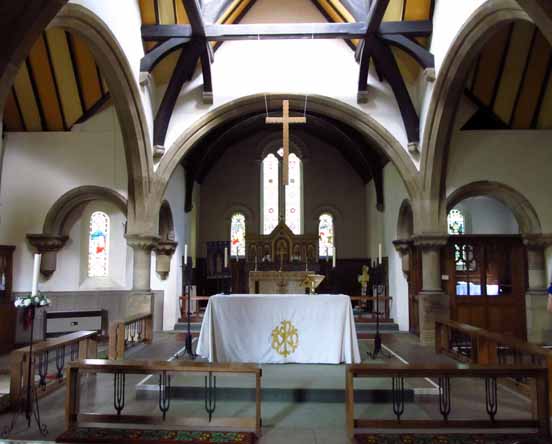
The remodeled, "original" altar area.

Virtually all of the small Nazarene churches of my experience are gone now.  Each of the congregations flourished for a time, but eventually dwindled and died.  In most cases, the buildings remain, and serve other congregations.  But one has been bulldozed, and the land covered with houses, leaving no trace of the church that once sat there, or the people who worshipped there.  It’s nice to think of a church that started small and grew into something larger.  It’s nice to have visited a church that was built nine hundred years ago, and still serves its community.  

So many of the churches we’ve visited in England are large and grand.  It would have been easy to skip St. Oswald’s.  But I’m glad we walked into Sowerby that hot and humid afternoon, and visited a small church that has not only survived, but also grown more vital with the passage of time.

Amazed,
Dragon Dave

Related Dragon Cache entries

Related Internet Links

Sunday, July 8, 2012

The “Hunter” of My Memories


In comparison, the cemetery at St. Oswalds in Sowerby,
just a few minutes' walk from Thirsk, is still open.
So Alf Wight (James Herriot) could have been buried there,
had he so desired.


On the night my father died, I left the hospital and walked the streets.  I watched the cars speed by.  I stared up at the stars glowing in the darkness.  The unthinkable had happened, and I didn’t know how to respond.  Eventually, I decided that the world had not come to an end, and returned to the hospital.

My mother, of course, was frantic by this time, wondering where I had been.  But she settled down, and we seemed to do a lot of standing around, as doctors and staff came and went.  At some point, my father’s body was wheeled from the room, and I watched the staff push it down the hall. 

The pastor had been one of my father’s closest friends, and enjoyed similar TV shows.  He and his wife met us at the hospital, and they took us back to the parsonage, where we spent the night.  Before going to sleep, I remember sitting in the pastor’s study, watching a police drama, about a cop who took no prisoners (figuratively speaking), who would do anything necessary to catch the perpetrators of a crime.  It wasn’t a show I remember watching previously, but its name, “Hunter,” stuck in my mind.

In the last few years, the prices of TV series on DVD have fallen dramatically, and “Hunter” appeared in the stores.  I considered watching it again, because of my memory of that night so long ago.  I purchased the first two seasons when the shop bundled them together and reduced them for clearance.  Then they sat on my shelf for months.

Eventually, I reminded myself why I had purchased them, and watched the two-hour pilot that sold the series.  In a strange way, I found watching it a soothing experience, a link to that night so long ago, when the pastor and wife had shown my mother and I particular kindness.  But at the end of the pilot, I noticed the copyright date.  I shook my head.  No.  That couldn’t be right.

I dived onto Wikipedia, my first port of call in such matters.  Then I sat back, stunned.  The date was correct.  Production of “Hunter” began several years after the death of my father.

In pages 61-63 of his book, The Birth of Christianity, author John Dominic Crossan refers to a study on memory conducted at Emory University.  One hundred-and-six students filled out questionnaires on January 29, 1986, the day after the space shuttle Challenger exploded.  In March of 1989, follow-up interviews were conducted with forty of the original test subjects.  When their later “memories” of how they first learned of the disaster were compared with their original reports, ten differed completely.  Only seven achieved the highest possible score, and even those showed minor discrepancies between recall and their original answers.  When asked, subjects generally expressed great certainty in their recollections.  When shown their earlier reports, they said, “I have no recollection of it,” or “I still think it was the other way round.”  The researchers concluded, “As far as we can tell, the original memories are just gone.”

I’m not sure what to make of this study, or what it says about my recollection of the night my father died.  Like I said in yesterday’s post, "The Proper Role of Fiction," I’m absolutely, one hundred percent certain I was watching “Sanford And Son” when my father died.  Then again, for a long time I believed that I watched “Hunter” later that evening.  These memories, having bonded with the events and emotions of that evening, have burned themselves into my brain, and become a part of me.  But if my recollection of one event is wrong, might both be wrong?  In the case of “Sanford And Son,” might I be blaming myself for an incident that never took place?

This recent discovery suggests that the thoughts, emotions, and memories that drive us are more complex than we often believe.  How can I truly know myself, when I cannot be certain of the memories that shaped my consciousness?  Perhaps I can use this insight to craft more compelling characters in my fiction.  At the very least, I should remember this in my dealings with others. 

Musing on the meaning of my memories,
Dragon Dave

John Dominic Crossan is a former Catholic Monk and Priest.  He was also one of the leading historical Jesus scholars of the twentieth century.  His critical work, The Birth of Christianity, uses historical and scientific methods to understand how the era in which Jesus lived might have actually been, as opposed to how it is often portrayed.  It is a challenging tome, and I don’t necessarily agree with all (or even most) of his conclusions.  Nevertheless (as Mr. Spock might say), the research he utilizes, and the comparisons he draws, are fascinating.

“Hunter” was a police drama starring Fred Dryer, which ran from 1984-1991.  The show spawned two reunion specials, as well as five episodes of an aborted sequel series, the latter of which have apparently never been shown on TV.

Related Internet Link
St. Oswald’s Church in Sowerby, next-door to lovely Thirsk.