Showing posts with label Castle. Show all posts

Thursday, February 5, 2015

Beautiful & Historic Tamworth


The first thing my wife and I saw when we arrived in Tamworth was its beautiful gardens. They crowned the park with their carefully manicured beauty, and brightened our spirits on an otherwise cold and rainy day.


More flowers spread out throughout the town, in raised beds, window boxes, and hanging baskets. It appeared we had arrived during the Tamworth in Bloom festival. Either that, or the banner hanging over this street merely speaks to the pride the locals take in their town. 


We had come here to visit the town's castle, and in touring that ancient building, our purpose was more than adequately served. But in walking the streets, visiting its small shops, and letting the atmosphere seep into our souls, we emerged with a love of this town in the English Midlands.

Oh yes, and a desire to someday return.


More than this historic tower, and the beautiful gardens, preserve Tamworth as a place worth remembering and protecting. There's a reason why I'm writing this blog post today, as opposed to any other. It's about a discovery I made since we visited three-and-a-half years ago, and I'll tell you all about it in tomorrow's post.

See you then.

Dragon Dave

Monday, March 31, 2014

Our Evolving Morality in Castle and Marvel's Agents of S.H.I.E.L.D.

Society's ethics, and our own sense of right or wrong, is constantly influenced by what we experience, and those with whom we interact. Each generation embraces its own values, and casts aside ones they believe no longer serve their needs. We always believe we're making the right choices, the necessary choices for us, but our decisions define us, and our evolving sense of morality.

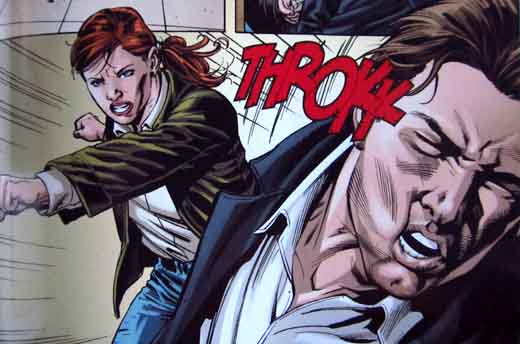
In the recent episode "T.A.H.I.T.I." on "Marvel's Agents of S.H.I.E.L.D.," Agent Skye lays dying. So Agent May bursts into their plane's detention room and wails away at Quinn, the man who shot Skye.


Their superior agent Coulson calls her off, so she returns to the cockpit. Agent Ward, who witnessed her assault on their prisoner, says, "It was good to see you wail on Quinn like that."


Later, agent Garrett boards the plane mid-flight. He believes Quinn has information that might save Skye's life. So he tells Quinn that he'd better answer his questions now…or he'll rip out his tongue.


In case Quinn doesn't believe him, Garrett shows him how that might feel.


The way Batman wailed away at the Joker's face in "The Dark Knight," while in police custody, turned me off that movie franchise. In "Star Trek Into Darkness," the way Captain Kirk wailed away at Khan, after Khan surrendered to him, left me disgusted. I know our world is full of villains who would do us harm, and embracing reasonable measures of protection is prudent. But as for taking out our anger on others, and employing torture to get the information we need to secure our safety…when did that become okay? 

In season four of "Castle," Captain Gates becomes Detective Beckett's commanding officer. As a former Internal Affairs officer, one of her overriding concerns is public officials who abuse their authority. In the episode "Dial M for Mayor," she asks Beckett, "As for the sergeant who abused my patrol partner under the mantle of authority, who holds him accountable?"


Last year, in the fifth season, boyish, nonviolent Richard Castle is thrown for a loop when his daughter Alexis is kidnapped in the two episodes "Target" and "Hunt." When the police can't find her fast enough, he asks Detective Beckett to leave him in a room, alone, and not come in, while he aggressively questions a man as to his daughter's whereabouts. 

So, naturally, she agrees.


It's easy to love those who love you and show you kindness. It's more difficult to love those whose words and actions annoy or anger you. But isn't the highest test of our morality--both as individuals and as a society--defined how we treat those in our care, whether they be subordinates or prisoners, and whether we approve of their actions or not?

Or does our safety, and that of those we love, trump all other concerns? 

Dragon Dave

Monday, September 16, 2013

Richard Castle's First Graphic Novel?


When it comes to author Richard Castle, public opinion remains divided. People view him as either lazy or hard-working, childish or mature, naive or jaded.  Perhaps the largest argument concerns whether he is actually a real person.  We all know an actor, Nathan Fillion, plays him on TV. But Fillion's portrayal seems so real that some maintain that it was informed by the author himself, and the TV show is just an adaptation of his life story.  Let's face it: if you were a bestselling author, and you tagged along with a good looking homicide detective like Kate Beckett, you wouldn't want all your fans following you around all day, would you?

After all, every author loves to be complemented on his work.  But everyone is also entitled to a certain amount of privacy, and no one enjoys being stalked.

In the case of Richard Castle's Deadly Storm, readers are in no doubt as to the existence of its authors.  In addition to penning every issue of "Ultimate Spider-Man," and numerous other comic books, Brian Michael Bendis is an architect of the Marvel universe.  He heads up a division of Marvel, where he helps decide which storylines each title should pursue, and how the events depicted in each will interact with the others.  His co-writer is Kelly Sue Deconnick.  She's best known for writing Marvel's "Avengers Assemble" and "Captain Marvel" comics, but she also writes other titles and edits English language translations of Japanese Manga books.  Both writers are very real, and someday you might have the pleasure of meeting them at a comic book convention.  

Just as the TV show "Castle" is an adaptation of author Richard Castle's life, so Richard Castle's Deadly Storm is an adaptation of his first Derek Storm novel.  (Sadly, like many of his older titles, it's out of print, but perhaps publishers will take note of this post, and make it available again).  We meet Derek Storm in a trailer park, where he has tracked down Jefferson Grout, and is using his video camera to record the man having a fling with another woman.  


Despite his cavalier charm, and the way he rarely seems to take anything seriously, Storm is a sensitive man, and isn't looking forward to giving his client, Mrs. Grout, proof of her husband's infidelity.  Thus preoccupied, he inadvertently steps on a piece of litter.  Within seconds, lights switch on all over the trailer park, and Derek finds himself on the run from three men with guns, blasting away at him.  When he makes it back to his office, he finds people waiting for him.  They wear nicer clothes than him, ooze confidence, and exhibit capabilities far beyond him.  In other words: CIA operatives.  

As Derek Storm will later clarify, CIA stands for the Central Intelligence Agency, not the Culinary Institute of America.  (Just in case you were wondering).  They're not supposed to carry out missions on American soil.  But it seems that Jefferson Grout, the man Storm was following, is a former CIA agent who has gone missing (or rogue), and he's not the first one the agency has lost recently.  While Grout evaded the CIA operatives sent after him, Storm managed to find him (until he lost him during the trailer park shootout).  Well, the CIA want him to track down Grout again.  Storm is intrigued by the case, as well as the beautiful Clara Strike, who will be his handler for this mission.  

Heck, he'll even be paid for serving his country.  


So he ignores the warnings of his father--a former CIA agent--and continues pursuing Grout, this time for his government.  Doing so will land him in jail, under suspicion for murder.  Tracking down leads will take him to a certain Latin American country with a history of CIA involvement.  He'll get beaten, risk jail and imprisonment, even death. Yet he'll follow the clues where they lead, because he wants to know why Grout disappeared, because he likes Clara Strike, and because he believes that, even if solving this case means taking a few hard knocks, it will make him an infinitely better detective.


Plus, he might just get to play with some cool, CIA espionage devices.  

Richard Castle's Deadly Storm is a slim volume, but a fun one.  It's a novel that could easily be filmed as an hour-long TV show, and can be read in one sitting.  After reading it the first time, you can peruse it again later, and discover aspects of the story you might have missed the first time around.  And then there are the Special Features.  For three pages of the novel, readers get the authors' script, complete with their notes and suggestions.  Another page reveals artist Lan Medina's initial breakdown of the page in pencil, and further pages show how those pages were inked and colored.  These features might seem basic to the experienced comic book reader, but for those less well versed in such matters, they offer welcome insight into the process of creating a graphic novel.  

Sadly, this book may not dispel the controversy surrounding Richard Castle's existence.  Even Brian Michael Bendis has suggested that he was tasked with adapting a nonexistent novel written by a fictional character.  Perhaps this is taking Richard Castle's anonymity too far. For just like Bendis and Deconnick, Richard Castle has his own website. There you can learn about his life, read summaries of his books, and even ask him questions.  After perusing his site, why not visit the websites of Brian Michael Bendis and Kelly Deconnick, as well as the art page featuring Lan Medina's work?  For regardless of who exactly contributed what to this adaptation, Richard Castle's Deadly Storm is a fun read, and those who craft entertaining stories are well worth learning about.

Just don't stalk them, okay?  No one likes that.

Dragon Dave

Related Internet Links
Brian Michael Bendis
Kelly Sue Deconnick
Lan Medina

Thursday, May 16, 2013

Brian Michael Bendis & Spider-Man


The “Castle” Season Three DVD set includes a twenty-minute extra called “Murder They Wrote.”  This roundtable discussion features Andrew Marlowe (who created the TV show), Rob Bowman (who alongside Marlowe, serves as Executive Producer), Michael Connelly (Best-selling mystery writer who has appeared on the show), Nathan Fillion (who plays writer Richard Castle on the show), and Brian Michael Bendis, a comic book writer and artist.  What is Bendis’ connection to “Castle,” you ask?  Well, along with Kelly Sue DeConnick, Lan Medina, and Tom Raney, he created “Richard Castle’s Deadly Storm,” a graphic novel based on the novel written by the fictional Richard Castle.

From Richard Castle's descriptions, I imagined Derek Storm as your typical private investigator.  Bendis envisioned him as a more exciting character, akin to James Bond.  He regarded “Deadly Storm” as a unique challenge: to adapt a novel that doesn’t exist, written by an author who doesn’t exist, and featuring a character that…well, you get the idea. 

"So Michael, tell us about yourself," Nathan asks.

What interested me more was how Bendis became a comic book author and artist.  When he was a child, his mother bought him comic books to read.  By age six, he had decided that he wanted to create his own comic books.  He particularly wanted to write stories about Spider-Man, his favorite superhero.  That dream guided him throughout his life, until he finally ended up at Marvel Comics, where for the past dozen years he’s been creating his own comic books about his favorite characters, including Spider-Man.

"I'm proud to say that I'm a comic book writer,
and I love Spider-Man."

Brian Michael Bendis is a prolific comic book writer and artist.  His numerous awards attest to the quality of his work.  But how did he get there?  He trusted his own judgment, even at the tender age of six.  He never listened to the naysayers who suggested a more reasonable or respectable career.  He never gave in to the fear of failure, or the allure of an easier, more achievable future. He knew what he wanted to do with his life, and worked hard to acquire the skills and abilities to fulfill his dreams.  

He didn't start off as a superhero, but he became one.  Just like his beloved Spider-Man.

Dragon Dave

Related Internet Links

Monday, April 29, 2013

No More Crying


A guest blog (and product review) by Dragon Dave’s wife.


Does the sight of an onion make you want to cry?  Do you end up throwing out your onions, because they went bad waiting to be chopped?  I understand completely, as chopping onions always makes me weep.  Last time, it got so bad that Dragon Dave finished the chopping for me as I escaped out to the yard.

I wondered why is that the onions make us cry, so I did a little research and found when you cut an onion, you break cells, releasing their contents which are enzymes and Amino acid sulfoxides in the form of sulfenic acids. Enzymes that were kept separate now are free to mix with the sulfenic acids to produce propanethiol S-oxide, a volatile sulfur compound that wafts upward toward your eyes. This gas reacts with the water in your tears to form sulfuric acid. The sulfuric acid burns, stimulating your eyes to release more tears to wash the irritant away. 

I found several folk remedies to keep the gases from getting into my eyes.  These included burning candles or matches nearby while slicing the onion, cooling or freezing the onion before cutting, and even slicing the onion underwater.  No matter what I tried, I always ended up crying.  Then one night, while watching "Castle" (one of our favorite TV shows), I noticed that Richard Castle and his daughter Alexis were wearing goggles while chopping onion.  This got me thinking,  “I need a pair of those!”


With two onions awaiting my attention, I decided the goggles were worth a try.  So I dug out a coupon for Bed Bath and Beyond, and off Dragon Dave and I went.  The first sales clerk had never heard of Onion Goggles, but the second led us to where the goggles were displayed amid a vast selection of kitchen gadgets.  They only had pink in stock, but I was thinking, “Yeah, they have the goggles!”  Then we headed home.  It was time to face the onions.

Gearing-up For Hazardous Duty

At home, I got out the onion, chopping board, and knife.  Donning the goggles I got started chopping.  What a great experience it was: no tearing up, no crying, and zero pain.  I can now chop onions anytime I need to.  The only drawback is that the goggles don’t fit over my glasses, so I have to be a little more careful when chopping so I do not chop off any fingers.

Mission Accomplished!

The next test will come when I harvest the dozen or so onions out in the garden.

Dragon Dave’s Wife

Related Internet Links

Tuesday, April 24, 2012

Richard Castle’s Secret Ambitions


Some claim he’s a starship captain, others that he’s the actor Nathan Fillion.  Some even assert that his novels are ghostwritten.  I sympathize with these doubters.  It’s sad that TV executives have replaced so many quality dramas with low-cost reality shows.  But regardless of the conspiracies that surround him, Richard Castle emerges from our TV screens as a witty and vivacious author.  With his latest book, Heat Rises, he not only demonstrates talent worthy of a bestselling novelist, but his growth as a human being.  

When Nikki Heat is summoned to an underground sex club at four in the morning, she discovers the body of a man bound to a Saint Andrew’s cross.  The victim turns out to be a priest: Father Graf of Our Lady of the Holy Innocents.  At the vicarage, the housekeeper tells her that Captain Montrose searched Graf’s belongings earlier, supposedly in response to a missing person’s report she filed.  But why should Captain Montrose search a missing priest’s house, when he’s already spending so much time down at One Police Plaza, making politically correct gestures to fend off an investigation by Internal Affairs?  When she finally talks with him, Montrose insists that she only investigate the priest’s death from the BDSM angle, even after she discovers $150,000 in Father Graf’s attic.  

It’s easy to see how Richard Castle drew inspiration from those he worked with during his first three “seasons.”  All the familiar faces are thinly disguised for our enjoyment.  Richard Castle becomes Jameson Rook, Kevin Ryan becomes Sean Raley, Javier Esposito is renamed Miguel Ochoa, and Lanie Parish renamed Lauren Parry.  Even Captain Montgomery, who sadly died at the end of last year’s “season,” is resurrected as Captain Montrose.  And everyone interacts largely as they do in real life: Lauren counsels Nikki on her lovelife, Raley and Ochoa work so closely together they’re known collectively as Roach, and Nikki’s relationship with her captain, while strained, is still based upon mutual respect and affection. 

Richard Castle also indulges in his love of wordplay.  From Pleasure Bound, the name of the underground sex club, to Father Graf (hidden money = graft) of the “Holy Innocents,” to some of the sex trade workers Nikki investigates along the way, who use such performance names as Marty Python, Hans Alloffur, and The Red Barin’, Castle's clearly writing in full smirk mode.  Raley and Ochoa’s police car becomes the Roach Coach.  And don't even get me started on the double entendres! I’m sure there’s lots more examples I haven’t listed or spotted: I look forward to discovering them during my second read-through.

The only name Castle utterly transforms is Kate Beckett’s.  The reason for this grows clearer with each novel.  While Nikki Heat’s life and past are remarkably similar to Kate’s, her present is very different.  Unlike Kate, Nikki braves having a relationship with Jameson Rook.  She consummates in Fiction what Kate shies away from in real life, and in so doing, becomes everything Richard Castle desires her to be.  

Likewise, Castle uses the novel to explore his secret ambitions.  When misunderstandings arise, Rook lays himself utterly bare before Nikki, and so works through any problem, leaving no room for further miscommunication.  He also changes his career.  Rook works as a serious journalist.  In so doing, Castle imagines what pursuing such Nonfiction stories might entail.  While Jameson Rook might have won two Pulizer prizes, he also winds a dangerous and unglamorous path chasing arms smugglers around the globe.  In exchanging his playboy lifestyle for that of the investigative reporter, Castle envisions paying a steep price: Rook isn’t allowed to help Nikki in any official capacity, as he’s finished the magazine piece he wrote on her during the first novel.  Rook isn’t even present during the first sixty pages of the novel.  I won’t tell you what Rook’s up to, but it’s bound up with the fictional persona that Richard Castle has imagined himself becoming. 

And then there’s the ending, which I won’t spoil for you.  Let’s just say, if you watched Season Three, you’ll understand not only why Castle ends the novel this way, but also how it expresses his innermost desires.

I’ve never read any of the Derek Storm novels.  Come to think of it, I’ve never even seen them in the bookstore.  But I’ve been enjoying his Nikki Heat novels; the stories get better with each installment.  It’s hard to imagine why some can’t accept that he’s a real person.  I’ll admit that Richard Castle and Nathan Fillion share certain facial similarities.  As for the comparison with Captain Malcolm Reynolds of the starship Serenity, well, I’ve seen “Firefly,” and they seem like completely different people to me.  On our TV screens, Richard Castle demonstrates all the qualities that shine so brightly in his writing.  Could someone really ghostwrite his novels, mimic his individuality so perfectly, while crafting such an enjoyable series of novels?  Why should they, when he's so capable?


Others may refuse to believe in him, but I appreciate Richard Castle’s willingness to share his secret ambitions with us through his Fiction.  I can’t wait to get my hands on the next Nikki Heat novel.

Related Dragon Cache entries
Sorry.  Of all my blog entries, I think this one’s pretty unique. (Have fun looking, though).

Related Internet Links