Monday, April 13, 2020

John Wyndham and Triffids in Brighton


Brighton, England


In Wyndham's novel The Day of the Triffids, some communities prove less open to strangers than others. Those living in the picturesque community of Brighton, for example, block all roads leading into the city. Anyone who attempts entry is shot on sight.

The principle reason for this is the disease, or plague, that sweeps through the population. The blind suffer worse than the sighted because they cannot see what they are eating. It's also likely that they pick up infection with their hands, since the blind must be more tactile than the sighted.

The disease is made worse because all essential services have broken down. With so many blind, there is no one to operate the water system, work at power plants, deliver goods and services. There are definitely no disposable wipes. The only way to protect against the plague is to isolate and quarantine. Even one infected person can wipe out an entire community.


A church mentioned in E. F. Benson's novel The Blotting Book

I'm glad I got to visit Brighton back in 2013. E. F. Benson set his 1908 novel The Blotting Book there. I enjoyed walking the streets, and visiting locations E. F. Benson used in his novel. One was a church that has since been turned into a homeless center. I gather the homeless situation has worsened since my visit, and Brighton hosts one of the highest homeless populations in the U.K. outside London.

I have no idea what the homeless situation in Brighton might have been like in the early 1950s, when John Wyndham wrote his novel. San Diego county certainly attracts the homeless, and seaside communities struggle to deal with and care for these poor people. I wonder if, while on a seaside holiday, John Wyndham noticed the homeless in Brighton, and that prompted him to include the city in his novel.

In The Day of the Triffids, Brighton is taken over by a militaristic regime. The leaders declare that each sighted person is responsible for ten blind people. It seems a hard life, and an untenable one to Bill Mason. He also worries about the leaders' talk of building an army to unify the country. But then, when John Wyndham wrote the novel, World War II would have been recent history.

 
The West Pier, Brighton, England


During our stay, one monument to the past my wife and I noticed was the West Pier, which had been closed for decades. The West Pier would have been standing in 1951, when The Day of the Triffids was published. It would be interesting to see Brighton with two active piers back then, along with the life, energy, and fun they would have brought. So if the Doctor's reading this, I'd gladly accompany you on a ride through time and space to Brighton 1951. Is that wheezing and groaning I hear coming from the TARDIS? I'd better sign off now, so I can look outside.

Dragon Dave

Monday, April 6, 2020

John Wyndham and Triffids in London


Piccadilly Circus, London, England

Recently, I watched the 1962 film "The Day of the Triffids." In this post-apocalyptic tale, most of Earth's population turn out to watch a dazzling light show caused by a meteor shower. The next morning, everyone who watched the light show is blind. The meteorites bring spores, from which plants sprout and grow. Unlike terrestrial plants, these tall plants rove about, killing people and threatening the Human race with extinction.

Impressed by the movie, I read the 1951 novel upon which it was based. In John Wyndham's novel, the Triffids have terrestrial origins. Russians bioengineered these plants--that can move under their own power, and injure or kill Humans--for industrial applications. When a plane carrying seeds was shot down, winds carried the seeds all over the world. Despite the danger the plants pose, corporations have built Triffids into an industry that grows and invigorates the economy. 

Likewise, the dazzling lightshow in the sky has terrestrial roots in Wyndham's novel. Whether one country initiates the conflict, or the calamity is driven by malfunction, all the orbital satellites activate. The explosions create terrific green flashes in the atmosphere that burn out a person's optic nerve. As nearly everyone goes out to view what the media terms a once-in-a-lifetime event, this results in a world in which ninety-nine percent of the world goes blind.

The Houses of Parliament, London, England

Prior to the light show, Bill Mason was injured while working on a Triffid farm. Even wearing protective gear, the plants' poison and stinger caused significant eye injury. He has lain in bed for days, recovering from an operation to restore his sight. When no one comes to remove his bandages, or bring him his breakfast, or assist him in anyway, he pulls off his bandages, and finds everyone else in the hospital is blind. 

He stumbles onto the streets of London, and finds society in chaos.

With most of the Human race blinded, and unable to secure food, or otherwise take care of themselves properly, many fall prey to disease. Meanwhile, the Triffids break loose from their confines. Bill knows that civilization has fallen, and the world has been changed forever. 

Other view the situation more optimistically. They believe that by working together, the sighted can save the blind, and build a new society from the ashes of the old. But the methods they choose seem harsh to many, and unworkable to Bill.

Trafalgar Square, London, England


While the protagonists in the film soon leave the chaos of England to see how people fare in other countries, more than half of Wyndham's novel takes place in London, and all of it occurs in England. So as I read Wyndham's story, I watched Bill battle and evade the Triffids in locations I visited in 2011 and 2013. I knew these places. I loved these places. I wanted to visit them again.

Yet Triffids were killing people there. The way people ordered their lives, and the way society functioned there, was gone. John Wyndham's novel offers a sobering look at how Humans tolerate, and sometimes even cultivate, the things that can harm them most.

Dragon Dave

Monday, March 30, 2020

Rick Steeves on Social Distancing

Sacramento Airport, St. Patrick's Day 2020

Recently, world traveler and TV presenter Rick Steeves has observed that travel has become extremely touristy. Instead of venturing into the unknown to make interesting discoveries, tourists swamp the most popular sites for Instagram moments. 

"Look where I am!" they say. "That's one off the bucket list!

Meanwhile, places off the beaten track, that could prove fun and inspiring destinations, and where tourism could really benefit the locals, go relatively unvisited. This sort of herd mentality, of having to go where everyone else goes, makes no sense to me. Don't people want to experience adventure and discovery anymore?

Besides, where's the fun of sitting in traffic, waiting in line, or being limited to a designated amount of time in a given location because it's such a popular destination? I suppose it's easier to impress your friends with photos and tales of the places you've been, if they are places they'll instantly recognize. But is that was travel is supposed to be about?


On my return flight, I was struck by how empty Sacramento Airport felt. Few restaurants had patrons. Most stood empty. I saw one person walking away from the counter at Starbucks, while Peet's Coffee & Tea was staffed, but seemingly closed. Hardly anyone waited for flights. Most of the chairs at the gates were empty. 

By now, admonitions to wash your hands, wipe down any surfaces you touch, and keep your distance from others were in the news. So we found an unoccupied area at the gate, disinfected the seats and sidetables w/ wetwipes, and pulled out our ebook readers. Within a few minutes, a woman plunked down next to us. Seemingly oblivious to us, she talked on her phone loudly and continuously enough to make reading impossible.


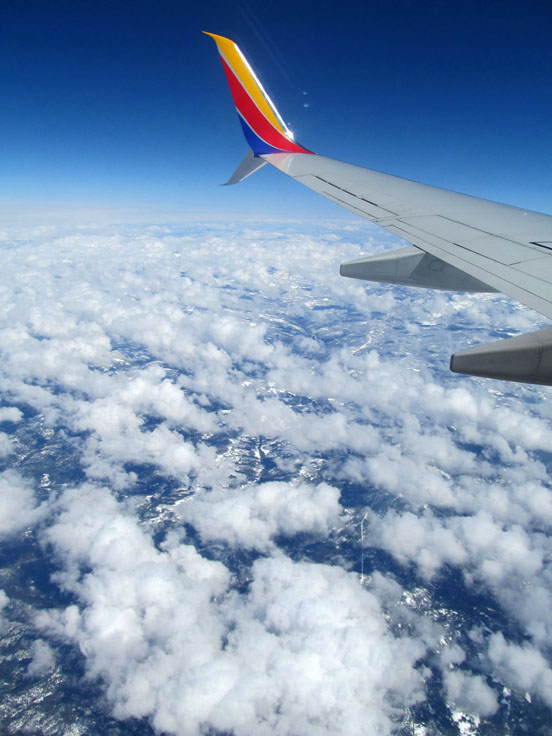
With people canceling or changing their travel plans, most airlines canceled flights. Despite only having thirty passengers, Southwest Airlines demonstrated their mission of customer service by not canceling our flight, or rescheduling all their flights to fly full. Instead, they kept to their schedule, operating at a loss to not inconvenience their passengers. 

The flight crew advised everyone to spread out, and leave plenty of space between themselves and others, in order to inhibit the potential spread of Coronavirus COVID-19. Being among the first to board, my wife and I took a row around a third of the way back. We disinfected out seats and tray tables, and strapped in. 

Despite warnings from government health authorities and the Southwest staff, passengers filled up seats and rows in front, beside, and behind us. Again: the herd mentality. When a family filled up the row directly in front of us, we abandoned our seats, and left our carry-ons where we had stowed them.


The view ahead on our Southwest flight

A little behind the wings, we found a row with no one else close around. We disinfected the seats and tray tables, and got comfortable. By the time boarding had finished, only six others had joined us from the wings back. This left 145 empty seats on the plane, with 22 people clustered up front.


The view behind

On our trips to England, we've visited many popular places, such as Westminster Abbey and Stonehenge. But most of the places we traveled to were places few international travelers go, such as the town of Bideford, where Charles Kingsley set his novel Westward Ho!, and Chagford, a historic stannery town featured in The Tinner's Corpse, a novel in the Crowner John mystery series by Bernard Knight. Some places, such as Cromer, have grown more interesting since our visit. Through my reading, I've accompanied characters on their visits to the seaside town in Tono-Bungay by H. G. Wells, Limitations by E. F. Benson, and So Disdained by Nevil Shute.


No one knows how Coronavirus COVID-19 may alter our world. Times like these make us reflect on our lives, and what really matters. Perhaps we should contemplate how Rick Steeves' observation relates to us. At the very least, it makes sense to adopt easy habits such as cleaning your hands, disinfecting surfaces, and keeping more distance from others than usual. 

Dragon Dave

Related Links
Rick Steeves' Blog

Monday, March 23, 2020

Marcus Aurelius and Coronavirus COVID-19

Jenkinson Lake, California

My wife and I debated whether or not to cancel a planned visit with a family member in Sacramento. In the end, we decided not to let the Coronavirus halt our plans. 

The airport seemed as busy as normal. While we waited to board, the airline staff certainly made lots of announcements. As we boarded, the flight attendants asked the passengers to spread out, and not congregate near the front. With over one hundred seats free, they wanted to balance out the weight on the plane.


With the constant interruption of announcements, I took a break from Peter F. Hamilton's science fiction novel The Abyss Beyond Dreams. Instead, I finished Meditations by Marcus Aurelius, which I had slowly been reading through, bit by bit, for some time. Then I dived into essays on the writer regarded as one of the last good Roman emperors. 

The plane did not wait in line on the runway. We had a pleasant flight, and arrived twenty minutes early at our destination.


My thoughts on the man, and his writings, carried through with me on our visit. According to the essays, Marcus Aurelius never wanted power, and valued a simple life. He wrote his notes, or sayings, not to impress or instruct others, but merely for his own benefit. Through what we might call a journal, the Emperor dwells on the importance of staying true to your calling, and what you hope to achieve in life. Let nothing stop you, he seems to keep saying. Let nothing divert you from your purpose.


In an age of Coronavirus COVID-19, when many of society's events and activities are shutting down, and even Churches are closing their doors to worshipers, his Meditations resonate. Marcus Aurelius insists that people are not made to be alone, to distance themselves from others. People are made to be with others, and at their best when they are serving others. They should do this with dignity, not because they wish please or to be honored, but simply because we are all part of the whole.

What does it matter how long you live, or how you're remembered? Do what is important, and in line with your purpose.  Whether people forget or revere you when you're gone, should not motivate your actions.


During our visit, we went to restaurants until they closed their dining rooms. We visited a bookstore, a comics shop, and an art supply store. Some places, notably supermarkets, seemed busier than normal. Others were less so. People went about their tasks, and life went on. (The following week, I suspect many of those visits would have been impossible).

One day, we drove to Jenkinson Lake. We visited midweek, and had the shoreline to ourselves. The beauty of nature refreshed and centered us. 

On the return drive, we stopped by a Starbucks. There, we were far from alone.

Dragon Dave

Monday, March 16, 2020

Catching Up With Peter F Hamilton

Peter F. Hamilton World Fantasy Convention 2013

While I've long been in awe of Peter F. Hamilton, I've only read a fraction of his novels. That seems unconscionable, given how highly I esteem his stories. Mostly, I'm familiar with him because of The Night's Dawn Trilogy. In the United States, the first two novels were split in half, and published as four mass market paperbacks in the late 1990s. The third and fourth halves of the story appeared a year after the first two. That's an acceptable interval between books in such an involved series. 

The third novel was published a year later, but in hardcover. Given how deeply I was into mass market paperbacks at the time, I waited an additional year for the fifth and sixth paperbacks. After the long interval, I had trouble remembering the characters, and all that had happened to them in the previous books. So I set the fifth and sixth paperbacks aside, vowing to read the entire series through from the beginning again. When I was ready.

Eventually, I did return to those novels. As best I recall, the process took me around six to eight months, and I completed the series in 2010. All together, this is one long, involved storyline, with weighty themes. Diehard Hamilton fans may regard it as unconscionable that I waited so long to start again, and took so long to finish the books. But while novels give, they also take. Those books brought me great joy, but they also took their toll on me. And in the meantime, while I was waiting to reread the saga, and then doing so, I was missing out on other great stories that Hamilton was creating. 


In 2013, I had the honor of meeting Peter F. Hamilton, and telling him how much I loved The Night's Dawn Trilogy. I also attended a reading he gave. In the years that have followed, I've gone on to read two more of his novels: The Dreaming Void and Mindstar Rising, as well as the short story collection Manhattan In Reverse. Ironically, while I usually prefer novels to short story collections, I enjoyed Manhattan In Reverse the most of the three.

Recently, I've started his novel The Abyss Beyond Dreams. While set in the same universe as The Dreaming Void, it's the first of a two book series called The Chronicle of the Fallers. It concerns life on a planet where much of the technology the settlers brought with them does not function. The growth of civilization is also limited by The Fallers, which are large eggs that fall through the atmosphere. They send out a hypnotic call that lures people to them, and once a person touches the egg, it absorbs the person, and then births a replica bent on killing anyone nearby. 

I find some of the technology the characters possess, and the abilities they wield, a little hard to believe in. Distanced as I am from these people, and how they interact, I find myself more removed from them than the characters in The Night's Dawn Trilogy. Yet as I read, I feel some of the same wonder I felt as I read those first mass market paperbacks in the 1990s. Also I get a little thrill remembering that when I met Peter F. Hamilton back in 2013, this was the upcoming novel he read an excerpt from. 

For those reasons, and perhaps even more importantly because of the way he treated me when we met, is why I'll keep reading Peter F. Hamilton, even if I don't read his novels in order, or in a timely manner.

Dragon Dave

Monday, March 9, 2020

E. F. Benson on Limitations

King's College, Cambridge UK

In E. F. Benson's novel Limitations, we meet Tom Carlingford, the son of a rich, retired English gentleman. He's attending King's College, but can't concentrate on his classes. University life in England is different from that in the United States. As best I understand it, students attend Sixth Form for two years, which equates to our 12th and 13th grades (or last year of High School and first year of college). Then they attend university for three years, where they have no general education requirements, but study only classes for their major. 

I'm not sure how easy it is to change your major once you've been accepted at a UK university. Unlike his friend Ted Markham, Tom finds he has little love for classical literature. So he loafs around, playing sports, and hanging out in the museums. Eventually, he decides he wishes to become a modern art sculptor. So instead of changing his major to Art (assuming that was possible back in 1890s, when the novel was published), Tom does the minimum he needs to graduate while reading up on sculpture. 

After graduation, he travels to Athens. There, he finds himself drawn to classical art. It affects him so powerfully that he vows to give up on modern art, and spend his life chipping classical Greek figures out of marble instead.

The Elgin Marbles room in the British Museum, London UK

While in Greece, he meets Maud, a young English woman. Her family is wealthy like his, and her father is an influential member of the government. While Tom is interested in her, she falls head over heels in love with him. But when they return to England, and he returns home, Tom is drawn to the sister of his old school chum Ted. Somehow, she embodies the grace and perfection Tom found in classical Greek sculpture. So Tom courts Ted's sister, and after they marry, takes an apartment in London. There he begins working on a life-size sculpture of the Greek goddess Demeter.

A frieze of Demeter, from the Parthenon in Athens, Greece

Unfortunately, his father dies shortly after learning that the company for which he worked has gone bankrupt. All the family finances were tied up in the failed company, which leaves Tom with no money. He attacks his statue with vigor, but it's a long, ambitious project. Worse, he can find no one interested in buying it. 

Once, when the financial strain has him in his grips, he seeks inspiration in the Elgin Marbles, or the portions of the Greek Parthenon on display in the British Museum. To clear his head, Tom walks past the Serpentine in Hyde Park. There he sees people swimming and enjoying themselves on a hot day in London.
The Serpentine, Hyde Park, London UK

Meanwhile, Maud's love for Tom has her tied up in knots. Unable to get past him and move on, she takes a holiday in the seaside Norfolk town of Cromer. She stays with a relation of Tom's for a month, enjoying the beach with huge sand dunes, and the quaint red-roofed buildings surrounding the church tower. There, she gains perspective. Although she refuses to marry another of Tom's friend, a promising modern art sculptor they met in Greece, perhaps one day she can open her heart to love another.
 
Cromer UK

In his novel Limitations, E. F. Benson ponders the limitations that define us. Each of us have strengths and weaknesses, and the paths we choose shape us just as Tom's chisel shapes his statue of Demeter. Tom's brother-in-law Ted, a bookish fellow student at Cambridge, becomes an instructor, and then a priest. His passion for for study and learning limits and isolates him from an ordinary social life. Maud's unrequited love for Tom limits her ability to love another who would make any sacrifice for her. And then there's Tom. No one in England is buying classical Greek art right now. It simply isn't the flavor of the month.

In order to make a living for his family, Tom is forced to make modern art sculptures instead. No matter what he does, he cannot awaken his original love for contemporary art. His passion for Classical Greek art has seemingly ruined him on every other form of art, or at least those that people will buy.

The first time I read Limitations, I could not empathize with the characters as much as on my recent reread. Having visited so many of Benson's settings in the interval, I better understand Tom, Ted, and Maud. I suppose, ultimately, that's why we travel: to better understand our world, and the people who inhabit it. 

Perhaps one day I'll visit Greece. I'd love to see the remains of the original Parthenon. I can only imagine how much more I might enjoy rereading E. F. Benson's novel again, after visiting the country that so transformed young Tom.

Oh, and while I'm dreaming, perhaps one day I'll return to England on a hot day. A visit to London when I'm not constantly wearing a jacket? Now that would really be something!

Dragon Dave

Monday, March 2, 2020

William Shatner and the villainous Leonard Nimoy


Aside from the overwhelming sense of how much William Shatner misses his friend, another takeaway from his biography Leonard is how long and hard Leonard Nimoy worked until he achieved success. Unlike William Shatner, whose leading man qualities allowed him to make a decent income fairly early on, Leonard Nimoy scrambled to make a living. His move to Los Angeles did help him pick up work in TV and film. Sadly, the parts he got were largely one-offs, and usually limited to just a couple lines of dialogue. 

Shatner paints a poignant description of Nimoy's work on projects filmed on location. The crew and cast of these poorly funded productions often literally had to pick up their equipment, and run from one location to another, just to film the next line or so of dialogue. Far from being concerned about continuity, or matching up backgrounds, all that mattered was getting enough natural light to complete the scene!

Even more surprising, Leonard Nimoy's looks largely relegated him to bad guy roles prior to Star Trek. Far from being cast as a wise intellectual like Mr. Spock, or the kind and compassionate man he was, all-too-often Nimoy was cast as a thug, a hired gun, or some other minor villain. So Nimoy struggled to find a way to make his bad guy roles more distinctive. As he was a smoker, he often suggested to the director that he could smoke in the scene. Surely the way he smoked a cigarette would distinguish him from his fellow bad guys, or say something about his villainous character?

"Sorry," the director or TV producer would always say. "We can't have a villain smoking cigarettes if the TV broadcasters pick up commercials from a particular cigarette brand. We don't want to send a message that only villains smoke cigarettes. Or worse still, that villains smoke the sponsors' brand!" In an age when the virtues of smoking marijuana seems to be celebrated by popular culture, and advertised in so many mediums, it's interesting to look back, and see how our perceptions change over time.

Leonard Nimoy would eventually find success through Star Trek, but that would take him fifteen-or-so years of solid acting. Nimoy continually took classes in acting, and any other skill he thought could contribute to making him a better actor. And eventually, his hard work paid off. Like Shatner, Gene Roddenberry invited Nimoy to his new TV show, and handed him the choice role of Mr. Spock on a plate. Someone had finally noticed Leonard Nimoy, and believed in him enough to give him a major part. Even more incredible, Roddenberry  fought to keep Nimoy on as Mr. Spock when the studio heads wanted to get rid of that pointy-eared Vulcan. 

Why would the studio heads dislike the character of Mr. Spock, you ask? Because he looked too evil, or villainous! That's why.

Dragon Dave

Monday, February 24, 2020

William Shatner Mourns


After awhile, you get to thinking you know everything you need to know about a given person or subject. Having grown up watching Star Trek, I studied all aspects of the program, and followed the actors. From innumerable magazine articles, to books like I Am Spock by Leonard Nimoy and Star Trek Memories by William Shatner, I felt as if I knew everything about my first beloved Sci-Fi TV series. And yet, there's always more to learn.

And, given the inconstancy of memory, there's always more to learn again. So when I saw Leonard by William Shatner on the sale rack, I said "Why not?"

All too often, books get purchased, stored away somewhere, and don't get read for months or years, if ever. I picked up Gene Roddenberry: The Last Conversation by Yvonne Fern several years ago, but didn't read it until recently. But something called to me about William Shatner's book, so I started reading it almost straight away. 

Despite differences in where they grew up, Shatner looks back on his friend and sees all the similarities, from the era of their births, to the economic and social situations in which they were raised. For example, both men were raised Jewish, and their families immigrated to the United States to seek better lives. Obviously, they both grew up with a love of acting, and took up smoking, a socially acceptable vice that, at the time, seemed fairly harmless to most people. When Star Trek finally came along, and offered them other opportunities, they both grabbed at them. So both became singers and released albums. Both took up writing, and performed one-man plays. Both championed causes, and gave back to their communities.

I realize I'm being vague here, but the details of their separate lives really aren't important. What's underlying Shatner's book is a yearning for his friend. He's looking back, and thinking about how much they had in common, and how it united them in life and friendship. Ironically, despite both actors' uneasy relationship with the science fiction conventions, and the ongoing role of Star Trek in their lives, neither man considered the other a friend until after the TV series ended, and they started attending conventions together. It was only then, when they weren't competing with each other in the high pressure environment of the TV studio, that they began to sense a commonality, and build a real relationship together. 

Shatner is strikingly, even brutally honest in this book. He describes himself as a man with many casual acquaintances, but few real friends. He also admits that he and Nimoy stopped talking with each other, toward the end. Friendships are hard, and Nimoy was a far more private man than Shatner. Nimoy was far less easygoing, and felt things more deeply. So Shatner grieves not only for his loss, but for whatever he said or did that made Nimoy turn away from him, and refuse to speak with him, or answer his letters.

It's hard to believe that five years have passed since Leonard Nimoy's death. For most of us, even the more fervent Star Trek fans, life goes on. But after reading William Shatner's book, I suspect that, for him, that time has passed far more slowly.

Dragon Dave

Monday, February 10, 2020

A Sketch from Richardson Beach


Since I started sketching, I take fewer photographs. Instead of trying to capture every interesting camera angle, I spend more time looking for something interesting to draw. 


When visiting new places, I sketch as often as I can. While my wife captures her watercolor visions relatively quickly, it takes awhile for me to complete the linework on a sketch. The process of building up color takes infinitely longer. 


Last year, on our trip to Colorado, I started lots of sketches. While I completed the linework on all of them, I only started coloring a few, and completed just one. So on our latest trip to Hawaii, I decided I just wanted to do one or two sketches, and make sure I completed them.


We returned several times to this little parking lot. We sat in the car, and I gradually added to my sketch. I found it helpful to inhabit the same place, to see the trees, rocks, and sea before me. When we returned home, I used the above photo on my computer as a reference. After several more coloring sessions, I completed it.

It may not be exactly what I saw, but it's what I could draw.


As it turned out, I started three sketches in Hawaii. There's another one I really want to work on, of the nearby Japanese Gardens. I'm not sure when, or if, I'll get around to the third. But if all I ever finish is this one sketch from our recent visit, I'll be happy. 

Dragon Dave

Monday, February 3, 2020

Rick Riordan and Socrates Part 4

The head of the Greek god Pan at the British Museum

After reading Rick Riordan's Percy Jackson novels about the Greek and Roman gods, as well as Plato's stories Apology, Crito, and Phaedo, I wondered if Socrates' teachings might actually have been radical for his time. At one point, he talks in Phaedo about the world being round, not flat. While Pythagorus, an earlier Greek philosopher, argued that the Earth was spherical, most philosophers before Socrates still held that the world was flat. So when Plato writes about Socrates believing in a spherical Earth, that could be every bit as radical as Galileo claiming the solar system didn't revolve around the Earth. And we all know what happened to Galileo, don't we?

Furthermore, while Socrates regularly mentions demigods and gods, he usually refers to God in the singular. One time, he even invoked Jupiter, the Roman version of Zeus. Did Socrates sees the Roman depiction of the gods as superior to that of his traditional Greeks? Or was he teaching that the ultimate form of religion should be monotheistic? 

Interestingly, the word monotheism is itself derived from Greek, and Socrates appears to have held beliefs similar to modern monotheists. Socrates seems to equate God with goodness, thus a believer should cultivate goodness in his or her character. Even if he didn't believe in one God like the Jews and later Christians, did he buy into the whole Greek pantheon, make sacrifices at their temples, and worship all the gods for their individual qualities.

As Pan was the god of theatrical criticism, did Socrates invoke Pan when he discussed a play he had attended? As Dionysus was the god of wine, did he honor Dionysus by pouring a little wine onto an altar, like Percy and the demigods give a portion of each meal to their divine parents? People are always watching you, and with someone like Socrates, who spent his days with his thoughts, perhaps he didn't pay respect to the gods in all the little ways everyone else did.

People are always concerned when philosophers and religious teachers preach a different message from everyone else. People want their children to hold the same values and ideals that they prize. Someone who teaches a radically different message, or even appears to, could be labeled a danger to society.


A drinking cup devoted to Dionysus, the god of wine, in the British Museum.

In any case, whether the leaders of Athens saw him as a bothersome old man, or a dangerous radical, why the need to kill him? Couldn't they just send him away? That was an option they extended to Socrates. But the philosopher rarely if ever left his beloved Athens. While he might praise aspects of other Greek city-states, moving to another town would be like moving to another country today. Suppose someone was kind enough to take him in, give him free room and board, attend his physical needs, and pay for his doctors' visits. The city's style of government would be different. Its cultural and religious festivals would clash with what he was used to. The cultural lens--formed by that city's unique history, government, and religious beliefs--would be completely different from the one through which he saw the world. 

Most old people want to die where they feel like they belong: in their homes. Socrates wouldn't want to be exiled to a foreign city-state. So whether his teachings were really subversive, or his physical needs and/or societal views just got on people's nerves, he opted to take the poison and die surrounded by his followers and friends. What old person, faced with the choice of dying in their own home, or being sent off to a sanatorium (or nursing home) wouldn't make the same choice?

In Rick Riordan's novels, the demigods live in cabins dedicated to their parents. As a child of Poseidon, Percy finds himself bunking alone at Camp Half-Blood. He can visit the cabin dedicated to another god, but he couldn't spend the night in one. Regardless of how lonely he felt, he just wouldn't belong in a cabin dedicated to another god. While modern readers might feel this is unfair, if Rick Riordan had written these stories in Socrates' time, I suspect people would have seen this treatment as right and proper.

Of course, they probably would have seen Rick Riordan's stories as disrespectful in any number of other ways. They might not have liked that Grover, a satyr who dreams of finding the lost god Pan, eats aluminum cans. Or they might objected to seeing the god Dionysus, who runs the camp, as disconsolate because Zeus always prevents him from drinking wine. People always find reasons to brand something they dislike as wrong, regardless of what age they inhabit, or whom they hurt as a result.

Dragon Dave