Showing posts with label Siegfried Farnon. Show all posts
Friday, June 28, 2013
James Herriot's First Job
Dalek the Gray: Mr. Herriot, wake up! The telephone is ringing!
James Herriot: A prolapsed what? Oh, I really don't think I could--
Dalek the Gray: Of course you can. Remember what Master Siegfried says: "If called upon, you must attend."
James Herriot: But Mr. Farnon hasn't hired me. I haven't even met him yet.
Dalek the Gray: That is immaterial. Immaterial! Burn this into your brain, Mr. Herriot: If called upon, you must attend! YOU MUST ATTEND!
Dalek the Gray: Here's the cow in pain. Please hurry!
James Herriot: Oh, very well. (Sighs) You know, this really shouldn't happen to a vet.
Dragon Dave
Related Internet Links
The World of James Herriot
Thursday, June 27, 2013
James Herriot Trivia
Included in the DVD release for the third season of “All
Creatures Great and Small” is a commentary track for the episode “Pig in the
Middle.” The title of the episode is
drawn not from an actual pig, but from a situation James finds himself in,
where Siegfried and Tristan Farnon ask him to arbitrate over the matter of
which brother will get to take a particular night off. Both have good reasons why they should not
have to remain home that evening in case a veterinarian’s skills are needed,
and both are James’ close friends. As he
doesn’t wish to favor one over the other, James decides that neither should
benefit, and both should cancel their plans and remain at home that evening. Needless to say, neither Siegfried or Tristan
is satisfied with his ruling.
Providing commentary was Michael Hayes, the
director of the episode, Carol Drinkwater, who played James’ wife Helen, and
Robert Hardy, who portrayed James’ senior partner Siegfried Farnon. I found their commentary informative and
delightful, and thought I would share some snippets with you.
When producer Bill Sellars approached Robert Hardy about the part, he
sent him the first two books Alf Wight had written under the name James
Herriot. These were American editions,
as the Herriot books first gained popularity there. Hardy read the first, All Creatures Great and
Small, which was a compilation of two shorter books originally published in England. While Hardy found the stories “enchanting,” he
called Sellars and said, “I don’t know how you’ll make a TV show out of this.
You’ll bore the cities and enrage the country.”
![]() |
| Farms in Darbyshire |
Nor was Hardy particularly wowed by Sellars’ initial
decision to film the series in Darbyshire, another portion of England from
James Herriot’s beloved Yorkshire. While
Darbyshire was closer to London, would have simplified production, and saved
costs, Hardy saw the landscape as completely different, and the idea
disrespectful to the author and his stories.
He told Sellars that either the TV series would be shot in Yorkshire, or
he would have nothing to do with it.
![]() |
| Darbyshire Cow: "C'mon Hardy, be reasonable!" |
![]() |
| Yorkshire cows outside Askrigg: "Stick by your convictions, Robert!" |
The locals had mixed feelings about the production. Many people enjoyed it, and one town even demanded that their rector change the time of the Sunday morning services so they could get home in time to watch the program. Carol Drinkwater remembered that the couple
who owned the house in Askrigg that doubled for Skeldale House
later sold it for far above its market value.
And, as people began to visit remote locals such as Askrigg which the
production used for James Herriot’s fictional Darrowby, many of the houses
located at the center of such villages were converted into shops, restaurants, and vacation
cottages. During the fourth through
seventh seasons, which were filmed several years after the third, Robert Hardy
fainted on a particularly hot summer day.
The doctor who attended him said that, while he didn’t particularly mind
being called out, he wasn’t happy about doing so for them, as they had made his
beloved region into a tourist attraction.
![]() |
| Skeldale House in Askrigg: A tourist attraction? Never! |
The weather changed dramatically during our visit to Yorkshire, from cold, rainy days to hot and sunny weather. Thankfully, I never fainted.
Dragon Dave
Saturday, May 25, 2013
Queen Elizabeth II: Mother to a Nation Part 1
Starting as we did, the United States never had a royal
family. This has made it difficult for me to understand the role that the
British royal family exerts on the average citizen in England. Whenever the subject arises on TV news,
English broadcasters and celebrities assure us that the only people who revere
the royal family are foreigners. In
particular, they point the finger at Americans, claiming that because we broke
away from England centuries ago, we suffer from a case of Royal Envy.
In the episode "The Course of True Love" of the TV show “All Creatures Great and Small,” the
veterinarians learn that King George VI has just died. Siegfried Farnon looked particularly gutted,
as if part of the basic framework of his life had just been ripped from beneath
his feet. But by the end of the story,
Queen Elizabeth II has ascended to the throne, and the vets look forward to a
glorious new Elizabethan era.
![]() |
| A Coronation Day Edition of "The Daily Mirror" newspaper at The World of James Herriot |
Of course, I know part of the role that the Queen and her
family play in modern England. They are
always highly sought after by organizations and businesses, and a royal visit
is always cause for celebration. Each
member of the royal family makes a hefty schedule of visits each year, and each
unleashes an army of police who make sure an area is completely secure well in
advance of the day of the visit.
Each year, the Queen also bestows honors upon prominent citizens. One year, she honored Alf Wight, who wrote his All Creatures Great and Small novels as James Herriot, with an OBE (Order of the British Empire).
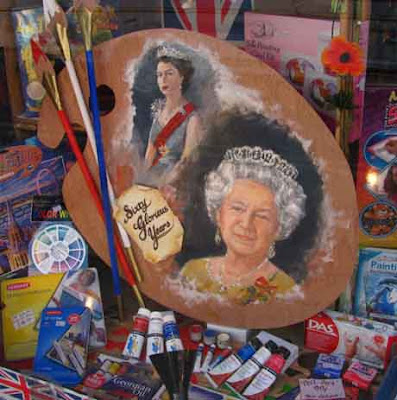
![]() |
| A shop window display in Thirsk where Alf Wight, the real James Herriot, lived and worked. |
As she wears the crown, it makes sense
that the Queen is the most celebrated.
Everywhere we went last year in England, we saw banners announcing the
upcoming Diamond Jubilee, celebrating Queen Elizabeth’s sixty years on the
throne. Curios filled shop windows, and
streamers and union jacks decorated the streets. Handymen were kept especially busy,
repainting and repairing the fronts of houses and buildings as the celebrations
neared.
Toward the end of our vacation, a hotel manager assured me
that those who spoke disparagingly about the royal family in the TV news programs reflected
the views of the majority. From what I
could tell, he must have been right. In
the United States, our government consists of a president, along with a bunch of
elected and appointed people. Each
spends a few years in office, and then fades from view. But a royal is there to stay. He (or she) serves the entire country, for as
long as he lives. And the Queen is most
important, as she wears the crown, and represents England’s sovereignty.
![]() |
| "Um, excuse me, your majesty..." |
Much as I’d like to, I don’t think I’ll ever understand what
the Queen represents to the common British citizen. But I can respect the fact that she’s there,
year in and year out, through good times and bad. Regardless of economic hardships, political
scandals, war, or other difficulties.
People look to her, and in her they see everything they desire their
country to be. Given the vets reaction in "All Creatures Great and Small," perhaps most British citizens even see her as the mother of their nation. I can respect that. I suppose, in a way, I can even envy that.
Dragon Dave
Related Internet Links
Tuesday, January 31, 2012
Siegfried’s Double-Yolk
Just as you can't make an omelet without breaking a few eggs, it takes more eggs to make an egg-white omelet if you get a double-yolk.
Perhaps I’ve lived a sheltered life, but for the first time I can remember, I cracked open an egg last week and found a double-yolk. This seemed odd to me: I had bought large eggs. Surely you wouldn’t get a double-yolk unless you purchased extra-large or jumbo-sized eggs? But I was busy making my omelet, so I forgot the conundrum and got on with the task at hand.
The next day, I recalled a scene from the TV series “All Creatures Great and Small.” Siegfried Farnon tells a farmer he’d like to purchase a dozen eggs. After he tends to the man’s sick ducks, he returns to his car, where the farmer has left eggs for him. Siegfried counts them up, and says, “I’m sorry, but I wanted a dozen eggs.” When the farmer assures him that he’s fulfilled the veterinarian’s request, Siegfried insists that he’s only received eleven. The farmer’s reply? “I’m tellin’ you, mister: one of them eggs is double-yolked.”
Siegfried’s eyebrows raise, but he pays the farmer for a dozen eggs and drives away.
I’ve watched that episode several times over the years, but only now does it strike me as strange. How could the farmer know that one of his eggs was double-yolked? Could he tell by the egg’s shape? Its size? Had he determined that his hens produced a double-yolk with every eleven eggs? And why would he count an egg with a double-yolk as two eggs? On a subsequent visit to the farm, Siegfried found that the ducks’ condition had worsened. Then he noticed that the bottle of medicine he had sold the farmer contained many more pills than it should have.
Sometimes we can be too cheap for our good. This is a recurring theme in the series, as farmers routinely plead poverty and furiously question the charges on the veterinary bills. And there are other disagreeable qualities that even the most jovial and agreeable farmers display at times. But one thing shines through each show: Siegfried Farnon and James Herriot love and admire the farmers. To these country vets, the Dales farmers are some of the best people on Earth.
Awhile back, it struck me that one person I remembered negatively had made quite a positive influence in my life. During my teen years, I regarded him as a counselor, a guide, and a friend. True, he did a few things that annoyed me. His personal journey led him to criticize some of my views and life choices. At times he judged me harshly, and I resented his punishment. But overall, his kindnesses outnumbered these minor faults. All he had done to help me outweighed the injustices he had perpetrated upon me. Moments of callousness could not obliterate his years of concern and selfless service.
I sent him a card, thanking him for all he had done. I told him how the seeds he had planted in my life were still growing today. I let him know that I still remembered him fondly. And I wished him well. In due course, I received a reply. He told me how much helping me had meant to him. He told me he still looked back on our time together with fondness. And he mentioned how something would occasionally remind him of one of our many discussions.
Perhaps this particular Dales farmer in this episode was always mean and tight-fisted. But he was part of a group of people that Siegfried Farnon and James Herriot loved, admired, and tirelessly served. I imagine even Mr. Double-Yolk had a few good qualities that the episode failed to show.
Why is it we tend to remember the injustices we’ve suffered more than the kindnesses we’ve received? How is it that a thousand kindnesses can be blotted out by a single, unthinking act? Why must we judge others harshly for not reacting to a situation like we would, or adopting viewpoints different from our own? Finding that double-yolk the other day reminds me that even if I find one aspect of a friend’s character irritating (such as the farmer’s cheapness), more than likely he possesses many admirable qualities. I should be big enough to overlook the former and focus upon the latter.
Why do I find this so difficult? How can I change myself, reform my thinking, so that I can better emulate the forgiveness and generosity I admire in others. The light shines so brightly upon the path I should follow. Yet walking along it never grows easier.
Related Dragon Cache entries
Subscribe to:
Posts (Atom)


