Wednesday, November 20, 2013

Peter Crowther: Americanophile


“Somewhere on the windswept east coast of Yorkshire there’s a mind so steeped in the idioms and lore of American pop culture that it all but constitutes a 51st state.  The mind belongs to Peter Crowther, and at the heart of its multifarious, ever-churning swirl are the picket-fence stylings of Rockwell, the folksy profanity of King, the deadpan gravitas of Serling, and the madcap irreverence of Bunny (Bugs).”
--James Lovegrove

Remember that movie “Planes, Trains, and Automobiles”?  We utilized all three during this year's trip to England.  All those trips proved enjoyable in their own way, but our ride on the tube from Heathrow Airport to Victoria Station proved particularly memorable.  For my wife and I fell into conversation with a English gentleman from London who, it seemed, was as fascinated by American culture as we are by his own.  He shared with us his experiences during his recent trip to New York, and expressed a desire to drive Route 66, see Los Angeles and Silicon Valley, and visit “Big Sewer.”  

After a few repetitions of the latter term, we finally realized that he meant “Big Sur," a scenic spot along the California coast, just a little south of Monterey and Carmel.  

We shared with him about our trip last year to Yorkshire, and when we mentioned Holmfirth, he didn’t recognize the town. But when we mentioned that it was where “Last of the Summer Wine” was filmed, he nodded in recognition.  Of course, he knew of the show, as it’s the longest-running comedy series in British TV history (if not the world).  But try as he might, he had just never gotten the humor of the show.  For him, the series employed a form of Northern humor which he simply didn’t understand, and he found it interesting that we, not being British, and much farther removed from Yorkshire, should understand it and enjoy it, when he himself could not.


At the World Fantasy Convention in Brighton, I compared the membership list with the authors of the books we received at registration, and took the books that matched to the mass signing evening event.  For some reason, I missed Peter Crowther’s name on the list, or perhaps our copy of Darkness, Darkness hid somewhere in our room during the process.  But, along with the books I had for the attending authors to sign, we also took our convention book, which had an autographs page.  After waiting in line for several authors whose books we had read, I suddenly found myself standing near Peter Crowther.  

No one stood before him at that moment.  Peter Crowther looked at me. I looked at him.  Of course, I recognized his name.  Feeling somewhat guilty, as I had not read any of his stories to that point, I sheepishly asked if he would sign my book.  He did so.  Somehow, in that brief moment, I glimpsed a little of myself in him, or at least qualities I admire.  Quiet repose.  Satisfaction with his place in the world, without the need to trumpet his triumphs.  Generosity of spirit.  Kindness.  And, dare I say it?  He just seemed like a proper English gentleman. 


It’s dangerous to attribute qualities to a person you don’t know, but somehow, that brief moment in his company made me want to read something he had written.  I saw him several times over the course of the weekend, usually in the restaurant at breakfast, and each time, my observations only reinforced my initial assessment of his character.  So imagine my surprise when I later realized that I had received one of his books.  Imagine my delight at realizing that I possessed a book by someone who had impressed me.

Darkness, Darkness is worthy of the all the praise heaped upon it by other noteworthy authors at the beginning of the book.  Not only have readers found Peter Crowther's books enjoyable, but many of his stories have been adapted to TV.  He’s also noteworthy as a publisher, having started PS Publishing fifteen years ago, a firm which now publishes 30-40 books annually.  I’m glad I finally got around to reading one of his stories, and meeting a man who has become a driving force in the British Science Fiction and Fantasy genre.  It was also nice to meet someone, even briefly, who appears to be as fascinated by American culture as I am by his own. 

Darkness, Darkness is heaped with aspects of American culture that sucked me into the story, from the Marlboros the characters smoke, the Juicy Fruit gum they chew, the DeSoto trucks they drive and the Cameros that fly (Yes, fly!), to the names of the musicians the radio DJ Melanie plays, such as Perry Como, Frank Sinatra, and Andy Williams.  Now, if only Crowther had set his story along Route 66.  Or better yet, somewhere near “Big Sewer.”  (Or, if you prefer, “Big Sur”).   I can think of another English gentleman who might have enjoyed reading it, even if it was written by a Northerner.

Dragon Dave

Related Internet Links

Tuesday, November 19, 2013

Peter Crowther Lures Me Into Darkness


The World Fantasy Convention is typically held each year in late October or early November.  You know, when it’s cold outside.  This means, when it’s held in places higher up the globe from me like Canada or England, that it’s really cold outside.  (Or at least colder than I'm used to).  Yet one of the things I like about the World Fantasy Convention is that they give you free books.  When you arrive at registration, and pick up your convention badge, they also hand you a bag of free books.  That’s a bag of books that, most likely, you might never otherwise read.  That’s not to say that the authors aren’t noteworthy, or the prose isn’t well written.  It’s just a fact of life that one can never read all the books, or for that matter all the authors, that one would like to.  So when someone places a stack of books in your hands, books that the publishers feel deserve a wider audience, it’s an open invitation to discover new authors.  It's like the publishers are saying, "These stories are so great that you really need to read them." Sure, some of them may not be to your liking, but you never know.  Who’s to say you won’t discover a new favorite author?

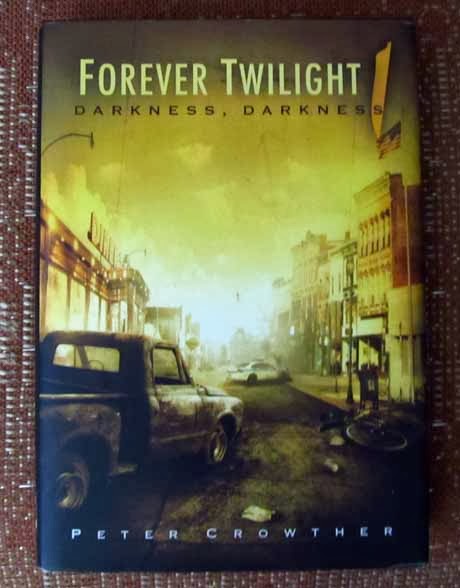
The organizers of the 2013 World Fantasy Convention continued this great book-giving tradition, and one of the novels I took up the challenge of reading was Darkness, Darkness by Peter Crowther.  It’s a well-printed hardcover, with attractive cover art, and at 127 pages, promised to be an easy read.  It’s a horror novel set in Jesman’s Bend, “affectionately known locally as the one-horse town to end them all.”  There we meet Rick, a young man who, months ago, was involved in a fatal auto accident.  While it wasn’t his fault, he’s still haunted by the crash, and hasn’t been able to drive since.  Rick holds down the night shift at a local radio station, managed by his brother Geoff.  His sister-in-law Melanie is the DJ.   One day, around three a.m., Rick awakens from another nightmare involving the auto accident to discover that everyone else in the world seems to have disappeared.  Or at least, everyone outside the radio station. 

For a while, Melanie continues to play her music, an eclectic mix of easy listening.  But no one calls in for requests, or just to talk with her, as per usual.  Rick and Geoff make phone calls, but no one answers.  Eventually, they go into town to investigate.  They find crashed cars and half-eaten dinners, but no people.  That evening, they load up on canned goods and lock down their radio station.  They don’t know what’s happened, but they know it can’t be good.

Early the next morning, signs of life appear.  A crashed car drives away.  Those who disappeared are seen working on their cars.  And yet, everything is different too.  The vehicles drive without their lights on, even though it’s still pitch black outside.  People they know walk around with sunglasses on, and their movements are slow and wooden, as if they are no longer familiar with their bodies.  When the men go to town to investigate, their friends and neighbors attack them with slow, purposeful, and emotionless violence. 

These people may sound like zombies, but they’re not mindless.  As they pursue Rick and his brother, they gradually gain familiarity with how their limbs should move, and learn how to respond better to attack.  And some of the cars they’ve worked on are now able to fly.  When their dark glasses get knocked off, their eyes glow red, suggesting that they now see by infrared light.  However, like zombies, these people seem intent on killing the living, which means that the men must flee back to the radio station, where Melanie awaits.  Can they reach her alive, and before the townspeople arrive?  And will they be safe inside its walls?  These are the questions that drive the latter half of the novel.

Darkness, Darkness is a slim volume, and Crowther doesn’t answer all the questions he raises.  But he creates an imaginative world, and populates it with vivid characters and fantastic (if horrific) situations.  While it's too early to declare that I’ve found a new favorite author, I can say that I enjoyed reading his novel.  Crowther packs his story with such a terrific punch that I might just have to seek out the second book in the series to learn what happens next.  I’m glad I had a chance to read one of his stories.  That happy experience might never have happened had I not attended this year’s World Fantasy Convention in Brighton, and had the organizers not continued the practice of including books in the price of membership. 

Now, if only they could hold the convention earlier in the year.  You know, when it’s warmer.

Dragon Dave

Monday, November 18, 2013

The Cows of Seven Sisters

As an aspiring author, I always try to exist in the moment.  To quiet my thoughts, and take in my surroundings.  When I'm able to do so, I often sense and hear things that otherwise would have escaped me.  

Such proved the case during our adventure at Seven Sisters.  We came across a herd in a meadow, and to our surprise, the cows seemed as interested in us as we were in them.  We enjoyed spending a few minutes of our day with them, and getting a sense of what they wished to communicate to us.  

"Excuse me, I'm afraid I've lost my hair brush.  
Can I borrow yours?"

"Agnes, look at the nice man with the camera.
Go on, he won't hurt you.
Show him your smile."

"I don't suppose you brought a Snickerdoodle along with you?
Or a custard tart?

While I prefer homemade, 
I also like the packaged treats they sell as Morrison's."

"Okay, go on, say it.  I'm used to it.  I know I'm brown.
I just wish I knew what the 'How now' part means."

What can I say?  I'm not sure why they really spoke to us, but I'm glad they did.

Dragon Dave

Friday, November 15, 2013

The TARDIS of Brighton Pier


"Okay, let's try this again.

Like moths to a flame, Master & Mistress were drawn to the glowing lights of Brighton Pier.  They took us with them, so we could also see what was happening inside.


Their senses were inundated by sounds, colors, and activity. They wanted to leave, but we counseled that they might only come here once, and they should try their hand at a few games.


In fact, we had one we especially wanted Master to play.

He put his 30 pence in the coin slot, and had a go of it.  He pressed one button, and the claw moved backward.  Another button made the claw swing to the side.  Then he pressed the final button, and the claw descended.


It missed one of our cousins, but grasped hold of the TARDIS, lifted it up, and dropped it down a chute.


In this way, Master secured a time machine for all of us.  He and Mistress assured us that we would all have many happy adventures together.  Now, will you let us inside?


K-9: How Master procured his time machine is irrelevant.  I will not allow you inside.
Artist: But we were there when he acquired it.
K-9: Your proximity to Master & Mistress while procuring their TARDIS is irrelevant.
Rex: K-9, where did the pterodactyl come from?
K-9: Master and I brought it back from prehistoric times.
Rex: You mean you've already accompanied Master on an adventure, yet you won't even allow us to look inside?
Artist: K-9, be reasonable.  We're Master's friends.  The Mistress made us.  She wouldn't mind--
K-9: Who made you is irrelevant!  Daleks are the enemies of the Doctor, and I will not allow you to discover the secrets of the TARDIS!
Pterodactyl: Aarrck aarrck aarrck!


K-9: Good bird.  Way to scare away those conniving Daleks.

Artist & Rex Dalek, K-9, & Pterodactyl

Thursday, November 14, 2013

Recovering From My Seven Sisters

Sometimes, the journey home seems longer that the trip away.  This proved the case with our return from visiting Seven Sisters.  The muddy path demanded even greater concentration than before, and although it had stopped raining, we were still cold, and lunchtime had long since passed.

At one point, a hearty-looking gent breezed past us, taking his three dogs out for a walk and a romp.  He threw the ball for them, and barked commands, and they obeyed him joyfully and without hesitation.  While we skated along as if on ice, he strode along in wellies, the rubber boots making easy work of the soft, squishy earth.  His example reminded me of Compo, the small, scruffy character in "Last of the Summer Wine." Having visited Holmfirth, and knowing how changeable the weather in Yorkshire can be, Compo's decision to always wear wellies, regardless of how sunny and bright the day began, suddenly seemed wise.

By the time we reached the road, it was after 2 p.m., and for some reason, neither of the food places nearby appealed.  So we boarded the bus back to Brighton.  


At one point in our walk, we had noticed a rabbit watching our slow, steady progress.  While not as large as the Giant Rabbit Guardian of Sacramento Airport, he had nonetheless seemed large for a rabbit.  On the bus, we overheard a woman tell her friend about an old lady who lived in a cottage at the outskirts of her town.  The old woman's husband had died a few years back, and she kept to herself, and spent her time caring for small wild animals such as our friend the rabbit.  The woman seemed as skittish of civilization as the animals she cared for, so the lady on the bus occasionally brought her a hot meal, and sat down to talk with her for awhile, before returning to her everyday life in the city.


Of all the nearby towns, I had wanted to visit Rottingdean.  Rudyard Kipling, a writer perhaps best remembered for The Jungle Book, lived there.  I thought it would be nice to see his house and the gardens named in his honor.  But we were tired and hungry as we left the bus, and a pub called The White Horse promised hot drinks, good food, and above all rest for our cold, weary bodies.  We heeded its siren song.


A woman with open wounds pulled drinks behind the counter, and a young man with a darkened face took our order.  We found a comfortable table inside, and watched the storm clouds looming overhead.  I felt sorry for the two behind the bar: death seemed to have claimed them so early in life, and their bodies were rapidly decaying. Then I remembered what day it was, and I took heart.  

Even Zombies return to life on the day after Halloween.


The staff at The White Horse served us two pots of hot tea, and plates loaded with more delicious food than we could eat.  


We tried our best to honor the cook's glorious efforts.


By the time we finished our lunch/dinner (Linner?), the sun was setting, and the male zombie informed us that the Kipling Gardens were most likely closed, or soon would be.  Outside, the air had grown colder, and the sky was spitting down rain again.  So we clustered under the shelter of the bus stop, and waited for the bus back to Brighton.  


Farewell, Seven Sisters!  Farewell, Rottingdean!  Perhaps one day we can return, and visit you both again!

Dragon Dave

Related Dragon Cache entries

Tuesday, November 12, 2013

Visiting My Seven Sisters: Part 2


In The Blotting Book by E. F. Benson, young Morris Assheton learns that his character has been maligned.  Strangely, it seems that Godfrey Mills, the partner of his solicitor and legal guardian Edward Taynton, has been spreading these rumors.  With his thoughts full of anger, and wondering how to counteract the man's actions, Morris takes his car out of Brighton.  He drives South past towns like Rottingdean, Newhaven, and Seaford, and only stops when he reaches the outskirts of the suburbs of Eastbourne.  Then he heads back, and parks to sit along the chalk cliffs a mile from Brighton, near a narrow channel. 

E. F. Benson frequently mentions the South Downs, and the white chalk cliffs, in his novel.  These features of the local landscape provide stark contrast to the dilemmas Morris Assheton and Edward Taynton undergo throughout the story.  As the Seven Sisters are striking examples of England's white chalk cliffs, my wife and I followed Morris' journey as best we could, utilizing public transportation.  A bus took us South from Brighton, past Rottingdean, Newhaven, and Seaford, to the Seven Sisters area, just a few miles North of Eastbourne.  Then we began our long, slow march to the coast.


By the time we reached the beach, the strong wind had already bent the metal frame of my inexpensive umbrella.  Still I used it as best I could, to shield myself and my camera from the rain.  Then an unexpected gust blew the umbrella out of my hands, and it fell over the edge of the high section of beach.   At first I thought I had lost it to the water leaving the valley and rushing out to sea, but then I saw it lying on the rocks by the stream, and I found a way down to the lower section of beach.

Below, the concrete and wooden sea wall fortifying the higher area of beach offered me shelter from the rain.  I gazed up through a hole in the sea wall at the coast guard cottages.  I wondered how often those inside the cottages spotted a ship in trouble, and rushed out to its aid.


We crunched over the beach, admiring the shapes of the rocks we found, and how the low light and dampness brought out their colors. Then we trudged up the hill.  As we neared the cottages, the rain eased off, and we were able to enjoy the view a little more.


After hours of standing, the nearby benches looked tempting, but they promised to further soak our already-wet jeans.  We also decided not to emulate Morris Assheton by sitting on the cliff edge.  


With the cessation of rain, the sky quickly cleared, and the cliffs, which before had been obscured by clouds, grew visible.  The Seven Sisters stood out proudly, as if welcoming us after our long journey.


We were glad that we read The Blotting Book, and that Morris Assheton's journey inspired us to undertake a similar adventure.  Seven Sisters was definitely a sight not-to-be missed!


Then we returned to the valley floor, and the muddy path that would lead us back to civilization.  Or at least the bus stop.

Dragon Dave

Monday, November 11, 2013

Visiting My Seven Sisters: Part 1

K-9: Wind and rain aren't good for my circuits.
Rex: Daleks aren't afraid of stormy weather.  We're indomitable.

In storm-battered Brighton, it would have been easy to stay inside our comfortable warm hotel room.  But adventure favors the brave!  So we bundled out, and headed for the bus stop.

In The Blotting Book by E. F. Benson, our young protagonist needs to think.  So he takes his car (simply called a motor back in early 20th Century Britain) and drives South from Brighton along the coast.  We opted to replicate his journey as best we could with public transportation.

A brief introduction to my Seven Sisters.  Their names are:
Haven Brow, Short Brow, Rough Brow, Brass Point, Flat Hill, Baily's Hill, and Went Hill.

At the Visitor's Center, a guide suggested the best--and shortest--hike, one that would take us out to the beach, where we could see the faces of all seven sisters.  Then we were off, to begin our 3 mile journey.
  

The narrow dirt path grew increasingly muddy as it rained. Our pace slowed as our feet slipped forward a little with each step. There was so much to see, and yet we were already wet. We didn't want to get covered in mud as well.  

Artist: Keep your distance, animals!
Humans and Daleks coming through!

Of course, we had to stop for cows.


Wild Blackberries offered sustenance along the way, as well as time to relax our concentration.  It was nice to just look around for awhile, and take in our surroundings.  

And yes, the berries were delicious.


Then the blackberry bushes disappeared, and after awhile, we saw why. Farmers had ripped them up, and in their place spaced out new fence posts.  As one man held up a wooden post, another drove his tractor up, and using a large hydraulic attachment, pounded it into the ground.  With their sharpened points, the posts dug into the soft earth quickly.  Later, the men would return, and string up new wire along the posts.

Their Border Collie looked on with interest. I imagine he would have rather been herding sheep.


With the rain, so much to see, and the need to concentrate on each step, our progress was slow.  But gradually, we neared our Seven Sisters.

Dragon Dave