Showing posts with label Space 1999. Show all posts

Wednesday, August 13, 2025

The Eagle Obsession: A Jeffrey Morris Film


A friend introduced me to Space: 1999 when I spent the weekend with him. I couldn't watch the TV series when it aired, as my parents were devoted to Lawrence Welk. But later, when the series was rebroadcast, and the time slot didn't conflict with my parents' favorite show, I watched Space: 1999 on our 13" Black & White TV. I made comlocks and stun guns out of paper. When a model kit of the Eagle was released, I bought and assembled it. The show lived on in my imagination. It's a part of my childhood that will be with me forever. 

Here's a new movie that celebrates the impact of Gerry Anderson's live-action science fiction extravaganza on fans like me:


A Stunning New Documentary - The Eagle Obsession

Journey Through Imagination, Memory, and the Dream of a Better Future

Spanning continents, decades, and disciplines—from Pinewood Studios to NASA, from Oscar winners to 5th graders, the film traces the unexpected legacy of the Eagle Transporter, a fictional spacecraft from the cult 1970s series SPACE: 1999.  Through the lens of this iconic ship, Jeffrey explores how bold science fiction and the Apollo era seeded a generation’s values, aspirations, and careers. At the heart of THE EAGLE OBSESSION is a childhood memory: a toy version of the Eagle Transporter that launched a lifelong pursuit of storytelling, science, and wonder.  


Decades later, director Jeffrey Morris retraces the impact of that ship, not just on himself, but on an entire generation shaped by the Apollo program and visionary science fiction. His journey takes him from the Kennedy Space Center to Pinewood Studios, from NASA engineers to Hollywood legends, revealing how the dreams of the past continue to shape the minds building tomorrow.  


Through archival treasures, original visual effects, and a sweeping global journey, THE EAGLE OBSESSION becomes a meditation on memory, identity, and the power of visionary media to change lives, not just entertain.


Along the way, he connects with those forever changed by the dream:  

  • William Shatner (Star Trek)

  • Barbara Bain and Nick Tate (SPACE: 1999)

  • Dr. Sian Proctor (Inspiration4 astronaut)

  • General Charles Duke (Apollo 16)

  • Brian Johnson (2001: A SPACE ODYSSEY, ALIEN)

  • Bill George (BLADE RUNNER, RETURN OF THE JEDI)

  • Kevin J. Anderson (DUNE, STAR WARS)


Years in the making and just recently completed, THE EAGLE OBSESSION has been submitted to the Toronto International Film Festival (TIFF) for its World Premiere in September 2025. It has also been entered in numerous additional festivals globally throughout late 2025.  


Thanks to The Eagle Obsession for sharing this announcement with us. 

Wednesday, March 25, 2015

Starsky & Hutch Versus The Dragon: Part 2

In the first season episode "Terror On The Docks," Starsky and Hutch enter an old Victorian mansion. They find themselves surrounded by occult objects, a regal dragon, and ultimately, a fearsome minotaur. Who could this minotaur be, they wonder. And more importantly, will it charge them?


Then the minotaur lifts off his head, and Starsky and Hutch see it is merely their informer Ezra in costume. 

Ezra welcomes the two detectives to his unholy house of occult worship, where he now teaches people to be witches and sorcerers. Starsky and Hutch ask him to use his contacts to learn who might be operating as a fence to sell the stolen goods for the theft ring operating at the docks. 


Starsky can't get over Ezra's new career, nor the paraphernalia of his occult practices. He's particularly intrigued by a gargoyle adorning this knife. Then he lifts a human skull, and eerie music fills the room. It's enough to hurry our two heroes back outside, where they can breathe a little easier, and concentrate on capturing the criminals.

Eventually, the clues they uncover lead them back to this strange, old house, where once again, they must confront the dragon. 


As it turns out, Ezra isn't so reformed after all. His new career as a master of the occult is merely a front. He's helping the criminals at the docks sell their stolen merchandise. Or he was, until our two heroes arrest him.

Bad Ezra! Evil Ezra!! How dare you try to fool Starsky and Hutch!!!

Sadly, one of the thieves was the fiancé of a young lady whom Hutch was to give away at her wedding. When Starsky refuses to step up and marry the girl, her mother demonstrates her displeasure.


Starsky, incensed at Hutch's laughter, decides to share this honor with his partner.


Thus, we are reminded of one of life's great teachings regarding confrontations with dragons. Even if you win, you can't help but emerge with a little cake on your face.

"Terror On The Docks" was written by Fred Frieberger, who produced many TV classics, including The Wild Wild West, Star Trek, The Six Million Dollar Man, and Gerry Anderson's live action series Space 1999. With such an extensive sci-fi resume, he must have known a lot about dragons.

Dragon Dave

Related Internet Links
One fan's extensive notes on "Terror on the Docks"

Tuesday, March 24, 2015

Starsky & Hutch Versus The Dragon: Part 1


In the first season episode "Terror On The Docks," a series of robberies, and the slaying of a fellow police officer, lead Starsky and Hutch to question Ezra, a former fence.


Inside this grand, Victorian mansion, the two detectives find themselves surrounded by a collection of occult objects and images.


Chief among these is a dragon, perched on his mighty pedestal, beside a flaming torch. 


Watch out, Starsky! Behind you!


Suddenly a minotaur appears, clad in solemn black robes. Perhaps the famous Greek historian Plutarch got his facts wrong, and Theseus did not kill the dreaded Minotaur of Crete? Or perhaps it is Dario Agger, C.E.O. of the Roxxon Energy Corporation, who seals a nefarious pact with the dark elf Malekith of Svartalfheim in THOR Issue 6? Could it be the minotaur from Atlantis who guarded the Crystal of Kronos in the Doctor Who story "The Time Monster"?

All the two detectives know is that they'd rather be back in their red-and-white Gran Torino, than facing down a dragon and a minotaur! But then, wouldn't you?

Dragon Dave

Thursday, May 2, 2013

When Commander Koenig Met Noah


Are you a fan of the old Sci-fi TV show Space 1999?  Are you intrigued by the ways Science Fiction often revisits Biblical stories?  Do you love comic books?  If you answered yes to any of those three questions, then you might be interested in “Return to the Beginning,” a record and comic book set released by Power Records in 1976. 


For those of you unfamiliar with Space 1999, a series of explosions tear the moon out of Earth’s orbit.  Commander John Koenig and the people stationed on Moonbase Alpha watch as the moon repeatedly encounters exotic phenomena that transport them to other planets.  While the moon never locks into orbit over one that’s perfect for human inhabitation, this allows Koenig and company to visit these planets in their Eagles, speak with an alien or two, and have an exciting adventure.

On those rare episodes when the moon doesn’t pass close to another planet, aliens usually visit them.

Although Science Fiction authors has often pondered what life might be like in a moonbase, Space 1999 never explored such potential realities.  Instead, stories featured the strange alien races we might meet, and how humans might react in perplexing, even weird situations.  Space is a dangerous, unforgiving environment, and the TV show embodied that view.  When aliens weren’t seeking to take advantage of the displaced humans, misunderstandings arose that made peaceful coexistence impossible.  Despite all the camp associated with the series, and its implausible settings and ideas, in that way Space 1999 wasn’t as divorced from reality as it often seemed.

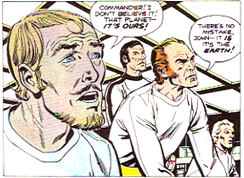
In “Return to the Beginning,” Moonbase Alpha is rocked by the space-equivalent of a hurricane.  Personnel are hurled to the floor and lose consciousness.  When they awaken, Professor Victor Bergman muses that they’ve passed through the fringes of a black hole.  Then they discover that they’ve returned to Earth.  


After Alan prepares Eagle One for launch, he flies Commander Koenig, Dr. Helena Russell, and Victor Bergman down to the planet’s surface.  


There, Victor realizes that they’ve arrived in the year 3347 B.C.  But after they hike across tranquil countryside to a quaint village, they find the inhabitants jeering an old man who urges them to repent of their sins.  Otherwise, God will make it rain for forty days and nights, and all of them will be washed away!


At first, I found the combination of Noah and a secular TV program disconcerting, but Science Fiction has often revisited Biblical history and teachings.  Consider how frequently the characters of any given Sci-fi series have met some version of God, or how often SF authors have revisited the Adam and Eve story.  The difference between most such attempts and “Return to the Beginning” is that the author portrays the story of Noah as history, offering scientific underpinnings for what many would consider no more than a fable or myth. 


I gather that many criticized this story when it was released, given the author’s approach to the material.  But like those children who yearned for more Space 1999 stories, I’m delighted to have found another.  When I listen to the accompanying audio track and read the story, it’s almost like watching a missing TV episode.  And you can share that experience too, by following the link below.  That is, if you can spare ten minutes and thirty-six seconds for Commander John Koenig, Dr. Helena Russell, Professor Victor Bergman, and the other residents of Moonbase Alpha.

Now if you'll excuse me, I'm heading off to my local comic book shop, to see if I can secure my own copy of "Space 1999: Return to the Beginning." 

Commander Koenig meets Noah.  Huh.  Who’d have imagined that?

Dragon Dave

Related Dragon Cache entries

Related Internet Links

Saturday, May 12, 2012

Those Spectacular Movies


In “The Power of Star Wars” Parts 1 and 2, I talked about how watching that particular movie in the cinema changed my life.  An activity that grew out of my love for Star Wars was attending conventions.  There were all kinds of conventions back then, just as there are today.  Some were primarily literary in nature.  Some focused more on Horror.  Some chiefly celebrated Star Trek.  But for me, the primary consideration for attending a convention was the movies they would show.

It’s hard for me to journey back in my mind and remember how I felt whenever I attended one of those media-based conventions.  Today, I’ve got many of my favorite TV shows, and oh-so-many movies, instantly at my fingertips via my DVD collection.  If those don’t suffice, I can turn on my 42” flatscreen TV, and watch any number of movies on more than a hundred channels.  But back in the late 1970s, science fiction and fantasy movies (sci-fi) were a more finite resource.  

My parents had two thirteen-inch Black-and-White TVs (with the old square-shaped screen) in our home.  My father swore that we would never have a color TV.  “They're bad for you,” he told me, whenever I would ask.  After “Star Wars” gave me an insatiable hunger for sci-fi, I talked my parents into letting me have one of the sets in my room.  Perhaps I complained about wanting to watch “Space 1999” when they were enjoying “The Lawrence Welk Show” until they caved in.  Maybe they just took pity on me.  At any rate, I would scan the TV listings for anything vaguely sci-fi on the six or so channels that we received, and hopefully it was scheduled for broadcast during a time period in which I could watch it.  Or, if it was scheduled for past my bedtime, I might have begged my parents to let me stay up.

Today, a filmmaker contracts special effects out to whichever company he believes can do the best job in the least time for the lowest price.  But before Star Wars and ILM, any director who wanted to make a sci-fi movie had to hire people individually, and hope that not only were they as good as they claimed, but that they could work well with him and their future coworkers.  There were special effects “wizards” like Douglas Trumbell and Ray Harryhausen, each of whom had their own unique style and capabilities.  If a moviemaker got one of them, he was fortunate.  But most of the time, producers hired what people they could afford, who would then conduct experiments in their laboratories, to see if they could realize the effects envisioned by the director.

Most of the time, they couldn’t.

Without ongoing effects houses, sci-fi movies were made less often.  Perhaps one or two might be released each year.  Certainly this would have been true of major studio productions.  Thus, there was a feeling that the catalogue of existing science fiction movies was limited.  If a person had the resources, and were sufficiently dedicated, he or she could see every sci-fi movie that had ever been made.  I don’t remember if I ever had such lofty ambitions, but I know that I wanted to see any sci-fi movie I could.  Thus, I looked forward to the major media conventions each year.  As soon as I arrived, I’d scan the programs and mark off all the movies that I had never seen.  Back then, all of them seemed unique in some way.  They might not have compared to “Star Wars,” but that didn’t matter.  Each presented a distinct vision of the writer and director.  Each displayed effects that people had worked hard to produce, many times using highly innovative techniques.  

Sometimes, I wonder what happened to that boy.  The one who hungered to see every sci-fi movie he could possibly see, instead of researching particular movies to determine which ones were truly worth his time.  The one who saw each one as special, instead of labeling it as derivative if the previews reminded him too much of another movie he’d seen.  

I seem to remember that he judged none of them too harshly. And that he loved them all.

When was the last time you really hungered to see a movie, not because it received great reviews or because your friends saw it as important, but merely because it represented a filmmaker's attempt to realize his unique vision?

Related Dragon Cache entries