Showing posts with label religion. Show all posts

Thursday, May 2, 2013

When Commander Koenig Met Noah


Are you a fan of the old Sci-fi TV show Space 1999?  Are you intrigued by the ways Science Fiction often revisits Biblical stories?  Do you love comic books?  If you answered yes to any of those three questions, then you might be interested in “Return to the Beginning,” a record and comic book set released by Power Records in 1976. 


For those of you unfamiliar with Space 1999, a series of explosions tear the moon out of Earth’s orbit.  Commander John Koenig and the people stationed on Moonbase Alpha watch as the moon repeatedly encounters exotic phenomena that transport them to other planets.  While the moon never locks into orbit over one that’s perfect for human inhabitation, this allows Koenig and company to visit these planets in their Eagles, speak with an alien or two, and have an exciting adventure.

On those rare episodes when the moon doesn’t pass close to another planet, aliens usually visit them.

Although Science Fiction authors has often pondered what life might be like in a moonbase, Space 1999 never explored such potential realities.  Instead, stories featured the strange alien races we might meet, and how humans might react in perplexing, even weird situations.  Space is a dangerous, unforgiving environment, and the TV show embodied that view.  When aliens weren’t seeking to take advantage of the displaced humans, misunderstandings arose that made peaceful coexistence impossible.  Despite all the camp associated with the series, and its implausible settings and ideas, in that way Space 1999 wasn’t as divorced from reality as it often seemed.

In “Return to the Beginning,” Moonbase Alpha is rocked by the space-equivalent of a hurricane.  Personnel are hurled to the floor and lose consciousness.  When they awaken, Professor Victor Bergman muses that they’ve passed through the fringes of a black hole.  Then they discover that they’ve returned to Earth.  
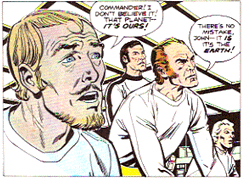

After Alan prepares Eagle One for launch, he flies Commander Koenig, Dr. Helena Russell, and Victor Bergman down to the planet’s surface.  


There, Victor realizes that they’ve arrived in the year 3347 B.C.  But after they hike across tranquil countryside to a quaint village, they find the inhabitants jeering an old man who urges them to repent of their sins.  Otherwise, God will make it rain for forty days and nights, and all of them will be washed away!


At first, I found the combination of Noah and a secular TV program disconcerting, but Science Fiction has often revisited Biblical history and teachings.  Consider how frequently the characters of any given Sci-fi series have met some version of God, or how often SF authors have revisited the Adam and Eve story.  The difference between most such attempts and “Return to the Beginning” is that the author portrays the story of Noah as history, offering scientific underpinnings for what many would consider no more than a fable or myth. 


I gather that many criticized this story when it was released, given the author’s approach to the material.  But like those children who yearned for more Space 1999 stories, I’m delighted to have found another.  When I listen to the accompanying audio track and read the story, it’s almost like watching a missing TV episode.  And you can share that experience too, by following the link below.  That is, if you can spare ten minutes and thirty-six seconds for Commander John Koenig, Dr. Helena Russell, Professor Victor Bergman, and the other residents of Moonbase Alpha.

Now if you'll excuse me, I'm heading off to my local comic book shop, to see if I can secure my own copy of "Space 1999: Return to the Beginning." 

Commander Koenig meets Noah.  Huh.  Who’d have imagined that?

Dragon Dave

Related Dragon Cache entries

Related Internet Links

Thursday, April 18, 2013

Religion and Revenge on Babylon 5


In the first season episode, “The Parliament of Dreams,” all the sentient species aboard Babylon 5 spend a week celebrating their culture’s dominant religion.  The Centauri host a feast commemorating a time in their history when they battled against another intelligent species, the Xon, for dominion of their home world.  The Minbari perform a ceremony of rebirth and renewal, which we later learn also doubles as a wedding ceremony.  Unfortunately, we don’t get to see all the religious ceremonies, as a major portion of the episode concerns an attempt on the life of Ambassador G’Kar.

When we first glimpse the Narn Ambassador, he is preparing a meal in his quarters, and singing this lighthearted Narn song with his beautiful tenor voice.

I'm thinking of thinking of calling her right
after my afternoon nap.
I'm thinking of thinking of sending her flowers,
right after Bonnie gets back.
So many fishies left in the sea,
so many fishies - but no-one for me...
I'm thinking of thinking of hooking a love,
soon after supper is done.

As he sits down to eat, a Narn messenger arrives and asks, “Are you Ambassador G’Kar?”  Annoyed, G’Kar responds, “This is Ambassador G’Kar’s quarters. This is Ambassador G'Kar's table. This is Ambassador G'Kar's dinner! What part of this progression escapes you?"  The messenger leaves him with a memory crystal, stressing that the message is urgent.  With a growl, G’Kar rises, and places the memory crystal in his computer.  All thoughts of his meal evaporate as an old political adversary, Du’Rog, reminds G’Kar of how he once disgraced Du’Rog before the Narn Council.  Now that he is dying, Du’Rog is liquidating his assets to hire an assassin.  Du’Rog says that while the assassin is close to him, G’Kar will not learn the identity of his killer…until it is too late. 

Ambassador G'Kar loses his appetite.

G’Kar bursts into action, intent on protecting himself any way he can.  Complicating matters is the arrival of his new aide Na’Toth.  She is replacing Ko’Dath, his former aide who died during an airlock malfunction.  While Na’Toth’s suggestions seem wise, her governmental sponsor was Li’Dak, and Li’Dak’s sponsor was his nemesis Du’Rog!

By pairing the celebration of religion with a tale of revenge, writer and producer J. Michael Straczynski suggests that, as much as we grow as a society, and as evolved as our species may become, as individuals we will still inflict harm on others, and occasionally “repay evil with evil.”  Yet religion gives us a means through which we can stretch ourselves, and attempt to embody our highest ideals. 


In the final scene, Commander Sinclair demonstrates “Earth’s dominant belief system” to the ambassadors of the major alien races.  Instead of holding a particular ceremony, Sinclair lines up representatives of various Human religions.  Having survived his encounter with death—a situation caused by how he harmed others in the past--G’Kar follows as Sinclair introduces each representative’s name and Faith, and shakes his or her hand.  


Even more solemnly than the commander, G’Kar greets each person, shaking hands or bowing.  Perhaps he has learned something that will light the way to his transformation later on.  Perhaps he recognizes now, more than ever, that the ultimate expression of religion is not only that we love and respect those who believe like we do, but that we love and respect those who believe differently, whether they be atheists, Roman Catholics, Zen Buddhists, Muslim, Jew, Greek Orthodox, Taoist, Shinto, Hindu, or any of the other 250 Humans who have assembled on the space station to represent “Earth’s dominant belief system.”

Dragon Dave

Related Internet Links

Friday, February 1, 2013

Adam, Eve, and Prometheus


With “Prometheus,” Ridley Scott set out to do a prequel to “Alien.”  But as Jon Spaihts and Damon Lindelof helped him craft the story, he used the movie to explore beliefs on the origin of the human species.  While many of the actors were drawn to work with Scott because of his reputation, or because they loved “Alien,” some grew excited by the “Science versus Religion” aspects of the story.  This proved the case for Noomi Rapace and Logan Marshall-Green, who played the researchers Elizabeth Shaw and Charlie Holloway, and Michael Fassbender, who played the android David. 

For those who have not seen the movie, Shaw and Holloway are archeologists who have observed the same star configuration in cave paintings from different cultures all over the Earth.  When Peter Weyland agrees to fund their expedition to an Earthlike planet circling one of the stars, he sends along David, an expert in ancient languages, to make contact with any sentient beings they may encounter.  As an android, David holds no religious beliefs, and feels no excitement over a potential meeting with a race that might have initiated or influenced mankind’s development.  The only discovery that matters to Charlie Holloway is that he can communicate with the aliens he believes created humanity.  Elizabeth Shaw, who refuses to abandon her Christian upbringing, confounds Holloway and David.  “How can you cling to your religion when your research leads you to believe that aliens created you?” they ask.  “Yes, but who created them?” she replies.

People of all religious persuasions can be stern with those who attempt to reinterpret their beliefs.  Yet all too often, when I mention to a Christian that I’m writing Science Fiction and Fantasy, I’m told “I’ve got a great idea for a story.”  Invariably, their great story involves a spaceship crashing on a planet, and the survivors, a man and a woman, end up populating this world, which usually turns out to be Earth.  (On such occasions, I’ve learned to nod, and say “Wow, what a powerful idea!”) 

While people outside the genre may not be aware of this, Science Fiction has reinterpreted the Adam and Eve story many times.  My 2011 series on “The Cage,” in which the Talosians kidnap Captain Christopher Pike, and attempt to repopulate their dead planet through him and Vena, reminded me how fascinated Gene Roddenberry was by the origin of man.  When the studio rejected “The Cage,” he wrote a second Star Trek pilot, “Where No Man Has Gone Before,” in which Lieutenant Gary Mitchell and Dr. Elizabeth Dehner are granted psionic powers, and plan on breeding a race with such godlike abilities.  Occasionally, someone like Roddenberry will reinterpret the Origin of Man stories in a new way that resonates with society, but such occasions are rare.  As we appear to be endlessly fascinated by this topic, most magazine and book publishers list “Adam & Eve” among those types of stories that they definitely do not want.  

I find it interesting that so many people of sincere religious belief are drawn to Science Fictional variants of the Adam and Eve story.  I find it equally interesting that every human culture and society has developed its own myths about the origins of humanity.  On the other hand, I find it boring and tiresome when we frame such discussions in terms of This versus That, as if a single person, group, or system could fully define Ultimate Truth.  Science, Mythology, Religion, Art, Music: none can fully capture, envision, or explain It.  All have their place in helping us understand and perceive the Truth about our origins, our planet, and ourselves.

As Jon Spaihts, Damon Lindelof, and Ridley Scott demonstrated with “Prometheus,” Fiction can also serve as an aid to enlightenment.  At least, to quote Elizabeth Shaw, “that’s what I choose to believe.”

Dragon Dave

Related Internet Links
Prometheus News & Discussion site