Thursday, April 4, 2013

The Conan Chronologies


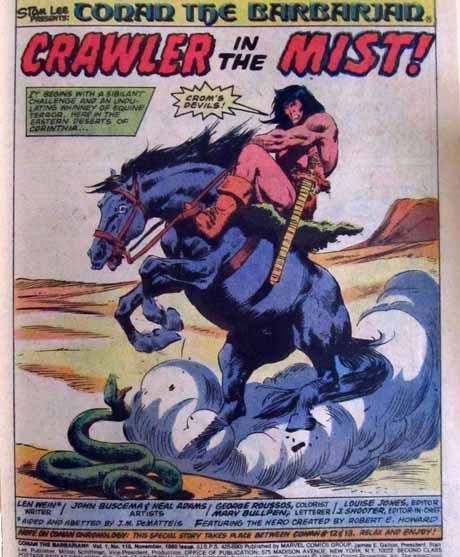
One of the first things I noticed, on the first page of "Conan the Barbarian" Vol. 1 Issue #116, was a line beneath the story credits.  It read “Note on Conan Chronology: This special story takes place between Conan #12 & 13. Relax and enjoy!”  I wondered at this, as comic book stories usually follow one another in sequential order.  But then I shrugged, and continued on with “Crawler in the Mist!” figuring the staff had decided to throw in an occasional out-of-sequence story.  I hadn’t read any of those early comics, but my interest was piqued by the note, as I knew that Marvel’s early “Conan the Barbarian” comics drew heavily on Robert E. Howard’s original stories. 

Fans of historically important people often read all the biographical information they can get their hands on, then wonder what the person did between recorded events.  Early Christians attempted to fill the gaps in the canonical gospels with stories about Jesus’ early years.  Perhaps the ultimate compliment a fan can pay an author is to attempt a timeline for their favorite fictional character.  Steven Brust’s character of Vlad Taltos certainly inspires such devotion.  Robert E. Howard’s Conan is another.

Howard wrote a score of Conan stories, and one novel, over a four-year period.  (Sadly, the last four years of his too-short life).  In my youth, I became aware of the character through the twelve paperback books edited by L. Sprague de Camp and Lin Carter.  The two men structured the series as one long, sweeping narrative of Conan’s life, so I assumed Howard had written his stories sequentially as well.  In fact, what I hadn’t realized was that the first Conan story Howard wrote, “The Phoenix on the Sword,” took place late in the character’s life, after he had become king of Aquilonia.  This is one of the reasons why Patrice Louinet served as editor for The Coming of Conan the Cimmerian.  By presenting the stories in the order Howard wrote them, he felt he could show fans how Howard saw the character, and how his concept of Conan evolved with each subsequent story.


Intriguingly, the first attempt to construct a chronology of Conan’s life seems to have begun during Howard’s life.  According to Wikipedia, Howard reviewed it in draft form in 1936 (the year of his death), and gave it his provisional blessing.  P. Schuyler Miller and John D. Clark published it two years later, in fanzine “The Hyborian Age.”  L. Sprague de Camp and Lin Carter used this as a basis for structuring their twelve book series, updating the chronology to encompass the stories they added to the Conan canon.  Since then, others (including celebrated Wheel of Time series author Robert Jordan, who wrote several Conan novels during his also too-short life) have contributed their own Conan chronologies.  This process will likely continue, as more stories and novels are written about this simple barbarian with whom fans seem eternally fascinated.

As I’m always interested in learning more about the stories I read, as well as the people who wrote them, I did a little research on “Conan The Barbarian” Vol. 1 Issue #116.  Apparently, Len Wein’s story was originally created for Power Records, a division of Peter Pan Records.  Power Records produced a series of “Book and Record” sets, combining one or more comic book adventures with a 45 RPM 7-inch record.  Children could read the comic book, or listen to the story, or do both simultaneously, giving them an audio-visual experience for $1.49 (roughly 4-5 times the price of a single comic book).  Power Records published “The Crawler in the Mists!” in 1976.  Four years later, after a slight alteration to the title, additional artwork, and changes in exposition, dialogue, and coloring, Marvel republished it in Issue #116. 


Literary canons and character timelines don’t necessarily include comic book adventures, but I’m glad Marvel republished “Crawler in the Mist!”  Like so many one-off stories and missing adventures, I’d never have known it existed, had it been left outside Marvel’s chronology of Conan’s life.  And now you can read it too, and even listen to it, by following the link below.  In the words of the mighty Marvel, “Relax and enjoy!”

Dragon Dave

Related Internet Links


Wednesday, April 3, 2013

My Reunion With Roald Dahl


On Easter morning, I left the shower to find an Easter Egg from See’s Candy in the bedroom.  After I dressed, I spotted another on the couch.  As we were visiting my mother’s church to spend the day with her, and had a long drive ahead of us, my wife suggested I grab a book.  So I picked up a book I’ve been wanting to read for some time now: Charlie and the Chocolate Factory by Roald Dahl.  Then I noticed a third Easter Egg beside my computer.

In Dahl’s novel, Charlie lives in a ramshackle house.  His father doesn’t earn much at the toothpaste factory, and with his meager pay, he supports his parents, his wife, her parents, and Charlie.  The diet for all seven consists of bread and margarine for breakfast, boiled potatoes and cabbage for lunch, and cabbage soup for dinner.  On Sundays this routine changes, when the family gets a second helping.  That’s assuming that no unexpected expenses occur, which require them to skip a few meals. 

Willy Wonka’s Chocolate Factory is located nearby, which means that with every breath, Charlie inhales the mouthwatering aroma of chocolate.  When he sees other children eating chocolate, he can only turn away.  Once each year he receives a Wonka candy bar, and, “on those marvelous birthday mornings, he would place it carefully in a small wooden box that he owned, and treasure it as though it were a bar of solid gold.”  For the first few days, Charlie would only allow himself to stare at it.  Then, “when he could stand it no longer, he would peel back a tiny bit of the paper wrapping at one corner to expose a tiny bit of chocolate, and then he would take a tiny nibble, just enough to allow the lovely sweet taste to spread out slowly over his tongue.”  Through his strict rationing, Charlie makes his chocolate bar last a month or more.

While my wife drove, I read some of the book to her, and shared with her the occasional illustration.  But I lacked Charlie’s self-control, and before the day was out, I had devoured Dahl's novel.  I loved the flow of his prose, his descriptions, inventiveness, and wit.  His characters leap off the page, over-the-top and yet reminiscent of people in the real world.  I haven’t read the story in over three decades, and I’ve never seen the movie adaptations.  I never owned the novel, but checked it out of my elementary school library.  And yet, as I read, memories resurfaced, preparing me for what would occur in the next chapter.  Or on the next page!

They say that you retain less than one percent of your long-term memory.  One percent doesn’t seem like much.  But I’ve reread books after far shorter intervals, and not remembered half of what I remembered of Charlie.  That suggests that Roald Dahl knew how to structure his plots so that they resonated with me, that he shaped his characters with care, and that he painted his scenes with just the right details to allow the mind to retain them.  His attention to detail made my second reading less a fond look back on a forgotten homeland, and more a reunion with a once-close friend.


The next afternoon, I opened up one of my presents, and gazed down at the See’s Easter Egg.  Then, when I could stand it no longer, I cut off a small piece, placed it on a dessert plate, and sat down on the couch.  (Yes, I also shared a piece with my wife).  I picked up the small piece of chocolate, took a tiny nibble, and allowed the chocolate buttercream to tantalize my taste buds.  I might have devoured Charlie and the Chocolate Factory, but I want these Easter Eggs to last!

Perhaps there are more than purely literary reasons why I remember this particular Roald Dahl novel.

Dragon Dave

Related Dragon Cache entries

Tuesday, April 2, 2013

The Dangers of Modern Travel


Some people worry about the dangers they may face when they travel, and so they seldom go on vacation, preferring to spend all their free time at home.  Some people are afraid of flying, which limits them to land-based travel, and the destinations they can reach in their available free time.  I’ve never particularly feared leaving home, or flying.  My philosophy is that we all face dangers every minute of our lives, and it’s usually the dangers that seem the most innocuous that end up causing us the most pain.

On our weekend trip to Lancaster, we stayed in a plush hotel, and had a comfortable room.  A dividing wall separated a living room area from the bedroom.  The placement of the wall left a narrow walkway on each side of the bed.  At the foot of the bed sat a dresser, atop which rested a TV.  As our bedroom at home is small, I’m using to getting up at night, navigating narrow walkways, and making several turns, until I reach the bathroom.  But this was a bedroom I was unfamiliar with.

I did fine our first night in the hotel.  But after our tour of Edwards Air Force Base, the first time I got up that night, I walked forward a few feet, and BAM!  I crashed into the dresser.  I had injured the middle toe on my right foot a few weeks back, and it had taken awhile to heal.  Well, I had just slammed my right foot into the dresser!  So, after sitting on the edge of the bed for a few minutes (and having awakened my wife from the impact), I turned on the light, walked to the fridge, and got a cold soda can to hold against my foot.  We were planning on hiking the next day, and all I needed was for my toe to start hurting and swelling up again!  My wife felt more attention was necessary, so she got dressed and left the room.  When she returned with the ice bucket, she made a cold compress using a few ice cubes in a plastic bag.  I held it against my foot for a while, and my wife gave me the small flashlight she had brought with her, in case I needed to get up again.  Then we turned off the light and went to sleep.

The second time I got up that night, my first thought was: avoid the dresser.  So I rolled out of bed, placed my feet on the carpet...and slammed into the divider wall.  Not only that, but the light switch dug into my scalp as I rose.  While my head ached, the overhead light didn’t come on, so I couldn’t have hit the switch with much force.  Nevertheless, my wife heard the impact, turned on the light, and asked me what had happened.  “Nothing,” I told her.  Then I lowered the hand clutching my head, and saw blood on my fingers. 


At least the ice in the bucket hadn’t all melted yet!


The following night, I slept more soundly, and only had to get up once.  Nevertheless, that time I remembered to use the flashlight before I even lifted the covers, and thus sustained no further injury.  Forget about car- and plane-crashes: the real dangers of modern travel include such terrors as dressers and light switches!

Dragon Dave

Monday, April 1, 2013

Our Visit to Edwards Air Force Base: Part 3

NASA Freebies

After touring the runway area, the tour bus stopped outside NASA’s Dryden Flight Research Center.  Our group was led inside to a briefing room, where we were shown a fifteen-minute video summarizing some of the facility’s past and present projects.  These covered various types of manned and unmanned aircraft, spacecraft, and systems that could be utilized in either type of craft, or on the ground.  (I particularly liked the flying drone powered by solar panels and tiny wind-driven propellers).  We were also given calendars showcasing spectacular photography from space, and copies of their newsletters.  One of the latter told of Nichelle Nichols’ recent visit to the Dryden, where she told the employees how her portrayal of Lieutenant Uhura on “Star Trek” had inspired Martin Luther King Jr.  Although I had read the account of her meeting with him in her autobiography Beyond Uhura: Star Trek and Other Memories, it was nice to be reminded that she still promotes interest in space exploration through her role in the 1960s TV show.

We still had an hour before Don, our tour guide, had told us the bus would return, so we headed over to the cafeteria, where we had our choice of purchasing burgers, sandwiches, pizza, and numerous other hot and cold foods, as well as ice cream for dessert.  We shared the Chicken Tenders and French Fries basket, mostly for sentimental reasons, as we do this every time we visit Kennedy Space Center in Florida.  Then we went outside to admire more airplanes on display, including another large and sleek Lockheed SR-71 Blackbird (we had seen one outside the museum), and an HL-10, one of the heavy lifting bodies NASA tested when it began investigating the space-plane concept, which eventually led to the development of the space shuttle.  Interestingly, the same rocket engine that helped Chuck Yeager’s Bell X-1 break the sound barrier powered the HL-10. 

When the bus arrived, all of us hopped on board, and Don concluded our tour of the base by showing us how the active-duty military personnel (and their families) who worked there lived.  We rode through the housing communities for enlisted personnel, and then the larger, upper-scale homes of the senior officers.  (All the houses had been rebuilt in recent years, and as the number of base personnel had fallen from its high point, this left more real estate for other purposes).  There were lots set aside for people to store their RVs, and others where families could offer their car, or any other unwanted items, for sale.  The bus also took us past their grocery store, fast-food restaurants like Burger King and Starbucks, several small strip malls, and their schools.  Like the base itself, all the streets were named after military officers who had made notable contributions to Edwards AFB.  Don pointed out that the junior high school was located at the intersection of two aptly named streets: Love and Payne.  Make of that what you will.

Before the bus dropped us off outside the base, Don, our large, well-rounded tour guide, related one final anecdote.  He said he was often asked if Chuck Yeager still visited the base, and he said that, yes, he did, but not so frequently as in the past.  For a long time, he served as a base consultant, and would stop by the base regularly, where he was still allowed to test airplanes.  Amazingly, although he’s now eighty-nine years old, Yeager still makes the occasional flight in a military jet.  At one point, Don was waiting in line in the cafeteria when who should get in line behind him but the great man himself.  Don knew that Chuck Yeager always got asked the same questions, such as “What was it like to break the sound barrier in the Bell X-1?”  He scoured his brain for a question that wouldn’t sound completely stupid, might intrigue Yeager, and perhaps even promote a long and interesting discussion.  Ultimately, the best he could come up with was, “So, are you buying lunch?”

Chuck Yeager looked at Don’s large frame and ample belly.  “Not the way you eat,” he said.

Of all the people on the bus, I think Don laughed the loudest.

Many thanks to the people who helped schedule our tour, who checked us in, our guide Don, our bus driver, all the helpful staff in museum, at Dryden, those who made our lunch in the cafeteria, and everyone else who made our day special.  Many thanks also to Edwards Air Force Base for offering these interesting tours.  Now, if only you would have let us bring our cameras with us…

Dragon Dave

Related Dragon Cache entries
Understanding Kimi Raikkonen: Part 6 (includes a summary of Chuck Yeager’s record-breaking flight)