Showing posts with label Simon Bowland. Show all posts

Thursday, July 2, 2026

Batman/Green Arrow/The Question: Arcadia #4 Review


Batman/Green Arrow/The Question: Arcadia #4 Review

Writer: Gabriel Hardman

Artist & Cover Artist: Gabriel Hardman

Colorist: Romulo Fajardo Jr

Letterer: Simon Bowland

Variant Cover Artist: Tonci Zonjic

Publisher: DC Comics

Price: $5.99 US (All Covers Card Stock)

Release Date: July 1, 2026


Bruce Wayne never confused Emil Rotha with the good guys. Still, he wanted to believe that the new owner of Queen Industries could help Humanity survive global warming. But when Captain Billings and his soldiers start killing his exploited workforce, Bruce fights alongside Green Arrow and the Question to help the captured migrants escape.


The Question came to the Arctic to find redemption. Green Arrow wanted to discover what Emil Rotha was doing at Queen Industries. Batman agreed to help Emil Rotha because he didn’t want Gotham to become a submerged city. But now, all their lives are on the line. Can the trio help the indentured servants escape from this remote part of the world? Or will Batman, Green Arrow, and the Question lose sight of what's important amid the whiteout conditions? Let’s leap into Batman/Green Arrow/The Question: Arcadia #4 and see!


Story

After the explosion at the construction site, Emil Rotha thinks his workers are out to get him. So, until his people uncover who was culpable, he tells Captain Billings to judge everyone guilty until proven innocent. The Question and Green Arrow tried to get a third of the workers off Alk. But after the Rotha’s private army shot them down, they set fire to the wrecked C-130.


In Batman/Green Arrow/The Question: Arcadia #4, the heroes manage to herd the survivors into a Cold War silo. But now they're trapped inside, and Rotha's people know the exits. Ashti, whose people endangered Emil Rotha's life, helps them determine what to do next. And Pinter, who didn’t alert Rotha when Batman searched his Records room, also wants to help. But as the Question remains mission-focused, Oliver Queen envies Bruce Wayne. Oliver fought the good fight and lost everything. But Bruce, who hides behind his mask, has the world by its toes.


Oliver Queen may have a chip on his shoulder. But like Emil Rotha, he and Bruce belong to the social elite. While their social and financial status sets them apart from others, Vic Sage had to borrow money for airline tickets to investigate why Queen Industries is exploiting the worsening conditions in Hub City. The reporter, who has gone by several names and covers his face with a featureless mask, dismisses Emil Rotha's intelligence. But the names Rotha gave his project, the subsidiary tasked with building it, and the terrorist group frustrating his operation illuminate Rotha’s views on the future he is trying to build, and his place in it, in Batman/Green Arrow/The Question: Arcadia #4.


Art

As Rotha's soldiers fire on the fleeing workers and set fire to the downed plane, they also unload their rifles on the canopy of Batman's Batwing. While Green Arrow lays down cover fire, the Question urges workers into the surface hatch, and Batman shields two people with his armored cape. After Gabriel Hardman devotes the biggest panel to this act of sacrifice, Batman owns a full-page spread. Batman also suffers perhaps his greatest trial amid the issue’s sole two-page horizontal layout. But while thin, wide panels provide a cinematic feel, and insets offer close-ups of the action, fraught scenes featuring Oliver Queen feature diagonal layouts.


As Romulo Fajardo Jr adorns Batman/Green Arrow/The Question: Arcadia #4 with a nuanced palette, soldiers attempt to break into the orange and yellow Batwing cockpit while setting fire to the C-130. While the fires rage on this small island off the coast of Greenland, the surface hatch glows sapphire as Batman helps Ashti inside. As the two study a yellow map, Batman and Ashti glow yellow, while the green workers clutch weapons and make Molotov cocktails. Oliver Queen gets his view on Bruce off his chest before a red spot of light in the darkness. Yet despite how he treats his workers as he has struggled to complete his project, Emil Rotha still tries to build a better future amid the blue ice and snow.


Bold black uppercase letters reveal the Question's thoughts, while red letters in beige boxes convey responses from the Batwing's control system. The uppercase dialogue in white balloons occasionally shrinks, grows bold with intonation, and swells for raised voices. Simon Bowland's sound effects enhance the brutal fighting, as autocannon rounds burn into Batman's armor, helicopters thunder over the snowfields, soldiers employ heavy equipment to reach harried workers, and explosions rock the former military facility. Thanks to DC Comics for sharing this story with us.


Final Thoughts

As Bruce Wayne told Oliver Queen, sometimes villains can accomplish good. Bruce was considering how best to safeguard Gotham and the world when he supported Emil Rotha. Yet as people fight and die while trying to build a better future, and heroes argue the merits of full disclosure, a masked reporter strives to give his readers the unscripted truth in Batman/Green Arrow/The Question: Arcadia #4.


Rating 10/10


To look inside see my preview of Batman/GreenArrow/The Question: Arcadia #4


For what happened last time see my preview of Batman/Green Arrow/The Question: Arcadia #3.

For what happened before that, see my preview of Batman/Green Arrow/The Question: Arcadia #2

For how this series started, see my preview of Batman/Green Arrow/The Question: Arcadia #1


Friday, June 12, 2026

Salvation’s Child Review


Salvation’s Child Review

Writer: Adrian Tchaikovsky

Artist: Mike Collins

Colorist: Pippa Bowland

Letterer: Simon Bowland

Cover Artist: Steve Stone

Editor: Paul Cornell

Designer: Dylan Todd

Introduction: Sophie Aldred

Publisher: Comixology

Kindle ebook Price: $6.99

Release Date: May 26, 2026


She lives under the threat of annihilation. So when an alarm rings through the colony, Marta Torino straps her belongings to her back and hurries from her quarters. When she gazes up into the sky, she sees an Architect ship descending into the atmosphere of her adoptive world. Despite her late-term pregnancy, Marta races along the crowded streets toward the spaceport.


By the time Marta boards the Ayou, people are filling the hold. But as they climb into their suspension pods, the pilot has yet to arrive. With port control urging them to depart, Marta takes charge. She straps herself into the cockpit, grabs the controls, and launches the Ayou into space. Where will Marta find refuge for all the people sleeping in her ship’s suspension pods? And why are the Architects intent on exterminating Humanity? Let’s leap into Salvation’s Child and see!


Story

Despite encountering difficulties leaving the planet, Marta manages to navigate the Ayou to a Throughway, the only safe way that Humans can travel through Unspace. Still, Marta knows she cannot retain her sanity if she remains awake. So, as the ship travels toward another star, Marta climbs into a suspension pod and sleeps during her journey to another star.


As Salvation’s Child begins, Humans have lived beneath the threat of extermination for half a century. After the Architects transformed the Earth, the aliens reshaped their colony worlds. After escaping the Architects yet again, Marga gives birth to her daughter Xavienne in a temporary medical camp. A decade later, Marta and Xavi live in a refugee camp on Istri’vii. But all the locals call it Crabtown.


Humans are only one of many intelligent species in Adrian Tchaikovsky's story. Yet they remain reliant on other species willing to feed and house the refugees. And whenever cultures clash, understanding each other becomes a problem. As a single mother, Marta strives to protect Xavi as best she can. But her daughter demonstrates a surprising ability to communicate with other species. So, Marta must stand back and allow her daughter to take on the responsibility for Humanity’s survival in Salvation’s Child.


Art

Despite the poster above her bed, Marta lives in a room devoid of individuality. When she awakens, Marta grabs the backpack containing her belongings and runs into a crowded corridor. As she reaches the street, Mike Collins tilts the camera angle. A double-page spread shows a maddened throng, spaceships lifting off landing pads, and an upside-down crystal city glowing in the night sky.


Despite carrying her unborn child, Marta climbs a ladder along with the other refugees. Then she gazes up at the makeshift floors of suspension pods filling the spaceship's hold. As the Ayou lifts off, it encounters other spaceships clustered above the churning atmosphere. When she races toward a Throughway, all of Pippa Bowland's bright colors fade. Then, Marta enters the black and white realm of Unspace in Salvation's Child.


Marta and her daughter journey across the cosmos, meeting aliens shaped like crabs and worms. They also encounter a race of cloned women. Simon Bowland shares their conversations using uppercase black letters in white dialogue balloons. Dark blue letters in light blue balloons appear when their friend Hermes, the Quartermaster and Logistician of his ship, speaks to Marta and Xavi. Giant letters race across the page when danger threatens, while white letters fill a panel aboard the Ayou, signaling an altered future for Marta and her unborn daughter. Thanks to Comixology for providing a review copy.


Final Thoughts

As Humans struggle to survive among the stars, they live under threat from an alien race they don’t understand. Like the Jana’ata in Maria Dora Russell’s novel The Sparrow, the Architects pursue a unique form of artistry. But instead of transforming people’s hands, they fashion worlds into uninhabitable shapes in Salvation’s Child.


Rating 9.6/10


To look inside see my preview of Salvation's Child


Wednesday, February 25, 2026

The Bat-Man: Second Knight #3 Review


Writer: Dan Jurgens

Artist: Mike Perkins

Colorist: Mike Spicer

Letterer: Simon Bowland

Cover Artists: Mike Perkins, Marc Aspinall & Stephanie Hans

Publisher: DC Comics

Price: $6.99

Release Date: February 25, 2026


In 1939, most people in Gotham struggled to put food on the table. The Great Depression has brought America to its knees, and a war rages overseas. When the Hood uses a series of bizarre and brutal murders to stoke Gotham’s fears, the Scarecrow spots a chance to realize his potential. Aiding the Hood, or Hangman, in killing community leaders, the Scarecrow uses his gas to bring the community’s fears to the boiling point.


After bullets rained on Julie Madison's film premiere, a new player bursts into the chaos. Some call him Superman. They claim he can fly. Bruce Wayne can thank him for saving Julie Madison’s life. But can he trust this super-powered do-gooder? And can Superman help him bring the Hood and the Scarecrow’s reign of terror to an end? Let’s grab a gas mask, leap into The Bat-Man: Second Knight #3, and see!


Story

Mayor Avril Vincent dislikes people hiding in their homes. He urges calm and community involvement. But Commissioner Gordon knows he cannot protect Gotham from the Hood's horrific slayings and the Scarecrow’s hallucinatory gas. He may have urged the Bat-Man to carry a gun and employed gas weapons recently. But having fought in World War I, Gordon cannot forget how machine guns and chemical weapons transformed battles into soulless slaughter. Still, when villains attack Gotham with a gas that turns neighbors against each other, Gordon must arm his men with Trench Sweepers and Tommy Guns to protect Joe Citizen.


After a mass shooting mars the premiere of The Night of a Thousand Cuts, Bruce Wayne is less worried about the movie he funded than what the terrorists will do next. His search for answers leads him to a nearby military base researching chemical weapons. But just as Lois Lane endangered Julie's life when she ran their car off the road, Superman threatens Bruce's attempts to safeguard his city.


Dan Jurgens roots his story in the 1930s with period dialogue and the conflicts that dominated people’s thoughts. His cast of characters shares their histories, fears, and what drives them. Jurgens pits the rich against the poor, the criminals against community leaders, and relationships versus careers. Yet The Bat-Man: Second Knight #3 is also about how we face setbacks. As Bruce Wayne and Clark Kent have grasped victory from defeat, a villain has seen his hopes for the future dashed. In an era when governments struggle to provide for their citizens’ needs, he seeks vindication by destroying civilization.


Art

Mike Perkins opens with Superman gripping his caped adversary amid fallen soldiers and a demolished concrete wall in an industrial lab. Bat-Man strikes an authority figure next to Lois Lane, while Maxie Cross battles cops in City Hall. Toting two handguns and wearing a gas mask, Commissioner Gordon and his masked squad look more like villains than heroes. Yet demons clad in uniforms and battle helmets loom over the mob, as if ushering the frightened citizens to Hell in The Bat-Man: Second Knight #3.


After Bat-Man and Superman's confrontation in a gray and green lab, Mike Spicer paints the traumatizing gas green. Dressed in blues and purple,  the Bat-Man may seem as dangerous to Gotham as the Hood. Yet Bruce Wayne drives a red car and wears a red robe. Wayne Manor's red fabrics and furnishings offer Clark Kent a warm welcome in his blue suit, red tie, and red handkerchief. The Scarecrow's brown attire links him with James Gordon. But unlike the Scarecrow, the Commissioner looks weighed down by his struggle to keep the city safe as another man in brown counsels the traumatized veteran.


Amid Mike Perkins detailed period art and Mike Spicer’s loaded palette of colors, Simon Bowland fills white balloons and boxes with black uppercase dialogue. The lettering grows bold for intonation and swells for raised voices, while Scarecrow’s dialogue has a haunted appearance. Sound effects accompany blows, alarms, gas, gunfire, and struggling engines in The Bat-Man: Second Knight #3. Yet they also herald the imposition of people the police might call leeches, and Bruce Wayne once dubbed hyenas and jackals. Thanks to DC Comics for providing a review copy.


Final Thoughts

Rabbi Jakob Cohen has always regarded people as inherently good. But he has watched his fellow Germans abandon their principles to commit atrocities in the name of patriotism. After finding haven in America, he saw corrupt and bigoted Americans prey on their neighbors. When the Scarecrow unleashes his gas, Jakob wonders if faith, education, and a system of laws can ever cure Humans of their selfish savagery. As Bruce Wayne races to protect Gotham by apprehending the Hood and the Scarecrow, The Bat-Man: Second Knight #3 ponders what drives us to push past our differences to create something greater than ourselves.


Rating 9.8/10


To look inside see my preview of The Bat-Man: Second Knight #3.


Thursday, January 1, 2026

The Bat-Man: First Knight #1 Review


Writer: Dan Jurgens

Artist: Mike Perkins

Colorist: Mike Spicer

Letterer: Simon Bowland

Cover Artists: Mike Perkins, Ramón Pérez, Marc Aspinall & Jacob Phillips

Publisher: DC Comics

Price: $6.99

Release Date: March 5, 2024


As he sits in his upholstered chair before a roaring fire, a man ponders how the 20th Century has shaped America. The country is enduring a Great Depression. Yet he foresees a glorious new era for them. He tells his followers to await his orders. Who is the Voice? And how does he intend to reshape Gotham in 1939? Let’s grab a plate of pasta, leap into The Bat-Man: First Knight #1, and see!


Story

Commissioner James Gordon pushes through the reporters outside Nick and Joe’s Italian Spaghetti House. But he’s not prepared for the crime scene inside. Vincent Hodges was one of Gotham’s leading Councilmen. Now, he’s just a headless corpse. Ruby isn’t his widow, but Maxie’s girl was spending the evening with him. She tells him that a couple of big mooks stormed in and beat poor Vinnie to a pulp.


The reporters may regard Bruce Wayne as Gotham's Little Lord Fauntleroy. Police officers may be jealous of the orphan's wealth. But James Gordon calls Bruce Wayne a friend. Like the Commissioner, the young socialite is concerned about the recent rash of high-profile slayings. Still, when Bruce repeats rumors about Beast-Men walking the streets, Commissioner Gordon cuts him off. Most of his force is on the take. The mayor is demanding that he find the perpetrators. Gordon must focus on what's real, not imaginary.


After introducing the setting and the stakes, The Bat-Man: First Knight #1 follows Bruce Wayne's double life of deep-pocketed socialite and secret crimefighter. With people struggling amid the Great Depression, he knows they need someone in Gotham that they can believe in. Still, Bruce keeps everyone at a distance to protect his secret identity as the Bat-Man.


People will slip through the cracks in any society. The Great Depression was an exception. Dan Jurgens immerses readers in an era when the United States government seems incapable of caring for its citizens. Morals have fallen, and the police give the mob a free hand. Struggling Gothamites notice people across the globe rallying around strong leaders with isolationist polices. But while killers walk the streets, people glimpse shadows in the night. One is the Bat-Man. It's too early to know whether he could become a symbol of hope. But in this era of broken promises, they'll reach for anything that promises a better tomorrow.


Art

Mike Perkins uses widescreen panels to give The Bat-Man: First Knight #1 a panoramic feel. Black borders and heavy inking evoke the darkness hovering over Gotham. Dots and smudges suggest the people’s struggle to get by in an era when the world seems against them. The inking emphasizes creases in clothing, the texture of the roads, and seeps into walls and buildings. Yet towers gleam in the sky, promising an escape from the darkness hovering over the city, at least for the privileged few.


Mike Spicer adorns the detailed art with vibrant colors. The palette suggests a classic Black and White film given a new life through modern coloring. A zeppelin hovers in a sky filled with colors akin to the northern lights. Blue uniforms make a strong presence in streets filled with Model T Fords and their successors. Ruby shines in a brown fur stole and a pearl white dress adorned with a red corsage. Yet, playboy Bruce Wayne's film star looks glow pink as he steers his white car into an abandoned warehouse. When Bruce changes into a blue suit, he casts a gargoyle-like shadow on a nearby wall.


After The Bat-Man: First Knight #1 opens with an iconic title page, Simon Bowland fills white balloons and boxes with black uppercase dialogue. The lettering grows bold for intonation, swells for raised voices, and occasionally changes color. Italicized words float in clouds when individuals fight for their lives. Sound effects accompany combat, shattered glass, and the Bat-Man's inventions as Bruce Wayne urges himself to be more careful, lest broken bones become a way of life. Thanks to DC Comics for providing a review copy.


Final Thoughts

In an era when corruption runs rampant, movies offer an escape from reality. A gap separates the wealthy from those struggling to make ends meet, and the death penalty seems the only thing keeping crime in check. In The Bat-Man: First Knight #1, a hero who suffered childhood trauma risks everything to protect everyone else from sharing his nightmare.


Rating 9.8/10


Find The Bat-Man: First Knight HC at your local comic shop and at Amazon.com


Monday, September 15, 2025

The Bat-Man: Second Knight #1 Preview


The Great Depression was a defining era in United States history. When I was growing up, my father discouraged me from becoming an artist. He had seen friends who were gifted artists struggle to get by during this period of hardship. My grandparents also told me about how difficult it was to get by. When they had nothing, a gift of one dollar allowed them to buy a sack of groceries that prevented them from starving.

This beautiful tale takes us back to that era of hardship and uncertainty. Soup kitchens feed the hungry. People yearn for gainful employment. But the residents of Gotham have more to fear than starvation and unemployment. Much more. 

Here's all the info from DC Connect:


The Bat-Man: Second Knight #1

Writer: Dan Jurgens

Artist: Mike Perkins

Colorist: Mike Spicer

Letterer: Simon Bowland

Cover Artists: Mike Perkins, Fabrizio De Tommaso, Marc Aspinall & Jorge Fornés

Publisher: DC Comics

Price: $6.99/$7.99 (Variant Covers)*

Issue Length: 48 Pages

Series Length: 6 Issues

Release Date: September 17, 2025


The year is 1940. Most of the Western world is embroiled in a war against a fascist regime whose march across Europe shows no sign of defeat. With the specter of global war looming, it’s a time of fear and paranoia for those living in Gotham. It’s only been a few months since the city was rescued from undead monsters by the masked vigilante known as The Bat-Man, but a vicious killer has been on a murder spree that’s taking the city to its breaking point. 


Bodies are turning up in theatrically gruesome ways…all staged with the killer’s calling card: a hangman’s noose. While The Bat-Man endeavors to solve the spate of murders, a young reporter from the Daily Star named Lois Lane arrives in Gotham. Meant to cover a movie premiere, it doesn’t take long for Lane to find herself caught in the grips of a new villain in Gotham. One whose mastery of fear will plunge the city into chaos!


Note: This perfect bound, magazine-size issue was originally solicited as 32 pages for $3.99/$4.99 (Card Stock). The longer length may mean a shorter series (which would be a shame, as it features such compelling art and storytelling). We’ll see!


Now, let's take a look inside:


Thanks to DC Comics for sharing this preview with us.

Monday, June 16, 2025

Be Not Afraid #1 Review


Writer: Jude Ellison S Doyle

Illustrator: Lisandro Estherren

Colorists: Francesco Segala & Gloria Martinelli

Letterer: Simon Bowland

Cover Artists: Jae Lee & June Chung; Reiko Murakami; Abigail Jill Harding; Ariel Olivetti; Javier Pulido

Designer: Madison Goyette

Editors: Caroline Butler, Allyson Gronowitz & Elizabeth Brei

Publisher: Boom! Studios

Price: $4.99

Release Date: June 4, 2025


Cora Rehms is having a baby. It's not something she is looking forward to. Like any would-be mother, Cora feels the burden of carrying a child to term. She dreads the pain of delivery. When her body signals readiness, no one is with her. Can she endure childbirth alone? And will Cora love her child? Let's grab a Bible, leap into Be Not Afraid #1, and find out!


Story

Cora's fear of childbirth proves unnecessary. One moment, her stomach is round and full. Next, Cora's abdomen is flat, and her hips narrow. Instead of clutching an infant to her breast, a toddler appears in the doorway. Her son smiles at her, clad in a shirt and overalls. Jordy walks beside his mother as they leave the room.


Like Cora, the townspeople don't understand Jordy's sudden appearance. Other children keep their distance from Jordy. As Jordy grows, Geraldine Gish takes him under her wing. Sadly, something changes in their relationship. By his teens, the citizens of Enoch fear Jordy in Be Not Afraid #1. And Geraldine wants him to keep away.


Jude Ellison S Doyle's story is a study of fear. It's also a reminder of how easily we can use our abilities to hurt others. Like Charlie X, Jordy doesn't belong in our world. He doesn't respect the boundaries of propriety. And he cannot sympathize with others. Worst of all, Jordy delights in tormenting his mother. As Jordy stands on the brink of manhood in Be Not Afraid #1, Cora wonders how much longer she can live with her son.


Art

Lisandro Estherren takes readers through a closed door to glimpse Cora lying on a bed in a thin, modest dress. When Cora stares down at her flat stomach, her fingers arc like a bird’s feet, and her hair coils like snakes. Young Jordy smiles. His eyes glow beneath a mop of hair as Jordy reaches for her. As Cora leaves the room and departs the cave with her newborn toddler, she may clutch Jordy’s hand. But Cora doesn’t smile in Be Not Afraid #1.


Francesco Segala and Gloria Martinelli adorn Lisandro Estherren’s shadowy, etched art with a limited palette. The colors enhance the depth and atmosphere of lines, shadows, and stippling. Like Cora and young Jordy, the color artists guide us into this remote midwestern town surrounded by waving corn. Beneath swirling storm clouds, Jordy’s dark, distorted figure evokes Reverend Henry Kane from Poltergeist 2. But the curly golden locks on his forehead glow like the sun.


Simon Bowland places Jude Ellison S Doyle's flowing narrative in boxes and the characters' dialogue in white balloons. The uppercase letters in boxes are more stylized than their cousins, but both are easy to read. Words embolden for emphasis, while lowered voices receive smaller, lowercase letters. Bowland carves dark symbols and words into panels to attend acts of kindness and defiance. Thanks to Boom! Studios for providing a review copy.


Final Thoughts

As children reach high school age, parents often struggle to bridge the gap with their teens' diverging interests. Jude Ellison S Doyle’s flowing, Biblical narrative transforms a fast-paced story about the challenges of one-parent families into a supernatural horror story in Be Not Afraid #1.


Rating 9.5/10


For more covers see my review at Comic Book Dispatch

Monday, January 15, 2024

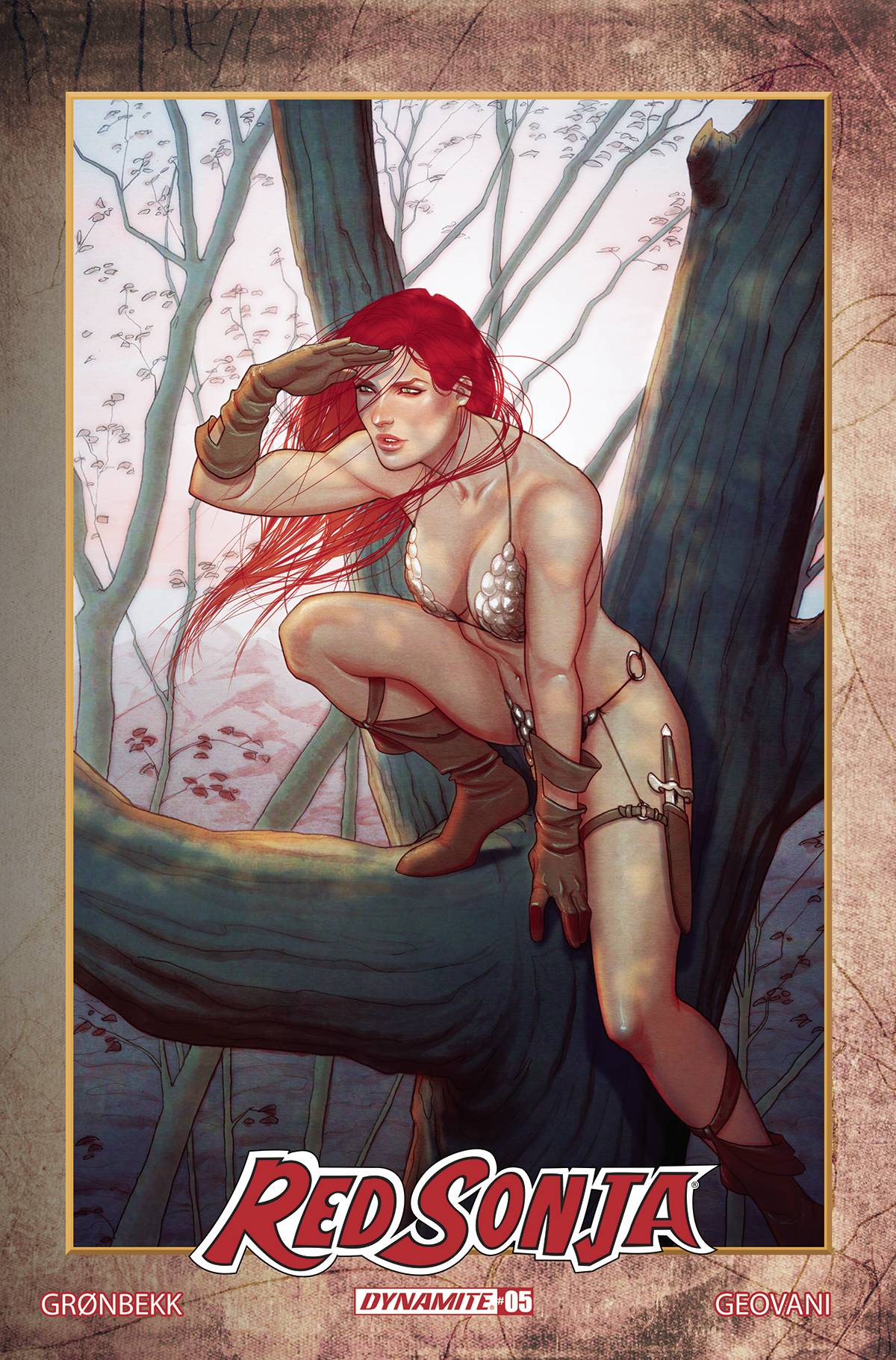
Red Sonja #6 Review


Writer: Torunn Gronbekk

Artist: Walter Geovani

Colorist: Omi Remalante Jr.

Letterer: Simon Bowland

Cover Artists: Lucio Parrillo, Bjorn Barends, Joseph Michael Linsner, Bryan Hitch, Jenny Frison, Frank Thorne & Cosplay

Publisher: Dynamite Comics

Price: $3.99

Release Date: December 27, 2023


By possessing a soldier, Kulan Gath helped Red Sonja infiltrate Vestfold. But when they reached the royal vault, the wizard turned on her. Now, the She-Devil lays dying. Can Lady Alaberta's black diamond save her? Let’s leap into Red Sonja #6 and find out!


Story

Thord Varg leads his army to Vestfold. The high priest made costly sacrifices for his kingdom. Now, as he beholds his beloved city, all he craves is power. His soldiers have brought him victory after victory. Yet he distrusts them. When the warrior-priest sees fire blossom atop his castle, he wonders if he is too late.


The god trapped within the black diamond hovers above Red Sonja as her blood spills onto the floor tiles. He asks her what she desires. She begs nothing for herself. Throughout this war, Red Sonja sought to protect others. She rescued those enslaved. Now, Red Sonja wishes to save the soldiers trapped by their oath. She feels a kinship with them. Long ago, Red Sonja swore an oath to become a death-dealing soldier. But can the god trapped in the stone release souls who willingly swore to serve Thord Varg and savored the power he gave them?


In Red Sonja #6, Torunn Gronbekk reflects on what brings us temporary versus lasting satisfaction. Like Vestfold's first king, Thord Varg sought to serve his city. Perhaps sorcerer Kulan Gath felt likewise in his youth. Yet, despite all his knowledge, he also succumbed to the allure of power. Now, crouching over Sonja, he believes the world cannot survive without his leadership.


Art

Thord Varg once took pride in his priestly robes. In Red Sonja #6, the armored general wears a grim expression as he leads his army home. He resembles the giant statue of Vestfold’s first king guarding his beloved city. Black drips like tears from the trio who ride alongside. Intriguingly, two of them are maidens. Unlike her warrior sisters, Sonja wears a vacant expression. The possessed soldier cradles her head with his hand. Yet rage overcomes his face as the castle guards burst in. Kulan Gath remembers what it was like to kill. Indeed, killing seems to empower him.


Ascending to another plane, Red Sonja walks through the sky among the blue spirits of those who swore service to Thord Varg. Retaining the colors of life, her scarlet hair and cape, her tanned skin, leather gloves and belt, and the hilts of her sword and dagger make a startling contrast. Yet when the fire of Vestfold embraces her, it sweeps her into a storm of yellow, orange, and red, banishing the cold, wispy spirits.


History says the last dragon lit Vestfold’s perpetual fire. Yet Walter Geovani portrays the god trapped in stone differently. An image of Greek perfection, Omi Remalante Jr. conveys the god's vibrant nature with the purple fabric that encircles him like a snake. Artist and Remalante Jr. work hand in hand to deliver a stunning finale to Red Sonja’s battles with Thord Varg in Red Sonja #6.


Torunn Gronbekk’s narration guides us through these epic events. Her words appear in scraps of beige parchment. The living speak using white dialogue balloons, while the possessed man utilizes black balloons encircled in red. All appear large and easy to read. Simon Bowland conjures few sound effects and reveals the intensity of emotions through giant, colored letters. Yet a red font—no matter how large—cannot protect Thord Varg from the fate he willingly embraced.


Thanks to Dynamite Comics for providing a copy for review.


Final Thoughts

While power blinds people to the needs of others, mercy releases people from bonds. Yet mercy proves a double-edged sword in Red Sonja #6, as it releases the innocent and the guilty.


Rating 9.8/10


To preview interior art see my review at Comic Book Dispatch.


Tuesday, December 5, 2023

Red Sonja #5 Review


Writer: Torunn Gronbekk

Artist: Walter Geovani

Colorist: Omi Remalante Jr.

Letterer: Simon Bowland

Cover Artists: Lucio Parrillo, Bjorn Barends, Joseph Michael Linsner, Bryan Hitch, Jenny Frison, Frank Thorne & Cosplay

Publisher: Dynamite

Price: $3.99

Release Date: November 15, 2023


Kulan Gath remembers his mortal life. As he gazes down from the astral plane, he watches Red Sonja ride through a snowstorm. What does the dead wizard plan for this warrior maiden who carries the late Lady Alaberta's black diamond? Let’s leap into Red Sonja #5 and find out!


Story

Kulan Gath shares his disdain for civilization with Conan and Red Sonja’s creator. Yet Robert E. Howard never sanctioned poisoning someone, let alone a trusted friend and mentor. Kulan Gath once pursued his quest for power without regard for loyalty or mercy. Now, as his spirit watches people fight and die on the mortal plane, he remembers what it felt like to be alive and kill those around him.


In Red Sonja #5, Thord Varg conquered Velanger to capture her black diamond. By bringing it to the High Priest's city of Vestfold, perhaps Red Sonja can stop his reign of terror. Yet she halts her flight to free refugees. Like an uncaring disease, slavers capture the frightened and homeless. But in Red Sonja, they find more than they bargained for.


Torunn Gronbekk meditates on loyalty versus reason, power versus compassion, and achievement versus satisfaction in Red Sonja #5. As priests use sex, violence, and human sacrifice to worship their gods, Torunn reveals a clue to Thord Varg’s power. The High Priest believes he slaughtered innocents to safeguard Vestfold's future. Yet is he wiser than the She-Devil, who doesn't overthink things and grasps whatever opportunities she finds? Unlike Thord Varg, she knows power comes with a price. She paid it to avenge her family's deaths. Now, she uses any power she possesses to help others.


Oh, and Red Sonja likes her horse. She talks to it as she would a person. That says a lot about her, too.


Art

Kulan Gath walks through a garden surrounded by planets and stars. Via a reflecting pool, he watches Red Sonja ride through a snowstorm. As she passes burning homes and buildings, she spies a caravan. Red Sonja rides toward the refugees shackled to a horse-drawn wagon. Pairs of red eyes glow in the darkness beneath the wagon’s fabric-strewn wooden hoops.


Walter Geovani imbues Sonja’s horse Erder with personality. Walter’s storybook art packs panels with more power than many double-page spreads. Little touches enhance his visual feast. Consider the similarity between the coils of Sonja's hair and the many-headed hydra. Observe how he mirrors a severed hydra neck with a slaver’s bloody stump. A circular staircase evokes the coils of a serpent, reminding us of the power that tempts priests and wizards in Red Sonja #5.


Omi Remalante Jr. imbues Kulan Gath’s remembrance with a faded quality, illuminated by torchlight. He surrounds the dead wizard with lustrous colors, comparing the ethereal beauty of his new life with the gray, burning lands Sonja rides through. Yet richness creeps into Hyborean lands as the morning light invades the storm. While bold and vibrant colors fill panels, Omi backlights scenes to suggest Red Sonja's indomitable nature. Amid all the bloodletting, blood dances in darkness, reminding readers of the source of Thord Varg’s power. 


Simon Bowland writes Torunn Gronbekk’s compelling narrative using uppercase black letters on parchment. Simon grants white dialogue balloons to human characters, while those inhabited by a possessing spirit speak with white letters in black balloons. No sound effects invade the pages of Red Sonja #5. Yet Simon ends Torunn’s tale on a chilling note, as bloodthirsty believers demand the death of any who impedes their cause.   


Thanks to Dynamite Comics for providing a copy for review.


Final Thoughts

While Red Sonja rescues the powerless and bestows mercy on monsters, a fallen foe influences events from beyond the grave, raining destruction upon the Hyborian world in Red Sonja #5.


Rating 9.8/10


To preview interior art and view other covers see my review at Comic Book Dispatch.